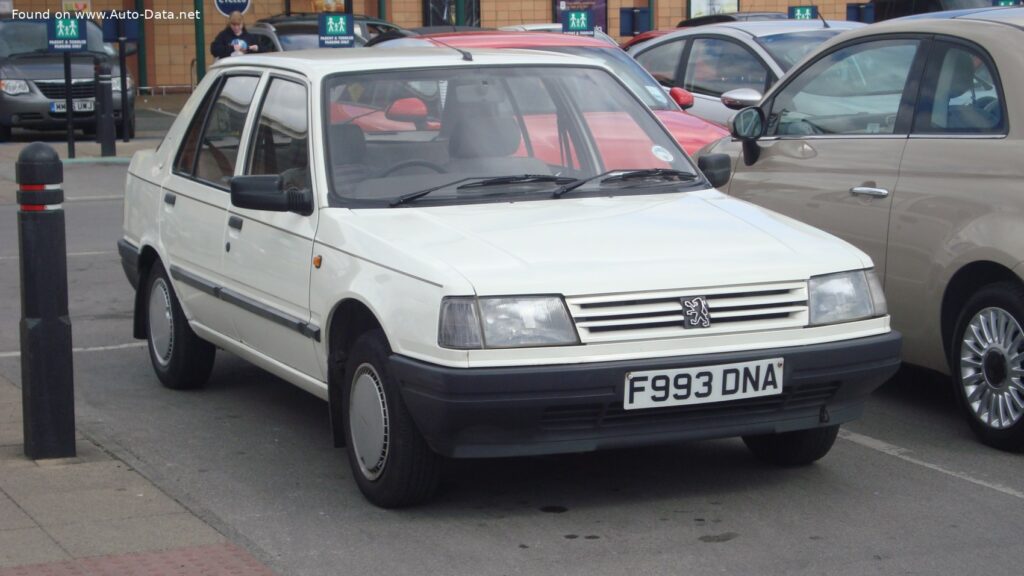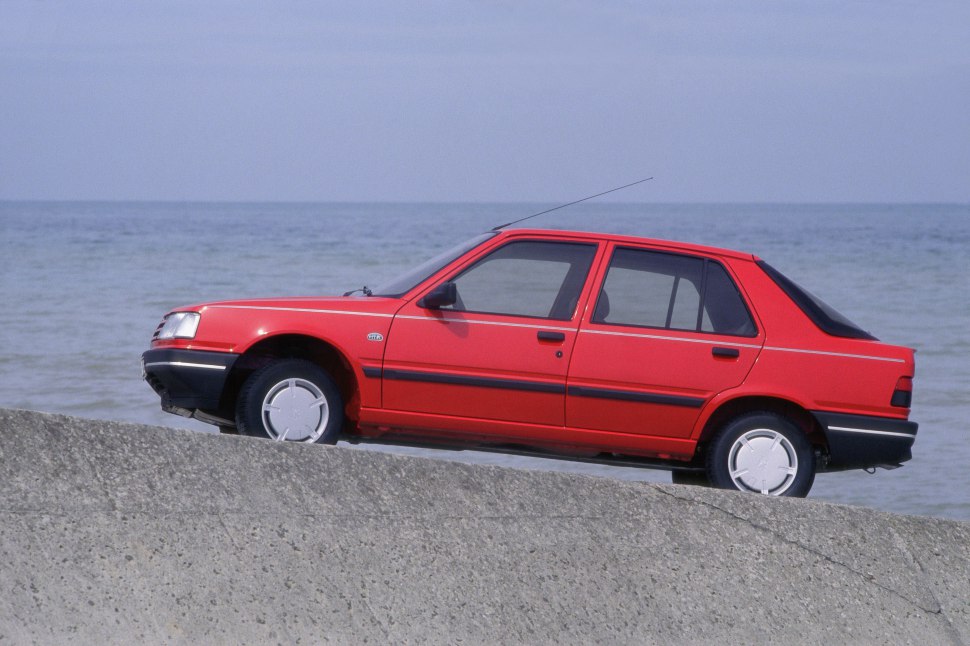
The Peugeot 309 (3C,3A facelift 1989) 1.9 Diesel (64 Hp) represents a significant chapter in the European automotive landscape, embodying the era’s focus on practicality, economy, and robust engineering. Introduced in 1985 and undergoing a notable facelift in 1989, the 309 was a crucial model for Peugeot, bridging the gap between the highly successful 205 supermini and the larger, more upscale 405 sedan. Its origins trace back to the C28 project, initially conceived as a Talbot model before the brand’s eventual discontinuation and integration into the Peugeot lineup. The 1.9-liter diesel variant, produced from 1989 to 1993, became particularly revered for its exceptional fuel efficiency and reliability, making it a popular choice for families and fleet operators across Europe who prioritized low running costs and dependable performance.
The Peugeot 309 (3C,3A facelift 1989) in Context
The Peugeot 309 arrived at a time of intense competition in the European compact hatchback segment. While not officially sold in the United States, its design and engineering philosophy reflected the global trends of the late 1980s and early 1990s, albeit tailored for the specific demands of the European market. The 1989 facelift, designated as the ‘Phase 2’ model, brought a series of refinements, addressing some of the earlier criticisms and modernizing its appearance. These updates included a revised front end with new headlights and grille, a redesigned dashboard, and improved tail lights, aligning its aesthetics more closely with the contemporary Peugeot 405. Internally, the 309 benefited from Peugeot’s renowned expertise in chassis tuning, offering a comfortable ride combined with surprisingly agile handling for a family hatchback of its size. Its role was to offer a more spacious and practical alternative to the smaller 205 without directly competing with the larger 405, effectively carving out its own niche. The diesel engine, in particular, was a cornerstone of its appeal, capitalizing on the growing demand for fuel-efficient vehicles in a market sensitive to fuel prices.
Powertrain and Performance of the Peugeot 309 (3C,3A facelift 1989) 1.9 Diesel (64 Hp)
Engine Specifications and Efficiency
At the heart of the Peugeot 309 1.9 Diesel (64 Hp) was the robust and widely acclaimed XUD9A (DJZ) or D9A XUD9 engine. This naturally aspirated 1.9-liter (1905 cm3 or 116.25 cu. in.) inline four-cylinder diesel engine was a testament to Peugeot’s engineering prowess in diesel technology during that era. It delivered a modest but highly effective 64 horsepower at 4600 rpm, paired with a respectable 87.03 lb.-ft. (118 Nm) of torque peaking at a low 2000 rpm. This low-end torque characteristic made the vehicle feel responsive in everyday driving conditions, particularly in urban traffic and at lower speeds. The engine featured a precombustion chamber injection system, a common design for indirect injection diesels of the time, which contributed to smoother operation and reduced noise compared to the then-emerging direct injection technologies. With two valves per cylinder and a high compression ratio of 23.5:1, typical for diesel engines, the XUD9 was designed for durability and optimal fuel combustion. Its engineering focused on longevity and minimal maintenance, factors that significantly contributed to its popularity and the 309’s reputation for reliability. The engine oil capacity was 5 liters (5.28 US qt), and the cooling system held 8.5 liters (8.98 US qt), reflecting its robust design for sustained operation.
Driving Dynamics and Fuel Economy
Performance figures for the 1.9 Diesel 309 were pragmatic, aligning with its role as an economical family car rather than a performance machine. The vehicle could accelerate from 0 to 60 mph in a calculated 14.5 seconds (0-100 km/h in 15.3 seconds), with a maximum speed of 99.42 mph (160 km/h). While these figures may seem modest by today’s standards, they were competitive for a naturally aspirated diesel hatchback in the late 1980s and early 1990s. The 5-speed manual transmission, coupled with a front-wheel-drive architecture, provided a direct and engaging driving experience, characteristic of Peugeot vehicles. Where the 309 1.9 Diesel truly excelled was in its fuel economy. It boasted an impressive combined fuel consumption of 39.9 US mpg (5.9 l/100 km). Urban driving yielded 33.6 US mpg (7 l/100 km), while extra-urban conditions saw consumption drop to an outstanding 53.5 US mpg (4.4 l/100 km). These figures underscore the vehicle’s primary appeal: an incredibly efficient and cost-effective mode of transport, a critical factor for European consumers. The fuel tank capacity of 14.53 US gallons (55 liters) further enhanced its long-distance cruising capability, making fewer stops at the fuel pump.
Design, Features, and Practicality
Exterior and Interior Design
The Peugeot 309 (3C,3A facelift 1989) was offered in versatile 3-door and 5-door hatchback body styles, maximizing practicality for its segment. The facelift brought a more refined aesthetic, softening some of the original design’s sharper edges and integrating design cues from the more modern 405. Its compact dimensions—159.45 inches in length, 64.17 inches in width, and 54.33 inches in height—made it highly maneuverable in congested European cities while providing a surprisingly spacious interior for its size. The wheelbase measured 97.24 inches, contributing to a stable ride. The interior, with its 5-seat configuration, was designed for functionality and durability, prioritizing ease of use over lavish appointments. The trunk space was practical, offering a minimum of 10.42 cu. ft. (295 liters) with the rear seats in place, expanding significantly to 21.72 cu. ft. (615 liters) when the rear seats were folded, providing ample cargo versatility for a car in its class.
Chassis, Safety, and Comfort Features
The 309’s chassis engineering was a highlight, drawing on Peugeot’s reputation for excellent ride and handling. It featured an independent front suspension with coil springs, while the rear utilized a torsion beam setup, a sophisticated design for the time that allowed for a compact packaging and excellent road holding. This combination provided a comfortable ride that absorbed road imperfections effectively, without sacrificing dynamic capability. Braking was handled by disc brakes at the front and drum brakes at the rear, a standard configuration for vehicles in this segment. An Anti-lock Braking System (ABS) was available as an assisting system, representing a significant safety feature for the late 1980s. The steering system employed a hydraulic rack and pinion setup, offering precise control and feedback to the driver, further aided by power steering for improved maneuverability at low speeds. The car rode on 165/70 SR13 tires, providing a balance of grip and ride comfort. With a kerb weight of 2050.3 lbs. (930 kg) and a maximum permissible weight of 2976.24 lbs. (1350 kg), the 309 was a relatively light vehicle, which contributed to both its fuel efficiency and agile handling characteristics. Its practical design, robust mechanicals, and focus on economy made the Peugeot 309 1.9 Diesel a durable and valued member of the European automotive landscape for many years.
Technical Specifications
The following table provides a comprehensive overview of the technical specifications for the Peugeot 309 (3C,3A facelift 1989) 1.9 Diesel (64 Hp).
| Brand | Peugeot |
| Model | 309 |
| Generation | 309 (3C,3A facelift 1989) |
| Type (Engine) | 1.9 Diesel (64 Hp) |
| Start of production | 1989 year |
| End of production | 1993 year |
| Powertrain Architecture | Internal Combustion engine |
| Body type | Hatchback |
| Seats | 5 |
| Doors | 3-5 |
| Fuel consumption (economy) – urban | 7 l/100 km (33.6 US mpg) |
| Fuel consumption (economy) – extra urban | 4.4 l/100 km (53.5 US mpg) |
| Fuel consumption (economy) – combined | 5.9 l/100 km (39.9 US mpg) |
| Fuel Type | Diesel |
| Acceleration 0 – 100 km/h | 15.3 sec |
| Acceleration 0 – 62 mph | 15.3 sec |
| Acceleration 0 – 60 mph (Calculated) | 14.5 sec |
| Maximum speed | 160 km/h (99.42 mph) |
| Weight-to-power ratio | 14.5 kg/Hp (68.8 Hp/tonne) |
| Weight-to-torque ratio | 7.9 kg/Nm (126.9 Nm/tonne) |
| Power | 64 Hp @ 4600 rpm |
| Power per litre | 33.6 Hp/l |
| Torque | 118 Nm @ 2000 rpm (87.03 lb.-ft. @ 2000 rpm) |
| Engine layout | Front, Transverse |
| Engine Model/Code | DJZ XUD9A, D9A XUD9 |
| Engine displacement | 1905 cm3 (116.25 cu. in.) |
| Number of cylinders | 4 |
| Engine configuration | Inline |
| Cylinder Bore | 83 mm (3.27 in.) |
| Piston Stroke | 88 mm (3.46 in.) |
| Compression ratio | 23.5:1 |
| Number of valves per cylinder | 2 |
| Fuel injection system | Precombustion chamber injection |
| Engine aspiration | Naturally aspirated engine |
| Engine oil capacity | 5 l (5.28 US qt) |
| Coolant | 8.5 l (8.98 US qt) |
| Kerb Weight | 930 kg (2050.3 lbs.) |
| Max. weight | 1350 kg (2976.24 lbs.) |
| Max load | 420 kg (925.94 lbs.) |
| Trunk (boot) space – minimum | 295 l (10.42 cu. ft.) |
| Trunk (boot) space – maximum | 615 l (21.72 cu. ft.) |
| Fuel tank capacity | 55 l (14.53 US gal) |
| Length | 4050 mm (159.45 in.) |
| Width | 1630 mm (64.17 in.) |
| Height | 1380 mm (54.33 in.) |
| Wheelbase | 2470 mm (97.24 in.) |
| Front track | 1405 mm (55.31 in.) |
| Rear (Back) track | 1380 mm (54.33 in.) |
| Drivetrain Architecture | Front wheel drive (Internal combustion engine drives front wheels) |
| Drive wheel | Front wheel drive |
| Number of gears and type of gearbox | 5 gears, manual transmission |
| Front suspension | Coil spring |
| Rear suspension | Torsion |
| Front brakes | Disc |
| Rear brakes | Drum |
| Assisting systems | ABS (Anti-lock braking system) |
| Steering type | Steering rack and pinion |
| Power steering | Hydraulic Steering |
| Tires size | 165/70 SR13 |