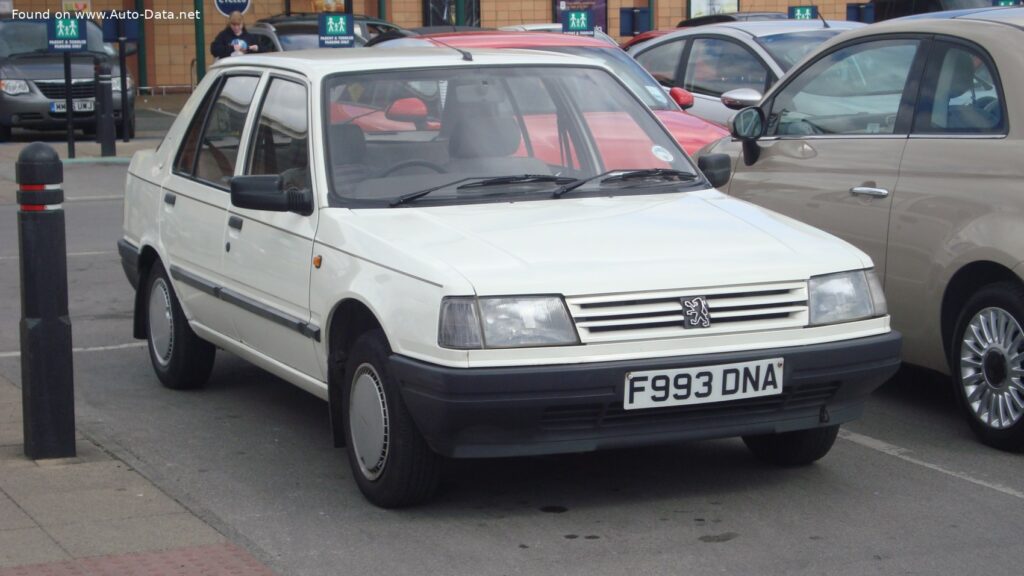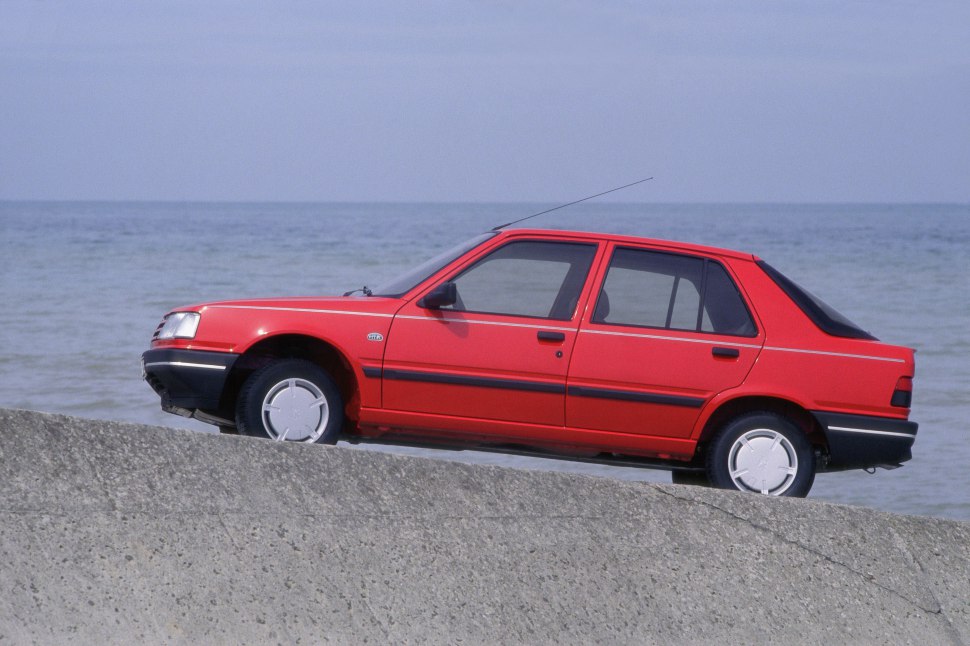
The Peugeot 309 (3C,3A facelift 1989) 1.9 GTI 16V (147 Hp) stands as a quintessential hot hatchback from an era when driving purity and mechanical engagement were paramount. Produced between 1990 and 1993, this particular variant of the 309 represents the pinnacle of its performance lineage, building upon the success of Peugeot’s celebrated GTI models. While never officially imported to the United States, the 309 GTI 16V carved out a formidable reputation in its primary European market, where it was revered for its potent engine, nimble chassis, and unadulterated driving experience. It emerged as a strong contender in a highly competitive segment, offering a compelling alternative to rivals like the Volkswagen Golf GTI and Renault 19 16S. This generation of the 309, specifically the post-1989 facelift, refined the model’s aesthetics and technical specifications, solidifying its place in automotive history as a driver-focused machine that perfectly encapsulated the spirit of the early 1990s performance car.
Engine and Performance: The Heart of the Peugeot 309 (3C,3A facelift 1989) 1.9 GTI 16V (147 Hp)
At the core of the 309 GTI 16V’s formidable reputation was its powertrain, an engineering marvel for its time that delivered exhilarating performance. The vehicle was equipped with Peugeot’s renowned DFW XU9 engine, a 1.9-liter (1905 cm³, or 116.25 cu. in.) naturally aspirated inline-four unit. What set this engine apart was its 16-valve cylinder head, a significant upgrade over the 8-valve units found in many contemporary hot hatches. This multi-valve design allowed for superior volumetric efficiency, enabling the engine to breathe more freely and produce impressive power figures without the aid of forced induction.
The 1.9 GTI 16V generated a robust 147 horsepower (HP) at a spirited 6400 revolutions per minute (rpm), translating to an impressive power-per-liter output of 77.2 HP/l. Torque was equally impressive, peaking at 122.44 pound-feet (lb.-ft.) at 5000 rpm. This high-revving nature and strong mid-range torque curve ensured that power was readily available across a wide operating range, making the car both responsive in daily driving and thrilling on more demanding roads. Fuel delivery was handled by a multi-port manifold injection system, ensuring precise fuel metering and combustion efficiency, further contributing to both performance and the car’s relatively clean operation for its era.
Mated to a precise 5-speed manual transmission, the engine channeled its power to the front wheels, adhering to the classic hot hatch formula. The performance metrics were outstanding: the 309 GTI 16V could accelerate from 0 to 60 miles per hour (mph) in a brisk 7.6 seconds, and complete the 0-100 kilometers per hour (km/h) sprint in 8 seconds flat. Its top speed of 133.59 mph (215 km/h) was highly competitive, allowing it to hold its own against more expensive sports cars. The car’s lightweight curb weight of just 2204.62 pounds (1000 kg) played a crucial role in its dynamic capabilities, resulting in an excellent weight-to-power ratio of 6.8 kg/HP or 147 HP/tonne, and a weight-to-torque ratio of 6 kg/Nm. This combination of a potent engine and a light chassis created a truly engaging driving machine.
Despite its performance focus, the 309 GTI 16V offered reasonable fuel economy for its class. The combined fuel consumption was rated at 8 liters per 100 kilometers (l/100 km), which translates to approximately 29.4 US miles per gallon (mpg). In urban driving conditions, it consumed 11.8 l/100 km (19.9 US mpg), while on the extra-urban cycle, it achieved 6.5 l/100 km (36.2 US mpg). These figures underscore the balance between spirited performance and everyday usability that Peugeot aimed for with its GTI models, making the 309 16V a practical yet thrilling choice for enthusiasts.
Design and Features: Form Meets Function in the Peugeot 309
The Peugeot 309 GTI 16V (3C,3A facelift 1989) presented a design that was both functional and aesthetically pleasing, embodying the distinctive styling cues of Peugeot from the late 1980s and early 1990s. As a 3-door hatchback with seating for five, it combined sporty proportions with a practical interior. The facelift introduced in 1989 subtly refined the car’s appearance, bringing it in line with contemporary design trends while retaining its characteristically aggressive stance.
Measuring 159.45 inches (4050 mm) in length, 64.17 inches (1630 mm) in width, and 54.33 inches (1380 mm) in height, the 309 GTI 16V possessed compact dimensions that contributed significantly to its agility and maneuverability. A wheelbase of 97.24 inches (2470 mm), coupled with front and rear tracks of 55.31 inches (1405 mm) and 54.33 inches (1380 mm) respectively, provided a stable platform for its dynamic performance. The design was purposeful, with minimal overhangs and a low center of gravity, essential for a car designed to be driven enthusiastically.
The chassis and suspension setup were engineered to complement the powerful engine. The front suspension utilized a coil spring system, offering a balance of comfort and precise handling. At the rear, Peugeot employed a torsion bar suspension, a common and effective design for compact performance cars of that era, known for its ability to save space and provide responsive road feedback. Braking performance was handled by disc brakes at the front, offering strong stopping power, while the rear utilized drum brakes. For added safety, an Anti-lock Braking System (ABS) was available as an assisting system, a notable feature for a car of its class and era, enhancing control during emergency braking maneuvers. The steering system featured a hydraulic rack and pinion setup, delivering direct and communicative feedback to the driver, a hallmark of engaging sports cars.
Inside, the 309 GTI 16V provided a driver-centric cockpit, typical of performance Peugeots. While specific interior trim details are not provided, these models generally featured supportive sport seats, a clear instrument cluster, and a chunky steering wheel, all designed to enhance the driving experience. Practicality was not overlooked, with a minimum trunk space of 10.42 cubic feet (295 liters) that could expand to a maximum of 21.72 cubic feet (615 liters) with the rear seats folded, making it versatile for everyday use or weekend getaways. The fuel tank capacity of 14.53 US gallons (55 liters) provided a decent cruising range. The car rode on 195/55 VR15 tires, a size that offered a good balance of grip and ride comfort, further underscoring its dual role as a performance machine and a usable daily driver. The overall design and feature set of the 309 GTI 16V cemented its status as a highly desirable hot hatch, blending thrilling performance with practical considerations.
Technical Specifications
| Brand | Peugeot |
| Model | 309 |
| Generation | 309 (3C,3A facelift 1989) |
| Type (Engine) | 1.9 GTI 16V (147 Hp) |
| Start of production | 1990 year |
| End of production | 1993 year |
| Powertrain Architecture | Internal Combustion engine |
| Body type | Hatchback |
| Seats | 5 |
| Doors | 3 |
| Fuel consumption (economy) – urban | 11.8 l/100 km (19.9 US mpg) |
| Fuel consumption (economy) – extra urban | 6.5 l/100 km (36.2 US mpg) |
| Fuel consumption (economy) – combined | 8 l/100 km (29.4 US mpg) |
| Fuel Type | Petrol (Gasoline) |
| Acceleration 0 – 100 km/h | 8 sec |
| Acceleration 0 – 62 mph | 8 sec |
| Acceleration 0 – 60 mph | 7.6 sec |
| Maximum speed | 215 km/h (133.59 mph) |
| Weight-to-power ratio | 6.8 kg/Hp, 147 Hp/tonne |
| Weight-to-torque ratio | 6 kg/Nm, 166 Nm/tonne |
| Power | 147 Hp @ 6400 rpm |
| Power per litre | 77.2 Hp/l |
| Torque | 166 Nm @ 5000 rpm (122.44 lb.-ft. @ 5000 rpm) |
| Engine layout | Front, Transverse |
| Engine Model/Code | DFW XU9 |
| Engine displacement | 1905 cm³ (116.25 cu. in.) |
| Number of cylinders | 4 |
| Engine configuration | Inline |
| Cylinder Bore | 83 mm (3.27 in.) |
| Piston Stroke | 88 mm (3.46 in.) |
| Compression ratio | 9.7:1 |
| Number of valves per cylinder | 4 |
| Fuel injection system | Multi-port manifold injection |
| Engine aspiration | Naturally aspirated engine |
| Engine oil capacity | 5 l (5.28 US qt) |
| Coolant | 8 l (8.45 US qt) |
| Kerb Weight | 1000 kg (2204.62 lbs.) |
| Max. weight | 1400 kg (3086.47 lbs.) |
| Max load | 400 kg (881.85 lbs.) |
| Trunk (boot) space – minimum | 295 l (10.42 cu. ft.) |
| Trunk (boot) space – maximum | 615 l (21.72 cu. ft.) |
| Fuel tank capacity | 55 l (14.53 US gal) |
| Length | 4050 mm (159.45 in.) |
| Width | 1630 mm (64.17 in.) |
| Height | 1380 mm (54.33 in.) |
| Wheelbase | 2470 mm (97.24 in.) |
| Front track | 1405 mm (55.31 in.) |
| Rear (Back) track | 1380 mm (54.33 in.) |
| Drivetrain Architecture | Front wheel drive. Internal Combustion engine. |
| Drive wheel | Front wheel drive |
| Number of gears and type of gearbox | 5 gears, manual transmission |
| Front suspension | Coil spring |
| Rear suspension | Torsion |
| Front brakes | Disc |
| Rear brakes | Drum |
| Assisting systems | ABS (Anti-lock braking system) |
| Steering type | Steering rack and pinion |
| Power steering | Hydraulic Steering |
| Tires size | 195/55 VR15 |