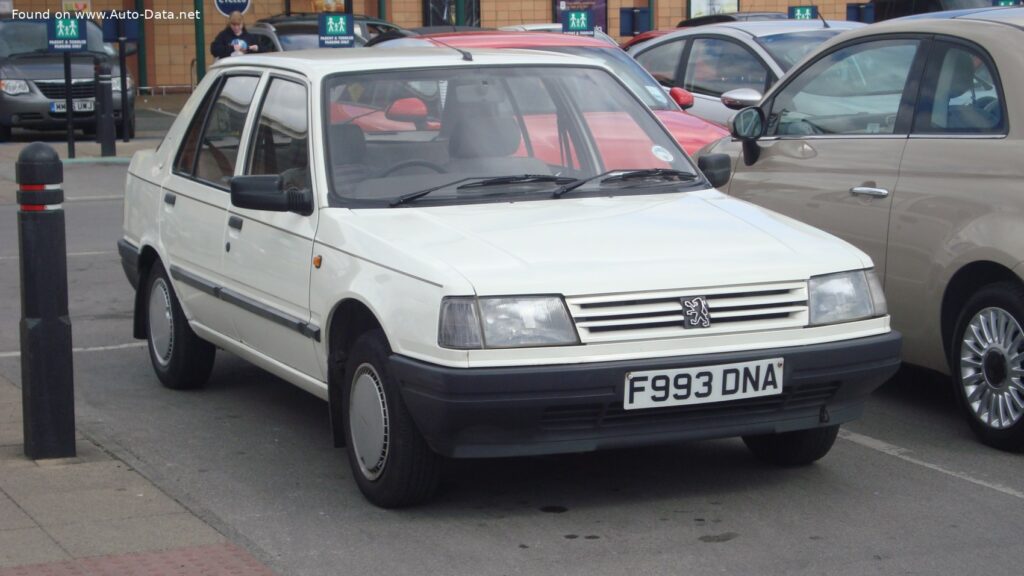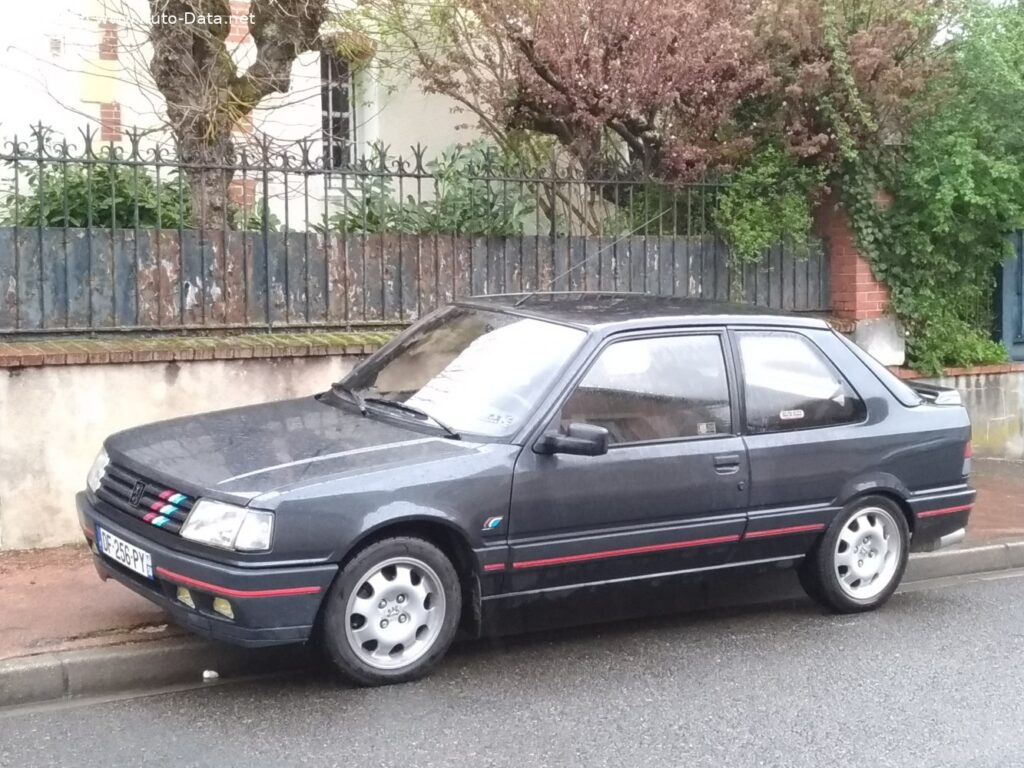
The Peugeot 309 (3C,3A facelift 1989) 3-door 1.1 (60 Hp) represents a significant chapter in the history of compact European automobiles, specifically within the highly competitive C-segment. Launched as a facelifted iteration of the original 309, this particular variant, produced between 1990 and 1993, was a core offering in Peugeot’s lineup, primarily catering to the European market where practical, fuel-efficient hatchbacks were highly prized. As a successor to the Talbot Horizon and positioned between the smaller 205 and the larger 405, the 309 was designed to provide a blend of compact dimensions, useful interior space, and economical operation, embodying the pragmatic approach to motoring prevalent in its era. While never officially sold in the United States, its mechanical underpinnings and design ethos reflect the engineering trends of late 20th-century European automotive manufacturing.
Engine & Performance: The Heart of the Peugeot 309
At the core of this particular Peugeot 309 variant is the HDZ TU1M engine, a robust 1.1-liter (1124 cm3 or 68.59 cu. in.) inline four-cylinder powerplant. This engine, a staple of PSA Group’s smaller offerings, was engineered for reliability and fuel economy rather than outright performance. It produced a modest 60 horsepower at 5800 rpm, delivering power efficiently to the front wheels. Torque output stood at 88 Nm (64.91 lb.-ft.) at a relatively low 3200 rpm, which contributed to its tractable nature in urban driving conditions. The engine configuration was front, transverse, a standard layout for maximizing interior space in front-wheel-drive vehicles.
The HDZ TU1M engine featured a classic naturally aspirated design, utilizing a carburettor for fuel injection—a common technology at the time, especially for entry-level models before widespread adoption of electronic fuel injection. With a compression ratio of 9.4:1 and an OHV (Overhead Valve) valvetrain with two valves per cylinder, it was a straightforward and proven design. The bore and stroke measured 72 mm (2.83 in.) and 69 mm (2.72 in.) respectively, indicating a slightly oversquare design, which generally favors higher revving characteristics but in this application was tuned for low-end torque and efficiency.
Performance figures for the 1.1-liter 309 were fitting for its segment. It could accelerate from 0 to 60 mph in a calculated 14.6 seconds, with 0 to 100 km/h taking 15.4 seconds. The maximum speed reached 162 km/h (100.66 mph), making it suitable for highway travel, though not a performance leader. The vehicle’s relatively light kerb weight of 1840.86 lbs. (835 kg) contributed to a weight-to-power ratio of 13.9 kg/Hp (71.9 Hp/tonne) and a weight-to-torque ratio of 9.5 kg/Nm (105.4 Nm/tonne), which, while not sports car territory, allowed for adequate responsiveness in daily driving.
Fuel economy was a strong suit for the 309 1.1. In urban driving, it consumed approximately 7.5 liters per 100 km, which translates to about 31.4 US mpg. On extra-urban cycles, consumption improved significantly to 5.2 liters per 100 km, or an impressive 45.2 US mpg. This efficiency, combined with a 55-liter (14.53 US gal) fuel tank, offered a respectable cruising range, a crucial factor for European motorists. Power was transmitted through a 4-speed manual transmission, a choice that prioritized simplicity and cost-effectiveness for this entry-level model, though it did limit ultimate flexibility compared to 5-speed units becoming more common in higher trims or competing models.
Design & Features: Practicality and European Flair
The Peugeot 309 (3C,3A facelift 1989) 3-door adopted a classic hatchback body type, a design that emphasized practicality and versatility. With three doors and seating for five occupants, it offered a compact footprint without sacrificing interior utility. Its dimensions—159.49 inches (4051 mm) in length, 64.17 inches (1630 mm) in width, and 54.33 inches (1380 mm) in height—made it maneuverable in congested European cities while still providing sufficient cabin space. The wheelbase of 97.2 inches (2469 mm) contributed to a stable ride for its class, and the relatively short front (29.65 in.) and rear (32.64 in.) overhangs enhanced its nimble character.
Visually, the facelifted 309 retained the angular yet purposeful styling that characterized Peugeot vehicles of the late 1980s and early 1990s. Its drag coefficient (Cd) of 0.35 was competitive for its time, aiding both fuel efficiency and reducing wind noise at higher speeds. The design was clean and functional, reflecting the era’s focus on aerodynamic efficiency without overly complex styling cues. The 3-door configuration lent it a slightly sportier appearance than its 5-door counterpart, appealing to a younger demographic or those prioritizing style over rear-seat access.
Inside, the 309 was designed with durability and straightforward ergonomics in mind. Despite its compact exterior, it offered a generous minimum trunk space of 14.02 cu. ft. (397 liters), which could be expanded significantly to 45.17 cu. ft. (1279 liters) by folding down the rear seats. This flexibility was a key selling point for hatchbacks, allowing them to adapt from passenger transport to light cargo duties with ease. The maximum load capacity was 1047.2 lbs. (475 kg), making it a capable workhorse for families or small businesses.
In terms of chassis and safety, the 309 featured a robust setup. The front suspension utilized coil springs, while the rear employed a torsion beam arrangement, a common and effective solution for compact front-wheel-drive cars, balancing ride comfort with handling characteristics. Braking power was provided by disc brakes at the front and drum brakes at the rear. Notably for its time, the 309 was available with ABS (Anti-lock Braking System) as an assisting system, a significant safety feature that was still becoming mainstream in the early 1990s, particularly in the compact segment. Steering was managed by a rack and pinion system, offering direct and predictable control. The vehicle rode on 145/80 R13 tires, a size indicative of its economical and light-duty nature, prioritizing comfort and low rolling resistance.
The 309’s overall architecture, with its front-wheel-drive drivetrain and internal combustion engine driving the front wheels, was a well-established and efficient layout for mass-market vehicles. Its engineering and design choices underscored Peugeot’s commitment to producing practical, reliable, and economical transportation for the European market, a legacy that continues to influence its offerings today.
Technical Specifications
| Brand | Peugeot |
| Model | 309 |
| Generation | 309 (3C,3A facelift 1989) 3-door |
| Type (Engine) | 1.1 (60 Hp) |
| Start of production | 1990 year |
| End of production | 1993 year |
| Powertrain Architecture | Internal Combustion engine |
| Body type | Hatchback |
| Seats | 5 |
| Doors | 3 |
| Fuel consumption (economy) – urban | 7.5 l/100 km (31.4 US mpg) |
| Fuel consumption (economy) – extra urban | 5.2 l/100 km (45.2 US mpg) |
| Fuel Type | Petrol (Gasoline) |
| Acceleration 0 – 60 mph | 14.6 sec |
| Acceleration 0 – 100 km/h | 15.4 sec |
| Maximum speed | 162 km/h (100.66 mph) |
| Weight-to-power ratio | 13.9 kg/Hp (71.9 Hp/tonne) |
| Weight-to-torque ratio | 9.5 kg/Nm (105.4 Nm/tonne) |
| Power | 60 Hp @ 5800 rpm |
| Power per litre | 53.4 Hp/l |
| Torque | 88 Nm @ 3200 rpm (64.91 lb.-ft. @ 3200 rpm) |
| Engine layout | Front, Transverse |
| Engine Model/Code | HDZ TU1M |
| Engine displacement | 1124 cm3 (68.59 cu. in.) |
| Number of cylinders | 4 |
| Engine configuration | Inline |
| Cylinder Bore | 72 mm (2.83 in.) |
| Piston Stroke | 69 mm (2.72 in.) |
| Compression ratio | 9.4:1 |
| Number of valves per cylinder | 2 |
| Fuel injection system | Carburettor |
| Engine aspiration | Naturally aspirated engine |
| Valvetrain | OHV |
| Engine oil capacity | 3.2 l (3.38 US qt) |
| Coolant | 5.7 l (6.02 US qt) |
| Kerb Weight | 835 kg (1840.86 lbs.) |
| Max. weight | 1310 kg (2888.06 lbs.) |
| Max load | 475 kg (1047.2 lbs.) |
| Trunk (boot) space – minimum | 397 l (14.02 cu. ft.) |
| Trunk (boot) space – maximum | 1279 l (45.17 cu. ft.) |
| Fuel tank capacity | 55 l (14.53 US gal) |
| Permitted trailer load with brakes (12%) | 800 kg (1763.7 lbs.) |
| Length | 4051 mm (159.49 in.) |
| Width | 1630 mm (64.17 in.) |
| Height | 1380 mm (54.33 in.) |
| Wheelbase | 2469 mm (97.2 in.) |
| Front track | 1405 mm (55.31 in.) |
| Rear (Back) track | 1380 mm (54.33 in.) |
| Front overhang | 753 mm (29.65 in.) |
| Rear overhang | 829 mm (32.64 in.) |
| Drag coefficient (Cd) | 0.35 |
| Drivetrain Architecture | The Internal combustion engine (ICE) drives the front wheels of the vehicle. |
| Drive wheel | Front wheel drive |
| Number of gears and type of gearbox | 4 gears, manual transmission |
| Front suspension | Coil spring |
| Rear suspension | Torsion |
| Front brakes | Disc |
| Rear brakes | Drum |
| Assisting systems | ABS (Anti-lock braking system) |
| Steering type | Steering rack and pinion |
| Tires size | 145/80 R13 |