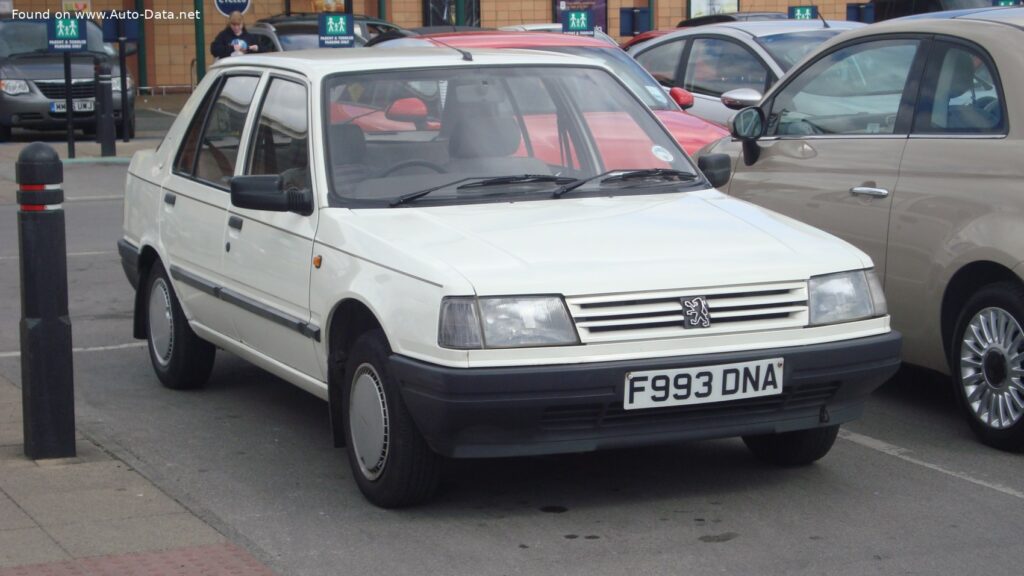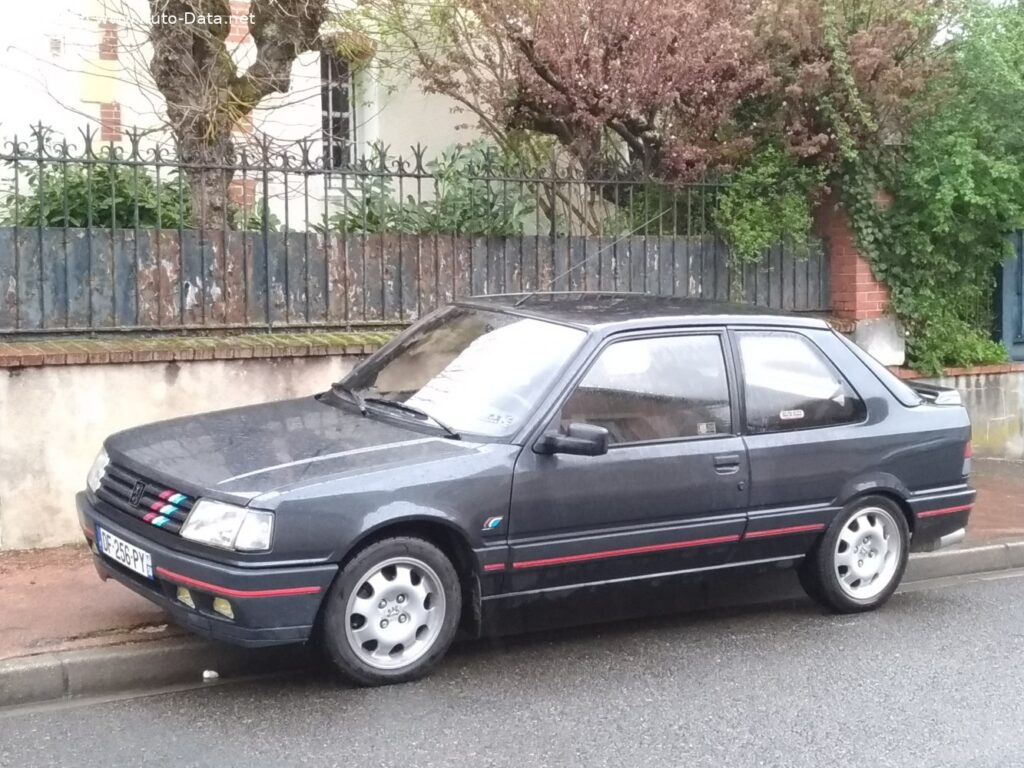
The Peugeot 309 (3C,3A facelift 1989) 3-door 1.4 i (75 Hp) represents a significant chapter in the history of compact European hatchbacks. Launched initially in 1985, the 309 was an unusual model in Peugeot’s lineup, intended to replace the Talbot Horizon following Peugeot’s acquisition of Chrysler’s European operations (Simca/Talbot). While not officially designated as a Talbot, the 309 utilized the Horizon’s chassis, albeit heavily modified, and was effectively a bridge between the smaller, iconic Peugeot 205 and the larger, more executive 405. The 1989 facelifted model, specifically the 3-door 1.4 i variant, brought a refreshed aesthetic and refined mechanicals, positioning it as a practical, economical, and engaging option in the highly competitive European C-segment. It offered a compelling blend of French design flair, respectable performance for its class, and a focus on everyday usability, making it a popular choice for families and individual drivers across its primary markets in Europe.
The Peugeot 309: A European Hatchback Legacy
The Peugeot 309 was a pivotal model for the French automaker, bridging a gap in its product portfolio that arose from the discontinuation of the Talbot brand. Developed under the internal code C28, the 309 initially faced a challenge in establishing its identity within Peugeot’s successful ’05’ series naming convention, hence its unique ’09’ designation. This model, particularly the facelifted version introduced in 1989, solidified its place as a robust and reliable compact car. The 3-door configuration appealed to a younger demographic and those prioritizing a sportier appearance, while still offering the practicality expected of a hatchback. Its design, though somewhat conservative compared to the groundbreaking 205, was clean and functional, reflecting the late 1980s automotive aesthetic. The 309’s enduring appeal in its segment stemmed from its accessible price point, low running costs, and a reputation for a comfortable ride and agile handling, characteristics that became synonymous with Peugeot vehicles of that era.
Powertrain and Driving Dynamics
At the heart of the 1989 Peugeot 309 (3C,3A facelift 1989) 3-door 1.4 i (75 Hp) lay a dependable and efficient 1.4-liter (1361 cm3 or 83.05 cu. in.) naturally aspirated inline four-cylinder gasoline engine, designated as the TU3M. This powerplant was a critical component of Peugeot’s renowned TU engine family, known for its compact design, reliability, and spirited performance relative to its displacement. Delivering a respectable 75 horsepower at 5800 revolutions per minute, and a peak torque of 81.87 lb.-ft. (111 Nm) at a lower 3400 rpm, the engine provided a flexible power band suitable for both urban commuting and longer journeys. The single overhead camshaft (OHC) valvetrain with two valves per cylinder and multi-port manifold fuel injection system ensured efficient combustion and throttle response. With a compression ratio of 9.3:1, it offered a good balance of power and fuel economy for its time.
Power was transferred to the front wheels via a smooth-shifting 5-speed manual transmission, a standard configuration that emphasized driver engagement and control. This drivetrain architecture, combined with the vehicle’s relatively light curb weight of 1873.93 lbs (850 kg), resulted in commendable performance figures for a compact car of its era. The 309 1.4 i could accelerate from 0 to 60 mph in a swift 10.5 seconds, and reach a top speed of 105.63 mph (170 km/h). These figures placed it competitively within its class, offering enough zest for confident overtaking and highway cruising. Fuel efficiency was also a strong suit, with urban consumption rated at 31.8 US mpg (7.4 l/100 km) and an impressive extra-urban economy of 42 US mpg (5.6 l/100 km), making it an economical choice for European motorists. The TU3M engine’s design, including a modest 3.2-liter oil capacity and 5.7-liter coolant capacity, pointed to a focus on simplicity and ease of maintenance.
Design, Ergonomics, and Safety Features
The 1989 Peugeot 309 (3C,3A facelift 1989) 3-door 1.4 i (75 Hp) showcased a design that was both practical and subtly elegant for its time. As a 3-door hatchback, it featured a clean, aerodynamic profile with a drag coefficient (Cd) of 0.32, which was competitive for the late 1980s and contributed to its fuel efficiency. The vehicle’s dimensions—a length of 159.49 inches (4051 mm), a width of 64.17 inches (1630 mm), and a height of 54.33 inches (1380 mm)—made it a maneuverable and easily parkable car in congested European cities. Despite its compact footprint, the 309 offered a surprisingly spacious interior, designed to comfortably accommodate five occupants across its two rows of seating. The 97.2-inch (2469 mm) wheelbase contributed to a stable ride and generous cabin volume.
Interior ergonomics focused on functionality, with a straightforward dashboard layout and controls that were intuitively placed. While luxury amenities were minimal, the emphasis was on durability and ease of use, reflecting the car’s role as an everyday workhorse. Cargo capacity was a notable advantage for the hatchback body style, with a minimum trunk space of 14.02 cu. ft. (397 liters), expandable to a substantial 45.17 cu. ft. (1279 liters) with the rear seats folded, offering considerable versatility for carrying luggage or larger items. The 14.53 US gallon (55-liter) fuel tank provided an ample cruising range.
In terms of chassis and suspension, the 309 featured a well-engineered setup that delivered Peugeot’s characteristic blend of ride comfort and handling prowess. The front suspension utilized an independent McPherson strut design with coil springs and an anti-roll bar, providing precise steering and good body control. The rear suspension employed a torsion beam setup, a common and effective solution for compact front-wheel-drive vehicles, offering a good balance of space efficiency and dynamic capability. Braking was handled by disc brakes at the front and drum brakes at the rear, a typical configuration for the segment. While not standard across all trims, an Anti-lock Braking System (ABS) was available as an assisting system, enhancing safety during emergency stops. The steering system was a rack and pinion type, offering direct feedback to the driver. The vehicle rode on 165/70 R13 tires, a common size for compact cars of the era, balancing grip, comfort, and rolling resistance.
Market Impact and Enduring Appeal
The Peugeot 309, especially the facelifted 1.4 i 3-door model, enjoyed a successful production run from 1989 to 1993, cementing its place in the European automotive landscape. It was praised for its robust build quality, comfortable ride, and engaging driving dynamics, characteristics often associated with Peugeot. While it never achieved the iconic status of its smaller sibling, the 205, the 309 played a crucial role in Peugeot’s strategy, successfully integrating Talbot’s legacy into the Peugeot brand and demonstrating the company’s capability in the volume compact segment. Today, the Peugeot 309 is remembered by enthusiasts as a reliable and practical classic, a testament to its solid engineering and the practical design principles that defined European compact cars of the late 20th century. Its blend of efficiency, practicality, and driving enjoyment ensures its continued appreciation among classic car aficionados.
Technical Specifications for the Peugeot 309 (3C,3A facelift 1989) 3-door 1.4 i (75 Hp)
| Brand | Peugeot |
| Model | 309 |
| Generation | 309 (3C,3A facelift 1989) 3-door |
| Type (Engine) | 1.4 i (75 Hp) |
| Start of production | 1989 year |
| End of production | 1993 year |
| Powertrain Architecture | Internal Combustion engine |
| Body type | Hatchback |
| Seats | 5 |
| Doors | 3 |
| Fuel consumption (economy) – urban | 7.4 l/100 km (31.8 US mpg) |
| Fuel consumption (economy) – extra urban | 5.6 l/100 km (42 US mpg) |
| Fuel Type | Petrol (Gasoline) |
| Acceleration 0 – 60 mph | 10.5 sec |
| Maximum speed | 170 km/h (105.63 mph) |
| Weight-to-power ratio | 11.3 kg/Hp (88.2 Hp/tonne) |
| Weight-to-torque ratio | 7.7 kg/Nm (130.6 Nm/tonne) |
| Power | 75 Hp @ 5800 rpm |
| Power per liter | 55.1 Hp/l |
| Torque | 111 Nm @ 3400 rpm (81.87 lb.-ft. @ 3400 rpm) |
| Engine layout | Front, Transverse |
| Engine Model/Code | TU3M |
| Engine displacement | 1361 cm3 (83.05 cu. in.) |
| Number of cylinders | 4 |
| Engine configuration | Inline |
| Cylinder Bore | 75 mm (2.95 in.) |
| Piston Stroke | 77 mm (3.03 in.) |
| Compression ratio | 9.3:1 |
| Number of valves per cylinder | 2 |
| Fuel injection system | Multi-port manifold injection |
| Engine aspiration | Naturally aspirated engine |
| Valvetrain | OHC |
| Engine oil capacity | 3.2 l (3.38 US qt) |
| Coolant | 5.7 l (6.02 US qt) |
| Kerb Weight | 850 kg (1873.93 lbs.) |
| Max. weight | 1330 kg (2932.15 lbs.) |
| Max load | 480 kg (1058.22 lbs.) |
| Trunk (boot) space – minimum | 397 l (14.02 cu. ft.) |
| Trunk (boot) space – maximum | 1279 l (45.17 cu. ft.) |
| Fuel tank capacity | 55 l (14.53 US gal) |
| Permitted trailer load with brakes (12%) | 800 kg (1763.7 lbs.) |
| Length | 4051 mm (159.49 in.) |
| Width | 1630 mm (64.17 in.) |
| Height | 1380 mm (54.33 in.) |
| Wheelbase | 2469 mm (97.2 in.) |
| Front track | 1405 mm (55.31 in.) |
| Rear (Back) track | 1380 mm (54.33 in.) |
| Front overhang | 753 mm (29.65 in.) |
| Rear overhang | 829 mm (32.64 in.) |
| Drag coefficient (Cd) | 0.32 |
| Drivetrain Architecture | The Internal combustion engine (ICE) drives the front wheels of the vehicle. |
| Drive wheel | Front wheel drive |
| Number of gears and type of gearbox | 5 gears, manual transmission |
| Front suspension | Independent, type McPherson with coil spring and anti-roll bar |
| Rear suspension | Torsion |
| Front brakes | Disc |
| Rear brakes | Drum |
| Assisting systems | ABS (Anti-lock braking system) |
| Steering type | Steering rack and pinion |
| Tires size | 165/70 R13 |