
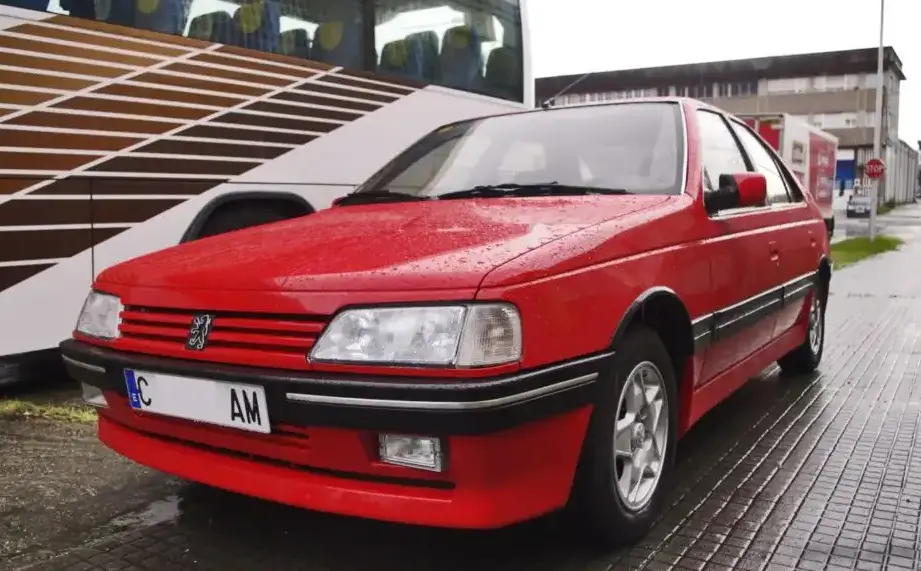
The Peugeot 405 I (15B) 1.9 Sport MI-16, produced between 1988 and 1992, represented a significant step forward for Peugeot in the mid-size sedan segment. Positioned as a performance-oriented variant within the 405 range, the MI-16 models, particularly the 1.9-liter version, were designed to appeal to enthusiasts seeking a blend of practicality and driving enjoyment. This model sat above the base 1.6 and 1.8 liter versions, offering substantially more power and a sportier driving experience, but below the more expensive and luxurious trim levels. It was a key player in Peugeot’s efforts to establish a reputation for engineering excellence and dynamic handling in the European market.
Technical Specifications
| Brand | Peugeot |
| Model | 405 |
| Generation | 405 I (15B) |
| Type (Engine) | 1.9 Sport MI-16 (147 Hp) |
| Start of production | 1988 |
| End of production | 1992 |
| Powertrain Architecture | Internal Combustion engine |
| Body type | Sedan |
| Seats | 5 |
| Doors | 4 |
| Fuel consumption (urban) | 12 l/100 km (19.6 US mpg) |
| Fuel consumption (extra urban) | 6.9 l/100 km (34.1 US mpg) |
| Fuel Type | Petrol (Gasoline) |
| Acceleration 0 – 100 km/h | 8.6 sec |
| Acceleration 0 – 62 mph | 8.6 sec |
| Acceleration 0 – 60 mph | 8.2 sec |
| Maximum speed | 214 km/h (132.97 mph) |
| Weight-to-power ratio | 7.4 kg/Hp |
| Weight-to-torque ratio | 6.4 kg/Nm |
| Power | 147 Hp @ 6500 rpm |
| Power per litre | 77.2 Hp/l |
| Torque | 170 Nm @ 5000 rpm (125.39 lb.-ft. @ 5000 rpm) |
| Engine layout | Front, Transverse |
| Engine Model/Code | DFW XU9J4Z |
| Engine displacement | 1905 cm3 (116.25 cu. in.) |
| Number of cylinders | 4 |
| Engine configuration | Inline |
| Cylinder Bore | 83 mm (3.27 in.) |
| Piston Stroke | 88 mm (3.46 in.) |
| Compression ratio | 10.4:1 |
| Number of valves per cylinder | 4 |
| Fuel injection system | Multi-port manifold injection |
| Engine aspiration | Naturally aspirated engine |
| Valvetrain | DOHC |
| Engine oil capacity | 5.1 l (5.39 US qt | 4.49 UK qt) |
| Coolant | 7.2 l (7.61 US qt | 6.34 UK qt) |
| Kerb Weight | 1085 kg (2392.02 lbs.) |
| Max. weight | 1550 kg (3417.17 lbs.) |
| Max load | 465 kg (1025.15 lbs.) |
| Trunk (boot) space – minimum | 470 l (16.6 cu. ft.) |
| Fuel tank capacity | 70 l (18.49 US gal | 15.4 UK gal) |
| Permitted trailer load with brakes (12%) | 1200 kg (2645.55 lbs.) |
| Length | 4408 mm (173.54 in.) |
| Width | 1714 mm (67.48 in.) |
| Height | 1406 mm (55.35 in.) |
| Wheelbase | 2669 mm (105.08 in.) |
| Front track | 1450 mm (57.09 in.) |
| Rear (Back) track | 1443 mm (56.81 in.) |
| Front overhang | 817 mm (32.17 in.) |
| Rear overhang | 922 mm (36.3 in.) |
| Drag coefficient (Cd) | 0.30 |
| Minimum turning circle (turning diameter) | 10.55 m (34.61 ft.) |
| Drivetrain Architecture | The Internal combustion engine (ICE) drives the front wheels of the vehicle. |
| Drive wheel | Front wheel drive |
| Number of gears and type of gearbox | 5 gears, manual transmission |
| Front suspension | Independent, type McPherson with coil spring and anti-roll bar |
| Rear suspension | Torsion |
| Front brakes | Ventilated discs |
| Rear brakes | Disc |
| Assisting systems | ABS (Anti-lock braking system) |
| Steering type | Steering rack and pinion |
| Power steering | Hydraulic Steering |
| Tires size | 195/55 R15 |
| Wheel rims size | 15 |
Powertrain & Engine Architecture
The heart of the 405 1.9 Sport MI-16 is the DFW XU9J4Z engine, a 1905cc inline-four cylinder unit. This engine is a derivative of Peugeot and Renault’s collaborative XU series, renowned for its robustness and tuning potential. The “MI-16” designation refers to the Multi-point Injection and 16-valve cylinder head, a significant upgrade over earlier Peugeot engines. The XU9J4Z features a dual overhead camshaft (DOHC) valvetrain, allowing for precise control of the intake and exhaust valves, contributing to its high-revving nature and improved breathing. Fuel delivery is managed by a multi-port fuel injection system, ensuring efficient combustion and responsive throttle control. The engine produces 147 horsepower at 6500 rpm and 170 Nm (125 lb-ft) of torque at 5000 rpm. The engine is transversely mounted, driving the front wheels through a five-speed manual transmission. This transmission was chosen for its sporty feel and ability to maximize the engine’s performance.
Driving Characteristics
The 405 1.9 Sport MI-16 offered a noticeably more engaging driving experience than its lower-spec siblings. The 147 hp engine provided brisk acceleration, with a 0-60 mph time of around 8.2 seconds and a top speed of 133 mph. While not a sports car by modern standards, it was quick for its time and offered a satisfying level of performance. The five-speed manual transmission allowed drivers to keep the engine in its sweet spot, maximizing power delivery. The gear ratios were well-chosen, providing good acceleration in each gear. The handling was also a strong point, with the McPherson strut front suspension and torsion beam rear suspension providing a good balance between comfort and control. The steering was precise and well-weighted, giving the driver a good feel for the road. Compared to the 1.6 and 1.8 liter models, the 1.9 Sport MI-16 felt significantly more responsive and capable, making it a popular choice for drivers who enjoyed a spirited driving experience.
Equipment & Trim Levels
The 405 1.9 Sport MI-16 typically came equipped with a range of features designed to enhance both comfort and performance. Standard equipment included power steering, ABS anti-lock brakes, and alloy wheels. The interior featured sporty cloth upholstery, a leather-wrapped steering wheel, and a comprehensive instrument cluster. Optional extras included a sunroof, air conditioning, and upgraded audio systems. The trim level was generally well-appointed for the time, offering a good balance between practicality and style. The interior design was functional and ergonomic, with all controls within easy reach of the driver.
Chassis & Braking
The 405 1.9 Sport MI-16 utilized an independent McPherson strut suspension at the front, providing good wheel control and ride comfort. The rear suspension employed a torsion beam setup, which was cost-effective and provided adequate handling characteristics for everyday driving. Braking duties were handled by ventilated discs at the front and solid discs at the rear, providing ample stopping power. The inclusion of ABS further enhanced braking performance, particularly in adverse conditions. The chassis was relatively lightweight, contributing to the car’s agile handling. Stabilizer bars were fitted to both the front and rear axles to reduce body roll during cornering.
Market Reception & Comparison
The Peugeot 405 1.9 Sport MI-16 was generally well-received by automotive critics. It was praised for its performance, handling, and overall refinement. Compared to its rivals, such as the Ford Sierra 2.0i and the Vauxhall/Opel Vectra 2.0, the 405 offered a more sophisticated driving experience and a more stylish interior. Fuel economy was respectable for a performance-oriented sedan, averaging around 34 mpg on the highway. Reliability was generally good, although some owners reported issues with the engine’s timing belt and cooling system. The 1.9 Sport MI-16 offered a compelling alternative to the more expensive and less practical hot hatches of the era.
Legacy
The Peugeot 405 1.9 Sport MI-16 remains a popular choice among classic car enthusiasts. The XU9J4Z engine is known for its durability and tunability, making it a favorite among those who enjoy modifying their vehicles. Parts availability is generally good, although some components can be difficult to find. Well-maintained examples of the 405 1.9 Sport MI-16 are becoming increasingly collectible, as they represent a high point in Peugeot’s engineering history. The car’s blend of performance, style, and practicality has ensured its enduring appeal.
