
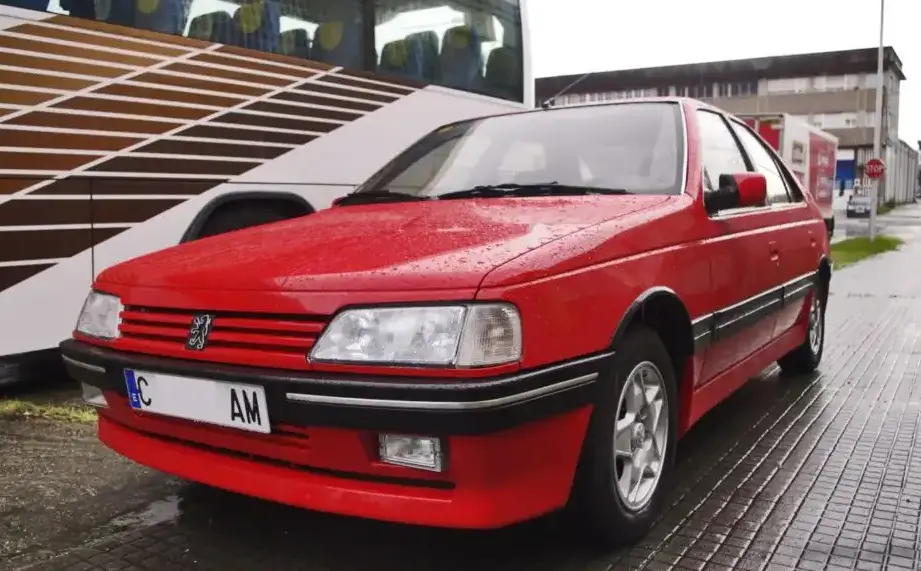
The Peugeot 405 I (15B) 1.9 Sport MI-16, produced between 1987 and 1991, represents a high-performance variant within the first generation of the Peugeot 405. Positioned as the sporting flagship of the range, it aimed to deliver a more engaging driving experience than the standard models. The 405 itself was a significant vehicle for Peugeot, replacing the aging 505 and representing a move towards more modern design and engineering. This particular variant, with its 158 horsepower engine, was a key player in establishing the 405’s reputation for performance and handling, particularly in European markets. It was built on the Peugeot 405 platform, designated 15B, and shared its basic architecture with other 405 models but distinguished itself through its enhanced powertrain and sporting features.
Technical Specifications
| Brand | Peugeot |
| Model | 405 |
| Generation | 405 I (15B) |
| Type (Engine) | 1.9 Sport MI-16 (158 Hp) |
| Start of production | 1987 |
| End of production | 1991 |
| Powertrain Architecture | Internal Combustion engine |
| Body type | Sedan |
| Seats | 5 |
| Doors | 4 |
| Fuel consumption (urban) | 11.3 l/100 km (20.8 US mpg) |
| Fuel consumption (extra urban) | 6.5 l/100 km (36.2 US mpg) |
| Fuel Type | Petrol (Gasoline) |
| Acceleration 0 – 100 km/h | 8.6 sec |
| Acceleration 0 – 62 mph | 8.6 sec |
| Acceleration 0 – 60 mph | 8.2 sec |
| Maximum speed | 220 km/h (136.7 mph) |
| Weight-to-power ratio | 6.9 kg/Hp |
| Weight-to-torque ratio | 6 kg/Nm |
| Power | 158 Hp @ 6500 rpm |
| Power per litre | 82.9 Hp/l |
| Torque | 181 Nm @ 5000 rpm (133.5 lb.-ft. @ 5000 rpm) |
| Engine layout | Front, Transverse |
| Engine Model/Code | D6C XU9J4 |
| Engine displacement | 1905 cm3 (116.25 cu. in.) |
| Number of cylinders | 4 |
| Engine configuration | Inline |
| Cylinder Bore | 83 mm (3.27 in.) |
| Piston Stroke | 88 mm (3.46 in.) |
| Compression ratio | 10.4:1 |
| Number of valves per cylinder | 4 |
| Fuel injection system | Multi-port manifold injection |
| Engine aspiration | Naturally aspirated engine |
| Valvetrain | DOHC |
| Engine oil capacity | 5.1 l (5.39 US qt | 4.49 UK qt) |
| Coolant | 7.2 l (7.61 US qt | 6.34 UK qt) |
| Kerb Weight | 1085 kg (2392.02 lbs.) |
| Max. weight | 1550 kg (3417.17 lbs.) |
| Max load | 465 kg (1025.15 lbs.) |
| Trunk (boot) space – minimum | 470 l (16.6 cu. ft.) |
| Fuel tank capacity | 70 l (18.49 US gal | 15.4 UK gal) |
| Permitted trailer load with brakes (12%) | 1200 kg (2645.55 lbs.) |
| Length | 4408 mm (173.54 in.) |
| Width | 1714 mm (67.48 in.) |
| Height | 1406 mm (55.35 in.) |
| Wheelbase | 2669 mm (105.08 in.) |
| Front track | 1450 mm (57.09 in.) |
| Rear (Back) track | 1443 mm (56.81 in.) |
| Front overhang | 817 mm (32.17 in.) |
| Rear overhang | 922 mm (36.3 in.) |
| Drag coefficient (Cd) | 0.30 |
| Minimum turning circle (turning diameter) | 10.55 m (34.61 ft.) |
| Drivetrain Architecture | The Internal combustion engine (ICE) drives the front wheels of the vehicle. |
| Drive wheel | Front wheel drive |
| Number of gears and type of gearbox | 5 gears, manual transmission |
| Front suspension | Independent, type McPherson with coil spring and anti-roll bar |
| Rear suspension | Torsion |
| Front brakes | Ventilated discs |
| Rear brakes | Disc |
| Assisting systems | ABS (Anti-lock braking system) |
| Steering type | Steering rack and pinion |
| Power steering | Hydraulic Steering |
| Tires size | 195/55 R15 |
| Wheel rims size | 15 |
Powertrain & Engine Architecture
The heart of the 405 Sport MI-16 is the XU9J4 engine, a 1.9-liter inline-four cylinder powerplant. This engine is part of Peugeot-Renault’s XU series, known for its robustness and tuning potential. The “MI-16” designation signifies “Multi-point Injection – 16 valves,” highlighting the engine’s advanced fuel delivery and valvetrain. The XU9J4 utilizes a Bosch Motronic fuel injection system, providing precise control over fuel mixture for optimal performance and emissions. The double overhead camshaft (DOHC) design, with four valves per cylinder, allows for efficient cylinder filling and exhaust scavenging, contributing to the engine’s high output. The engine’s 83mm bore and 88mm stroke result in a displacement of 1905cc. The engine was mated to a five-speed manual transmission, providing drivers with full control over the power delivery. This transmission was chosen to complement the engine’s sporty character and allow for spirited driving.
Driving Characteristics
The 1.9 Sport MI-16 offered a noticeably more engaging driving experience compared to the lower-spec 405 models. The 158 horsepower engine provided brisk acceleration, with a 0-60 mph time of around 8.2 seconds and a top speed of 136.7 mph. While not a sports car in the purest sense, the 405 MI-16 delivered a responsive and enjoyable driving experience. The five-speed manual transmission allowed drivers to keep the engine in its optimal power band, maximizing acceleration. The gear ratios were well-chosen for both everyday driving and spirited performance. The engine’s torque curve was relatively flat, providing good pulling power throughout the rev range. Compared to the 1.6-liter or diesel variants, the MI-16 offered a significant performance advantage, but it came at the cost of slightly higher fuel consumption.
Equipment & Trim Levels
The Sport MI-16 trim level included several features designed to enhance the driving experience and differentiate it from the base models. Standard equipment typically included sports seats with enhanced bolstering, a leather-wrapped steering wheel, and upgraded instrumentation. The interior trim was generally more refined than that of the lower-spec models, with higher-quality materials used throughout. Optional extras included a sunroof, air conditioning, and upgraded audio systems. The exterior styling was also subtly enhanced, with features such as a rear spoiler and unique alloy wheels. The overall aim was to create a sporty and sophisticated package that appealed to drivers who wanted a more engaging and refined driving experience.
Chassis & Braking
The 405 Sport MI-16 featured a McPherson strut front suspension and a torsion beam rear suspension. This setup provided a good balance between ride comfort and handling. The front suspension incorporated an anti-roll bar to reduce body roll during cornering. The braking system consisted of ventilated discs at the front and solid discs at the rear, providing adequate stopping power for the car’s performance capabilities. An anti-lock braking system (ABS) was also included as standard equipment, enhancing safety and control. The chassis was reinforced in certain areas to handle the increased power and stresses associated with the higher-performance engine.
Market Reception & Comparison
The Peugeot 405 Sport MI-16 was generally well-received by automotive critics. It was praised for its performance, handling, and refined interior. However, some critics noted that the ride could be a bit firm, and the engine could be somewhat noisy at high revs. Compared to rivals such as the Ford Sierra 2.0i and the Volkswagen Golf GTI, the 405 MI-16 offered a compelling combination of performance, comfort, and value. Fuel economy was reasonable for a performance car of its era, but it was lower than that of the more economical 405 models. Reliability was generally good, although some owners reported issues with the fuel injection system and the cooling system.
Legacy
The Peugeot 405 Sport MI-16 remains a popular choice among enthusiasts today. The XU9J4 engine is known for its durability and tuning potential, and many owners have modified their cars to extract even more performance. The 405 MI-16 is also appreciated for its classic styling and its engaging driving experience. While finding well-maintained examples can be challenging, the 405 MI-16 continues to be a rewarding car to own and drive, representing a high point in Peugeot’s engineering and design history. The engine’s robust design means many examples are still on the road today, though regular maintenance is crucial to ensure continued reliability.
