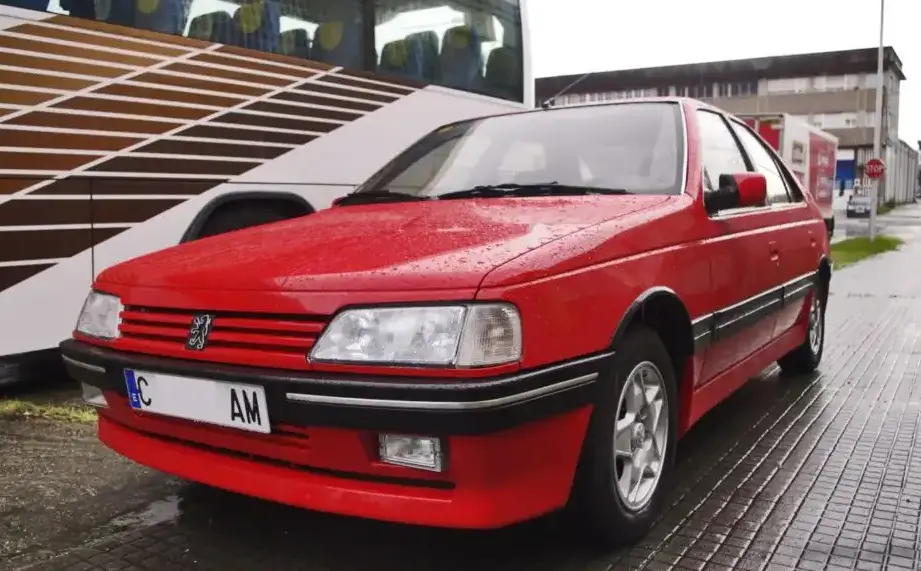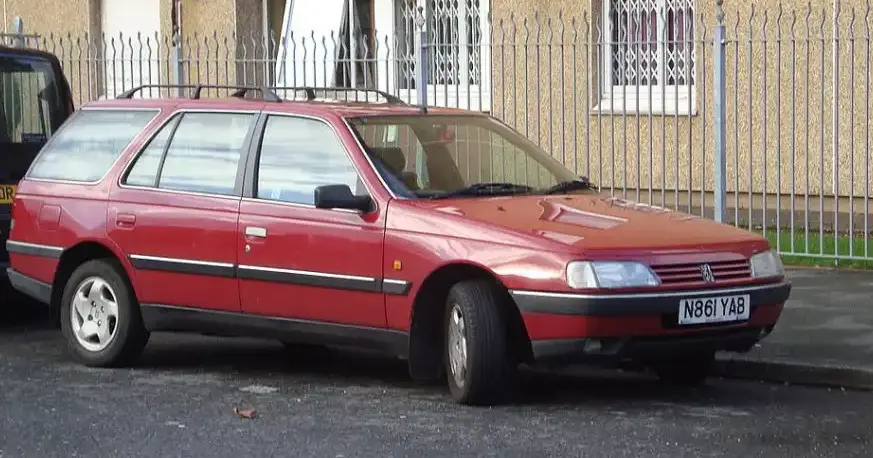
The Peugeot 405 I Break 1.6, produced from 1992 to 1996, represents a practical and economical variant within the broader 405 range. This station wagon (estate) body style, designated as the 15E after the 1992 facelift, was aimed at families and those requiring increased cargo capacity. Positioned as an entry-level offering, the 1.6-liter engine and five-speed manual transmission combination provided a balance between affordability and usability, particularly in European markets where fuel efficiency and practicality were highly valued. The 405 itself was a significant model for Peugeot, replacing the aging 505 and offering a more modern and aerodynamic design.
Technical Specifications
| Brand | Peugeot |
| Model | 405 |
| Generation | 405 I Break (15E, facelift 1992) |
| Type (Engine) | 1.6 (89 Hp) |
| Start of production | 1992 |
| End of production | 1996 |
| Powertrain Architecture | Internal Combustion engine |
| Body type | Station wagon (estate) |
| Seats | 5 |
| Doors | 5 |
| Fuel consumption (combined) | 7.4 l/100 km (31.8 US mpg, 38.2 UK mpg, 13.5 km/l) |
| Fuel Type | Petrol (Gasoline) |
| Acceleration 0 – 100 km/h | 14.1 sec |
| Acceleration 0 – 62 mph | 14.1 sec |
| Acceleration 0 – 60 mph | 13.4 sec |
| Maximum speed | 173 km/h (107.5 mph) |
| Weight-to-power ratio | 12.2 kg/Hp, 81.7 Hp/tonne |
| Weight-to-torque ratio | 8.1 kg/Nm, 123.9 Nm/tonne |
| Power | 89 Hp @ 5600 rpm |
| Power per litre | 56.1 Hp/l |
| Torque | 135 Nm @ 3000 rpm (99.57 lb.-ft. @ 3000 rpm) |
| Engine layout | Front, Transverse |
| Engine Model/Code | BDY XU5M2Z |
| Engine displacement | 1587 cm3 (96.84 cu. in.) |
| Number of cylinders | 4 |
| Engine configuration | Inline |
| Cylinder Bore | 78.5 mm (3.09 in.) |
| Piston Stroke | 82 mm (3.23 in.) |
| Compression ratio | 10:1 |
| Number of valves per cylinder | 2 |
| Fuel injection system | Multi-port manifold injection |
| Engine aspiration | Naturally aspirated engine |
| Valvetrain | OHC |
| Engine oil capacity | 4.6 l (4.86 US qt | 4.05 UK qt) |
| Coolant | 6.6 l (6.97 US qt | 5.81 UK qt) |
| Kerb Weight | 1090 kg (2403.04 lbs.) |
| Max. weight | 1590 kg (3505.35 lbs.) |
| Max load | 500 kg (1102.31 lbs.) |
| Trunk (boot) space – minimum | 425 l (15.01 cu. ft.) |
| Trunk (boot) space – maximum | 744 l (26.27 cu. ft.) |
| Fuel tank capacity | 70 l (18.49 US gal | 15.4 UK gal) |
| Length | 4398 mm (173.15 in.) |
| Width | 1704 mm (67.09 in.) |
| Height | 1481 mm (58.31 in.) |
| Wheelbase | 2669 mm (105.08 in.) |
| Front track | 1450 mm (57.09 in.) |
| Rear (Back) track | 1443 mm (56.81 in.) |
| Drivetrain Architecture | The Internal combustion engine (ICE) drives the front wheels of the vehicle. |
| Drive wheel | Front wheel drive |
| Number of gears and type of gearbox | 5 gears, manual transmission |
| Front suspension | Wishbone |
| Rear suspension | Trailing arm |
| Front brakes | Disc |
| Rear brakes | Drum |
| Assisting systems | ABS (Anti-lock braking system) |
| Steering type | Steering rack and pinion |
| Power steering | Hydraulic Steering |
| Tires size | 175/70 R14 |
Powertrain & Engine Architecture
The 405 I Break 1.6 utilized the BDY (and sometimes related XU5M2Z) engine code, a 1.6-liter inline-four cylinder petrol engine. This engine was a mainstay in Peugeot’s lineup during the early 1990s, known for its relative simplicity and durability. It featured a single overhead camshaft (OHC) valvetrain with two valves per cylinder. Fuel delivery was managed by a multi-port fuel injection system, a significant upgrade over earlier carbureted Peugeot engines, improving efficiency and reducing emissions. The engine’s 89 horsepower output at 5600 rpm and 135 Nm (99.57 lb-ft) of torque at 3000 rpm were modest, but adequate for everyday driving. The five-speed manual transmission was a common Renault-sourced unit, providing a reasonably wide range of gear ratios.
Driving Characteristics
The 1.6-liter engine in the 405 Break, paired with the five-speed manual, offered a practical but not particularly sporty driving experience. Acceleration was leisurely, with a 0-60 mph time of around 13.4 seconds. The engine felt most comfortable in the mid-range, providing sufficient power for highway cruising and overtaking, although it required downshifting for more spirited maneuvers. Compared to the more powerful 1.9 and 2.0-liter versions of the 405, or the diesel variants, the 1.6 felt noticeably underpowered. However, this was offset by improved fuel economy and a lighter front end, contributing to more predictable handling. The gear ratios were well-spaced, allowing the driver to keep the engine in its optimal power band.
Equipment & Trim Levels
The 1.6-liter Break typically represented the base trim level. Standard equipment included basic cloth upholstery, a simple dashboard layout, and manual windows and door locks. Power steering was often included, but air conditioning and central locking were usually optional extras. The interior was functional and durable, prioritizing practicality over luxury. Optional extras could include a sunroof, upgraded stereo systems, and different wheel covers. The focus was on providing a comfortable and reliable family vehicle at an affordable price point.
Chassis & Braking
The 405 Break featured a front-wheel-drive layout with an independent wishbone suspension at the front and a trailing arm suspension at the rear. This setup provided a reasonable balance between ride comfort and handling. The front brakes were discs, while the rear brakes were drums, a common configuration for vehicles in this price range during the early 1990s. Anti-lock braking system (ABS) was available as an option, enhancing safety. The steering was rack and pinion, providing precise and responsive control. The 175/70 R14 tires offered adequate grip for everyday driving conditions.
Market Reception & Comparison
The Peugeot 405 I Break 1.6 was generally well-received as a practical and affordable family car. Critics praised its spacious interior, comfortable ride, and fuel efficiency. However, the engine’s lack of power was often noted. Compared to the more expensive 1.9 and 2.0-liter models, the 1.6 offered a more economical option, but at the expense of performance. The diesel variants provided even better fuel economy, but with reduced refinement. The 405 Break competed with other European station wagons such as the Ford Mondeo Estate, Renault 19 Estate, and Citroën BX Break.
Legacy
The Peugeot 405 I Break 1.6, while not the most powerful or luxurious version of the 405, remains a popular choice among classic car enthusiasts and those seeking a reliable and affordable used vehicle. The BDY engine is known for its durability, and with proper maintenance, can provide many years of service. Parts availability is generally good, and the 405’s relatively simple construction makes it relatively easy to repair. Today, these vehicles are often found in good condition, representing a practical and charming reminder of 1990s automotive design. The 405 Break, particularly the 1.6 variant, holds a place as a solid, dependable, and economical family car from a bygone era.