
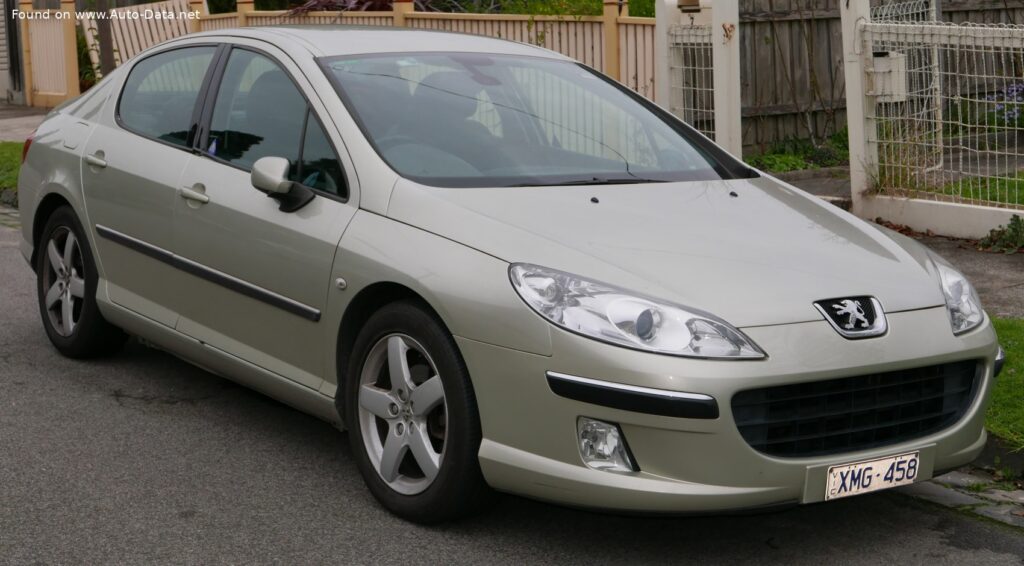
The Peugeot 407, produced between 2004 and 2010, was a large family car designed and manufactured by the French automaker Peugeot. Representing Peugeot’s entry into the mid-size segment, it aimed to compete with established rivals like the Ford Mondeo, Vauxhall/Opel Vectra, and Volkswagen Passat. The 407 was available in saloon (sedan), coupé, SW (estate/station wagon), and convertible body styles. This article focuses on the 2.2 HDI variant, a diesel-powered model popular in European markets from 2006 to 2008, known for its blend of performance and fuel efficiency.
Peugeot 407 2.2 HDI: Overview and Market Position
The 2.2 HDI version of the Peugeot 407 was primarily targeted at the European market, where diesel engines held a significant share of the automotive landscape. Unlike the United States, where gasoline engines dominated, European consumers favored diesel for its superior fuel economy and torque characteristics, making it ideal for long-distance driving. The 407, in general, was designed to elevate Peugeot’s image, offering a more sophisticated and refined experience compared to its predecessors. The 2.2 HDI specifically appealed to buyers seeking a comfortable, well-equipped, and economical family car.
Engine & Performance
The heart of the Peugeot 407 2.2 HDI is its 2.2-liter, four-cylinder diesel engine, designated the 4HT DW12BTED4. This engine produces 170 horsepower at 4,000 rpm and a substantial 370 Nm (272.9 lb.-ft.) of torque at just 1,500 rpm. The high torque output, characteristic of diesel engines, provides strong acceleration and effortless cruising. The engine utilizes a twin-turbocharger setup with an intercooler, enhancing both power and efficiency. This configuration allows for a broad torque curve, delivering responsive performance across a wide range of engine speeds. Acceleration from 0 to 100 km/h (0-62 mph) takes 8.7 seconds, while 0-60 mph is achieved in a calculated 8.3 seconds. The 407 2.2 HDI boasts a top speed of 225 km/h (139.81 mph). The engine’s power-to-weight ratio is 100.1 horsepower per tonne, and its torque-to-weight ratio is 217.8 Nm per tonne, contributing to its spirited driving experience. Fuel economy is a key strength, with combined cycle figures of 6.1 l/100 km (38.6 US mpg, 46.3 UK mpg), and CO2 emissions ranging from 159-160 g/km.
Design & Features
The Peugeot 407 is a four-door sedan with a sleek and modern design for its time. Its styling, penned by Pininfarina, features a distinctive front end with a prominent grille and elongated headlights. The interior is spacious and well-appointed, offering comfortable seating for five passengers. The 407 prioritized safety, incorporating features like Anti-lock Braking System (ABS), and a robust body structure. Standard equipment typically included air conditioning, power windows, and a CD stereo system. Higher trim levels offered options such as leather upholstery, automatic climate control, and a navigation system. The trunk (boot) offers a practical 407 liters (14.37 cu. ft.) of space. The 407’s suspension system – double wishbones at the front and an independent multi-link setup at the rear – provides a comfortable ride and good handling characteristics. The steering utilizes a rack and pinion system for precise control.
Technical Specifications
| Brand | Peugeot |
| Model | 407 |
| Generation | 407 |
| Type (Engine) | 2.2 HDI (170 Hp) |
| Start of production | 2006 |
| End of production | 2008 |
| Powertrain Architecture | Internal Combustion engine |
| Body type | Sedan |
| Seats | 5 |
| Doors | 4 |
| Fuel consumption (urban) | 8.1 l/100 km (29 US mpg, 34.9 UK mpg) |
| Fuel consumption (extra urban) | 5 l/100 km (47 US mpg, 56.5 UK mpg) |
| Fuel consumption (combined) | 6.1 l/100 km (38.6 US mpg, 46.3 UK mpg) |
| CO2 emissions | 159-160 g/km |
| Fuel Type | Diesel |
| Acceleration 0 – 100 km/h | 8.7 sec |
| Acceleration 0 – 62 mph | 8.7 sec |
| Acceleration 0 – 60 mph | 8.3 sec |
| Maximum speed | 225 km/h (139.81 mph) |
| Weight-to-power ratio | 10 kg/Hp, 100.1 Hp/tonne |
| Weight-to-torque ratio | 4.6 kg/Nm, 217.8 Nm/tonne |
| Power | 170 Hp @ 4000 rpm |
| Power per litre | 78 Hp/l |
| Torque | 370 Nm @ 1500 rpm (272.9 lb.-ft. @ 1500 rpm) |
| Engine layout | Front, Transverse |
| Engine Model/Code | 4HT DW12BTED4 |
| Engine displacement | 2179 cm3 (132.97 cu. in.) |
| Number of cylinders | 4 |
| Engine configuration | Inline |
| Number of valves per cylinder | 4 |
| Fuel injection system | Diesel Commonrail |
| Engine aspiration | Twin-Turbo, Intercooler |
| Engine oil capacity | 5.25 l (5.55 US qt | 4.62 UK qt) |
| Coolant | 9.7 l (10.25 US qt | 8.53 UK qt) |
| Kerb Weight | 1699 kg (3745.65 lbs.) |
| Max. weight | 2125 kg (4684.82 lbs.) |
| Max load | 426 kg (939.17 lbs.) |
| Trunk (boot) space – minimum | 407 l (14.37 cu. ft.) |
| Fuel tank capacity | 66 l (17.44 US gal | 14.52 UK gal) |
| Max. roof load | 80 kg (176.37 lbs.) |
| Permitted trailer load with brakes (12%) | 1850 kg (4078.55 lbs.) |
| Permitted trailer load without brakes | 750 kg (1653.47 lbs.) |
| Permitted towbar download | 74 kg (163.14 lbs.) |
| Length | 4676 mm (184.09 in.) |
| Width | 1811 mm (71.3 in.) |
| Height | 1447-1455 mm (56.97 – 57.28 in.) |
| Wheelbase | 2725 mm (107.28 in.) |
| Front track | 1552-1560 mm (61.1 – 61.42 in.) |
| Rear (Back) track | 1518-1526 mm (59.76 – 60.08 in.) |
| Front overhang | 1029 mm (40.51 in.) |
| Rear overhang | 922 mm (36.3 in.) |
| Minimum turning circle (turning diameter) | 12 m (39.37 ft.) |
| Drivetrain Architecture | Front wheel drive |
| Number of gears and type of gearbox | 6 gears, manual transmission |
| Front suspension | Double wishbone |
| Rear suspension | Independent multi-link suspension |
| Front brakes | Ventilated discs |
| Rear brakes | Disc |
| Assisting systems | ABS (Anti-lock braking system) |
| Steering type | Steering rack and pinion |
| Tires size | 215/55 R17 |
| Wheel rims size | 17 |
The Peugeot 407 2.2 HDI offered a compelling package for European buyers seeking a stylish, comfortable, and fuel-efficient family car. Its blend of performance, practicality, and features cemented its position as a strong contender in the competitive mid-size segment.
