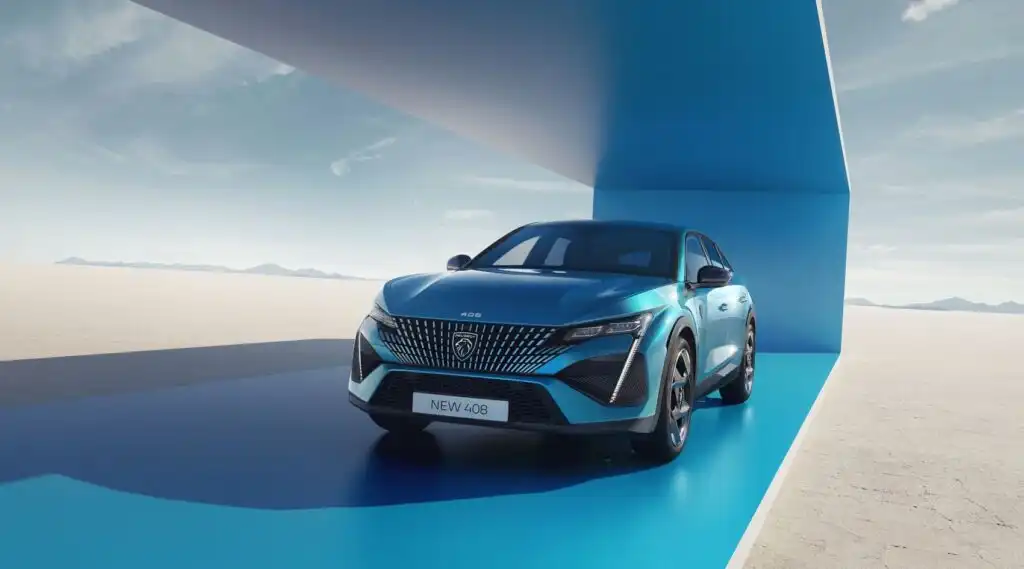
The Peugeot 408 e-408 58 kWh is an all-electric crossover introduced in October 2024, representing Peugeot’s entry into the increasingly competitive electric vehicle market. Positioned as a stylish and practical option within the 408 lineup, it offers a blend of modern design, efficient performance, and advanced technology. The e-408 is built upon the Stellantis EMP2 platform, shared with other Peugeot and Opel/Vauxhall models, and aims to appeal to buyers seeking a zero-emission vehicle without compromising on space or driving experience. This particular variant, with its 58 kWh battery and 213 horsepower electric motor, serves as the standard range option for the 408 e-408, offering a balance between affordability and usability.
Technical Specifications
| Brand | Peugeot |
| Model | 408 (crossover) |
| Generation | 408 (crossover) |
| Type (Engine) | e-408 58 kWh (213 Hp) |
| Start of production | October, 2024 |
| Powertrain Architecture | BEV (Electric Vehicle) |
| Body type | Coupe, SUV, Crossover |
| Seats | 5 |
| Doors | 5 |
| Fuel Type | Electricity |
| Acceleration 0 – 100 km/h | 7.2 sec |
| Acceleration 0 – 62 mph | 7.2 sec |
| Acceleration 0 – 60 mph | 6.8 sec |
| Maximum speed | 160 km/h (99.42 mph) |
| Weight-to-power ratio | 8.5 kg/Hp, 118.1 Hp/tonne |
| Weight-to-torque ratio | 5.2 kg/Nm, 191.2 Nm/tonne |
| Gross battery capacity | 58 kWh |
| Battery technology | Lithium nickel manganese cobalt oxides (Li-NMC) |
| Battery location | Below the floor |
| All-electric range (WLTP) | 445-453 km (276.51 – 281.48 mi) |
| Average Energy consumption (WLTP) | 15.1-15.3 kWh/100 km (24.3 – 24.62 kWh/100 mi) |
| Average Energy consumption (MPGe) | 139 – 137 |
| Average Energy consumption (km/kWh) | 6.6 – 6.5 |
| Average Energy consumption (mi/kWh) | 4.1 – 4.1 |
| Electric motor power | 213 Hp @ 3935-14000 rpm |
| Electric motor Torque | 345 Nm @ 250-4370 rpm (254.46 lb.-ft. @ 250-4370 rpm) |
| Electric motor location | Front axle, Transverse |
| Electric motor type | Synchronous |
| System power | 213 Hp @ 3935-14000 rpm |
| System torque | 345 Nm @ 250-4370 rpm (254.46 lb.-ft. @ 250-4370 rpm) |
| Kerb Weight | 1804 kg (3977.14 lbs) |
| Max. weight | 2250 kg (4960.4 lbs) |
| Max load | 446 kg (983.26 lbs) |
| Trunk (boot) space – minimum | 471 l (16.63 cu. ft) |
| Length | 4687 mm (184.53 in) |
| Width | 1848 mm (72.76 in) |
| Width with mirrors folded | 1859 mm (73.19 in) |
| Width including mirrors | 2062 mm (81.18 in) |
| Height | 1487 mm (58.54 in) |
| Wheelbase | 2787 mm (109.72 in) |
| Front track | 1589 mm (62.56 in) |
| Rear (Back) track | 1604 mm (63.15 in) |
| Front overhang | 904 mm (35.59 in) |
| Rear overhang | 996 mm (39.21 in) |
| Minimum turning circle | 11.2 m (36.75 ft) |
| Drivetrain Architecture | One electric motor drives the front wheels |
| Drive wheel | Front wheel drive |
| Number of gears | 1 |
| Type of gearbox | automatic transmission |
| Front suspension | Independent type McPherson |
| Rear suspension | Torsion |
| Front brakes | Disc, 330×30 mm |
| Rear brakes | Disc, 290×12 mm |
| Assisting systems | ABS (Anti-lock braking system) |
| Steering type | Steering rack and pinion |
| Power steering | Electric Steering |
| Tires size | 225/50 R19 100V |
| Wheel rims size | 19 |
INTRODUCTION
The Peugeot 408 e-408 58 kWh, launched in late 2024, is a battery electric vehicle (BEV) that expands the 408 model range. The 408 itself is a crossover vehicle, blending elements of a traditional sedan with the elevated ride height and practicality of an SUV. The “e-408” designation signifies the electric powertrain, and the “58 kWh” refers to the usable capacity of the lithium-ion battery pack. This variant is positioned as the entry point into the 408 electric lineup, offering a competitive range and performance profile for everyday use. It’s a key component of Peugeot’s broader strategy to electrify its entire model range by 2030, catering to the growing demand for sustainable transportation in Europe and beyond.
Powertrain & Engine Architecture
The e-408 utilizes a single electric motor driving the front wheels. This motor, a synchronous type, produces 213 horsepower and 345 Nm (254.46 lb-ft) of torque. The power is delivered through a single-speed automatic transmission, typical of electric vehicles. The heart of the system is the 58 kWh lithium-nickel-manganese-cobalt oxide (Li-NMC) battery pack, strategically positioned under the vehicle floor to optimize weight distribution and maximize interior space. The battery management system (BMS) is crucial for maintaining battery health, optimizing charging cycles, and ensuring safe operation. The e-408 supports both AC and DC fast charging, allowing for convenient charging at home, work, or public charging stations. The charging port location is typically on the rear quarter panel.
Driving Characteristics
The e-408 58 kWh offers a smooth and responsive driving experience, characteristic of electric vehicles. Instant torque delivery provides brisk acceleration, with a 0-60 mph time of around 6.8 seconds. While not as quick as some higher-performance electric crossovers, it’s more than adequate for everyday driving and highway merging. The single-speed transmission provides seamless acceleration without gear changes. The low center of gravity, thanks to the underfloor battery pack, contributes to stable handling and reduced body roll. Regenerative braking is adjustable, allowing drivers to customize the level of deceleration when lifting off the accelerator, maximizing energy recovery and extending range. Compared to potential future, higher-capacity battery versions of the 408 e-408, this variant prioritizes affordability over maximum range.
Equipment & Trim Levels
The standard equipment on the e-408 58 kWh typically includes a modern infotainment system with a touchscreen display, digital instrument cluster, automatic climate control, and a suite of advanced driver-assistance systems (ADAS) such as lane keeping assist, automatic emergency braking, and adaptive cruise control. Interior upholstery is generally cloth or a combination of cloth and synthetic leather, with higher trims offering full leather options. Optional extras may include a panoramic sunroof, premium audio system, heated and ventilated seats, and a 360-degree camera system. The trim levels vary by market, but generally follow a progression from basic to more luxurious configurations.
Chassis & Braking
The e-408 utilizes an independent McPherson strut suspension at the front and a torsion beam suspension at the rear. This setup provides a good balance between ride comfort and handling. The front brakes are disc brakes measuring 330x30mm, while the rear brakes are also disc brakes at 290x12mm. The braking system is equipped with ABS (Anti-lock Braking System) and electronic brake-force distribution (EBD) for enhanced safety. Electric power steering provides precise and responsive steering feel. The vehicle rides on 19-inch alloy wheels with 225/50 R19 tires.
Market Reception & Comparison
The Peugeot 408 e-408 has been generally well-received by automotive critics, praised for its stylish design, comfortable interior, and efficient electric powertrain. Comparisons with rivals such as the Kia Niro EV, Hyundai Kona Electric, and Volkswagen ID.3 often highlight the 408’s distinctive styling and refined driving experience. Fuel economy, expressed as energy consumption, is competitive within its class, with a WLTP range of 445-453 km (276.51 – 281.48 mi). Reliability data is still emerging, as the model is relatively new, but Peugeot has a generally good reputation for build quality and durability.
Legacy
As a relatively recent introduction, the long-term reliability of the e-408 58 kWh powertrain remains to be fully established. However, the underlying electric motor and battery technology are proven and have been used in other Stellantis vehicles. The e-408 represents a significant step forward for Peugeot in its electrification strategy, and its success will likely influence the development of future electric models. On the used car market, the e-408 is expected to hold its value well, particularly as demand for electric vehicles continues to grow. The 58 kWh variant will likely appeal to buyers seeking an affordable and practical electric crossover with a reasonable range.