
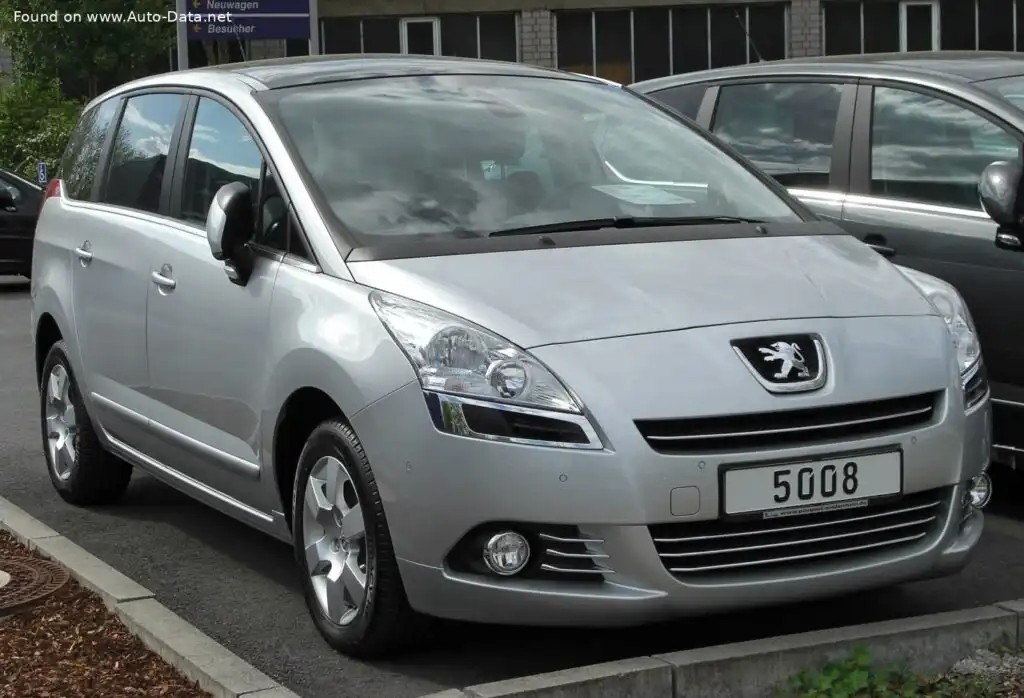
The Peugeot 5008, launched in 2009, represented Peugeot’s entry into the increasingly popular compact Multi-Purpose Vehicle (MPV) segment. The first generation, designated the 5008 I (Phase I), was produced from 2009 to 2013 and shared its platform – the EMP2 – with the Citroën C4 Picasso and Peugeot 308. Among the engine options available, the 1.6 e-HDi (112 horsepower) with a Diesel Particulate Filter (DPF) and Stop & Start technology (STT) offered a balance of fuel efficiency and practicality, positioning itself as a mid-range offering within the 5008 lineup. This variant aimed to appeal to families seeking a versatile vehicle with lower running costs.
Technical Specifications
| Brand | Peugeot |
| Model | 5008 |
| Generation | 5008 I (Phase I, 2009) |
| Type (Engine) | 1.6 e-HDi (112 Hp) FAP STT |
| Start of production | 2009 |
| End of production | 2013 |
| Powertrain Architecture | Internal Combustion engine |
| Body type | MPV |
| Seats | 5 |
| Doors | 5 |
| Fuel consumption (urban) | 5.4 l/100 km (43.6 US mpg, 52.3 UK mpg, 18.5 km/l) |
| Fuel consumption (extra urban) | 4.6 l/100 km (51.1 US mpg, 61.4 UK mpg, 21.7 km/l) |
| Fuel consumption (combined) | 4.9 l/100 km (48 US mpg, 57.6 UK mpg, 20.4 km/l) |
| Fuel Type | Diesel |
| Acceleration 0 – 100 km/h | 14.5 sec |
| Acceleration 0 – 62 mph | 14.5 sec |
| Acceleration 0 – 60 mph | 13.8 sec |
| Maximum speed | 183 km/h (113.71 mph) |
| Emission standard | Euro 5 |
| Weight-to-power ratio | 13.2 kg/Hp, 75.9 Hp/tonne |
| Weight-to-torque ratio | 5.5 kg/Nm, 182.9 Nm/tonne |
| Power | 112 Hp @ 3600 rpm |
| Power per litre | 71.8 Hp/l |
| Torque | 270 Nm @ 1750 rpm (199.14 lb.-ft. @ 1750 rpm) |
| Engine layout | Front, Transverse |
| Engine Model/Code | 9HR DV6C |
| Engine displacement | 1560 cm3 (95.2 cu. in.) |
| Number of cylinders | 4 |
| Engine configuration | Inline |
| Number of valves per cylinder | 2 |
| Fuel injection system | Diesel Commonrail |
| Engine aspiration | Turbocharger, Intercooler |
| Engine oil capacity | 3.75 l (3.96 US qt, 3.3 UK qt) |
| Coolant capacity | 6 l (6.34 US qt, 5.28 UK qt) |
| Kerb Weight | 1476 kg (3254.02 lbs) |
| Max. weight | 2070 kg (4563.57 lbs) |
| Max load | 594 kg (1309.55 lbs) |
| Trunk (boot) space – minimum | 679 l (23.98 cu. ft.) |
| Trunk (boot) space – maximum | 1754 l (61.94 cu. ft.) |
| Fuel tank capacity | 60 l (15.85 US gal, 13.2 UK gal) |
| Length | 4529 mm (178.31 in.) |
| Width | 1888 mm (74.33 in.) |
| Height | 1647 mm (64.84 in.) |
| Wheelbase | 2727 mm (107.36 in.) |
| Minimum turning circle | 11.1 m (36.42 ft.) |
| Drivetrain Architecture | Front wheel drive |
| Number of gears | 6 |
| Gearbox type | Manual transmission |
| Front suspension | Independent type McPherson |
| Rear suspension | Semi-independent, coil spring |
| Front brakes | Ventilated discs |
| Rear brakes | Disc |
| Assisting systems | ABS (Anti-lock braking system) |
| Steering type | Steering rack and pinion |
| Tires size | 215/55 R16; 215/50 R17 |
| Wheel rims size | 16; 17 |
INTRODUCTION
The Peugeot 5008 1.6 e-HDi, produced between 2009 and 2013, was a key variant in the first generation of Peugeot’s popular MPV. It slotted into the middle of the range, offering a more economical alternative to the higher-powered petrol engines and a more accessible price point than the flagship diesel models. The “e-HDi” designation signified Peugeot’s implementation of second-generation common rail diesel injection coupled with Stop & Start technology, aimed at reducing fuel consumption and emissions. The FAP (Filtre à Particules) denoted the inclusion of a diesel particulate filter, essential for meeting increasingly stringent European emission standards. This model was primarily marketed in Europe, where MPVs were a dominant force in the family car market.
Powertrain & Engine Architecture
At the heart of the 5008 1.6 e-HDi lies the PSA Group’s DV6C engine family, specifically the 9HR variant. This 1.6-liter, four-cylinder diesel engine utilizes a common rail direct injection system, delivering fuel at extremely high pressure for optimized combustion. The engine benefits from a turbocharger with an intercooler, boosting power output and improving torque delivery. The 9HR engine features a 16-valve configuration (two valves per cylinder) and is known for its relatively robust construction. The e-HDi system incorporates piezoelectric injectors for precise fuel metering and a variable geometry turbocharger for improved responsiveness. The Stop & Start system automatically shuts off the engine when the vehicle comes to a halt, restarting it instantly when the clutch is depressed (in the manual transmission version). This particular variant was paired with a six-speed manual transmission, chosen for its efficiency and driver engagement. The transmission’s gear ratios were tuned to maximize fuel economy and provide adequate acceleration for everyday driving.
Driving Characteristics
The 112 horsepower and 270 Nm (199 lb-ft) of torque produced by the 1.6 e-HDi engine provided adequate, though not exhilarating, performance for the 5008. Acceleration from 0-60 mph took around 13.8 seconds, and the top speed was approximately 114 mph. The engine’s torque peak, available from 1750 rpm, meant that the 5008 felt reasonably responsive in everyday driving situations, particularly when overtaking or climbing hills. However, compared to the more powerful 2.0-liter HDi variants, the 1.6 e-HDi felt noticeably slower. The six-speed manual transmission allowed drivers to keep the engine in its optimal power band, but required more driver involvement than an automatic. The ride quality was generally comfortable, thanks to the 5008’s well-tuned suspension, but the vehicle’s weight could be felt during cornering. The steering was light and precise, making it easy to maneuver in urban environments.
Equipment & Trim Levels
The 1.6 e-HDi variant of the 5008 typically came equipped with a respectable level of standard features. These included air conditioning, electric front windows, a CD stereo with auxiliary input, and ABS brakes. Higher trim levels, such as the ‘Sport’ or ‘Allure’ offered additional features like alloy wheels, rear parking sensors, cruise control, and a more sophisticated infotainment system. Interior upholstery was typically cloth, with options for upgraded materials on higher trims. The dashboard layout was functional and user-friendly, with a clear instrument cluster and logically placed controls. Optional extras included a panoramic sunroof, leather upholstery, and a navigation system.
Chassis & Braking
The Peugeot 5008 featured a McPherson strut front suspension and a semi-independent coil spring rear suspension. This setup provided a good balance between ride comfort and handling. The front brakes were ventilated discs, while the rear brakes were solid discs. ABS (Anti-lock Braking System) was standard, enhancing braking performance and safety. The 5008’s chassis was designed to provide a stable and secure driving experience, even when fully loaded. Stabilizer bars were fitted to both the front and rear axles to reduce body roll during cornering.
Market Reception & Comparison
The Peugeot 5008 1.6 e-HDi was generally well-received by automotive critics. It was praised for its fuel efficiency, practicality, and comfortable ride. However, some reviewers noted that the engine lacked outright power, particularly when the vehicle was fully loaded. Compared to the 2.0-liter HDi variants, the 1.6 e-HDi offered lower running costs but compromised on performance. Against competitors like the Renault Scenic and Citroën C4 Picasso, the 5008 1.6 e-HDi held its own, offering a compelling combination of features and value. Fuel economy was a key selling point, with the 5008 1.6 e-HDi achieving around 48 mpg on the combined cycle.
Legacy
The 1.6 e-HDi engine proved to be a relatively reliable unit, although, like all diesel engines, it required regular maintenance, including oil changes and DPF regeneration. The PSA DV6 engine family, in general, has a good reputation for durability. In the used car market, the 5008 1.6 e-HDi remains a popular choice for families seeking an affordable and practical MPV. Its fuel efficiency and spacious interior continue to appeal to buyers. However, potential buyers should be aware of the potential costs associated with DPF maintenance and ensure that the vehicle has been properly serviced throughout its life. The 5008, in all its variants, helped solidify Peugeot’s position as a major player in the European MPV market.
