
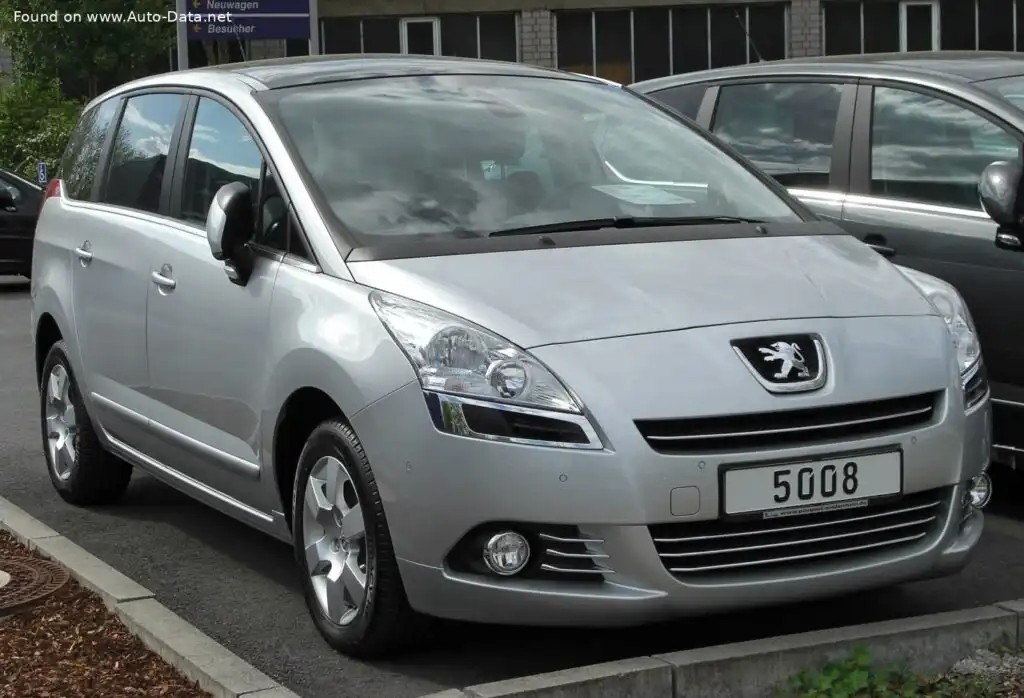
The Peugeot 5008, launched in 2009, represented Peugeot’s entry into the increasingly popular compact Multi-Purpose Vehicle (MPV) segment. The first generation, designated the 5008 I (Phase I), was produced from 2009 to 2013 and built upon the PSA Group’s EMP2 platform, shared with models like the Citroën C4 Picasso. Among the engine options available, the 1.6 THP (Turbo High Pressure) 156 horsepower variant paired with a six-speed automatic transmission offered a balance of performance and convenience, positioning itself as a mid-range offering within the 5008 lineup. This configuration aimed to appeal to families seeking a practical and reasonably efficient vehicle for everyday use.
Technical Specifications
| Brand | Peugeot |
| Model | 5008 |
| Generation | 5008 I (Phase I, 2009) |
| Type (Engine) | 1.6 THP (156 Hp) Automatic |
| Start of production | 2009 |
| End of production | 2013 |
| Powertrain Architecture | Internal Combustion engine |
| Body type | MPV |
| Seats | 5 |
| Doors | 5 |
| Fuel consumption (urban) | 11.2 l/100 km (21 US mpg, 25.2 UK mpg, 8.9 km/l) |
| Fuel consumption (extra urban) | 6 l/100 km (39.2 US mpg, 47.1 UK mpg, 16.7 km/l) |
| Fuel consumption (combined) | 7.9 l/100 km (29.8 US mpg, 35.8 UK mpg, 12.7 km/l) |
| Fuel Type | Petrol (Gasoline) |
| Acceleration 0 – 100 km/h | 9.8 sec |
| Acceleration 0 – 62 mph | 9.8 sec |
| Acceleration 0 – 60 mph | 9.3 sec |
| Maximum speed | 195 km/h (121.17 mph) |
| Emission standard | Euro 5 |
| Weight-to-power ratio | 9.7 kg/Hp, 103.3 Hp/tonne |
| Weight-to-torque ratio | 6.3 kg/Nm, 158.9 Nm/tonne |
| Power | 156 Hp @ 5800 rpm |
| Power per litre | 97.6 Hp/l |
| Torque | 240 Nm @ 1400 rpm (177.01 lb.-ft. @ 1400 rpm) |
| Engine layout | Front, Transverse |
| Engine Model/Code | 5FV EP6CDT |
| Engine displacement | 1598 cm3 (97.52 cu. in.) |
| Number of cylinders | 4 |
| Engine configuration | Inline |
| Number of valves per cylinder | 4 |
| Fuel injection system | Direct injection |
| Engine aspiration | Turbocharger, Intercooler |
| Engine oil capacity | 4.25 l (4.49 US qt | 3.74 UK qt) |
| Coolant capacity | 6.4 l (6.76 US qt | 5.63 UK qt) |
| Kerb Weight | 1510 kg (3328.98 lbs.) |
| Max. weight | 2075 kg (4574.59 lbs.) |
| Max load | 565 kg (1245.61 lbs.) |
| Trunk (boot) space – minimum | 679 l (23.98 cu. ft.) |
| Trunk (boot) space – maximum | 1754 l (61.94 cu. ft.) |
| Fuel tank capacity | 60 l (15.85 US gal | 13.2 UK gal) |
| Length | 4529 mm (178.31 in.) |
| Width | 1888 mm (74.33 in.) |
| Height | 1647 mm (64.84 in.) |
| Wheelbase | 2727 mm (107.36 in.) |
| Minimum turning circle | 11.1 m (36.42 ft.) |
| Drivetrain Architecture | Front wheel drive |
| Number of gears | 6 |
| Gearbox type | Automatic transmission |
| Front suspension | Independent type McPherson |
| Rear suspension | Semi-independent, coil spring |
| Front brakes | Ventilated discs |
| Rear brakes | Disc |
| Assisting systems | ABS (Anti-lock braking system) |
| Steering type | Steering rack and pinion |
| Tires size | 215/55 R16; 215/50 R17; 215/45 R18 |
| Wheel rims size | 16; 17; 18 |
Powertrain & Engine Architecture
The heart of this 5008 variant is the 5FV EP6CDT 1.6-liter turbocharged four-cylinder engine. This engine, part of Peugeot and Citroën’s Prince engine family developed in collaboration with BMW, utilizes direct fuel injection and a twin-scroll turbocharger to deliver a respectable 156 horsepower and 240 Nm (177 lb-ft) of torque. The direct injection system, coupled with the turbocharger, allows for efficient combustion and a broad torque curve, peaking at a low 1400 rpm. This characteristic is particularly beneficial for a family vehicle, providing ample pulling power for everyday driving and overtaking maneuvers. The engine features a timing chain, intended to reduce maintenance compared to timing belts. The six-speed automatic transmission, while not known for being particularly sporty, provides smooth shifts and contributes to the vehicle’s ease of use. It’s a conventional torque-converter automatic, prioritizing comfort over outright performance.
Driving Characteristics
The 1.6 THP automatic 5008 offers a comfortable and refined driving experience. Acceleration from 0-60 mph takes around 9.3 seconds, which is adequate for most situations but doesn’t offer particularly brisk performance. The automatic transmission is programmed for fuel efficiency, meaning it will upshift quickly to maintain lower engine speeds. This can sometimes result in the engine feeling slightly strained when accelerating uphill or with a full load. Compared to the manual transmission version of the same engine, the automatic sacrifices some responsiveness. The higher-output 2.0-liter HDi diesel variants offered significantly more torque and better fuel economy, but at the cost of increased purchase price and potentially higher maintenance costs. The 1.6 THP strikes a balance, offering a reasonable level of performance without the diesel’s complexity.
Equipment & Trim Levels
The 1.6 THP automatic trim typically included features such as air conditioning, electric front and rear windows, a CD/radio stereo system, and alloy wheels. Higher trim levels, such as the ‘Sport’ or ‘Allure’ variants, added features like automatic headlights and rain sensors, rear parking sensors, and a more sophisticated infotainment system. Interior upholstery was generally cloth, with options for leather upgrades on higher trims. The 5008’s modular interior was a key selling point, with individual rear seats that could be folded flat or removed entirely, providing a versatile cargo space.
Chassis & Braking
The 5008 I utilizes a McPherson strut front suspension and a semi-independent coil spring rear suspension. This setup provides a comfortable ride quality, well-suited for absorbing bumps and imperfections in the road. Braking duties are handled by ventilated discs at the front and solid discs at the rear. Anti-lock Braking System (ABS) is standard, enhancing safety during emergency braking situations. The steering is a rack and pinion system, providing reasonably precise control, although it lacks the feedback of more performance-oriented setups.
Market Reception & Comparison
The Peugeot 5008 1.6 THP automatic was generally well-received by automotive critics as a practical and comfortable family vehicle. However, some reviewers noted that the automatic transmission could feel sluggish at times, and the engine, while capable, wasn’t particularly exciting. Fuel economy was considered reasonable for a vehicle of its size and type, averaging around 29.8 US mpg in combined driving. Compared to competitors like the Renault Grand Scenic and Citroën C4 Grand Picasso, the 5008 offered a slightly more driver-focused experience, while the Citroën prioritized comfort. The Renault offered a wider range of engine options.
Legacy
The 1.6 THP engine, while generally reliable, has been known to exhibit issues with carbon buildup on the intake valves, particularly if not regularly driven on longer journeys. This can lead to reduced performance and increased fuel consumption. The automatic transmission, while durable, may require servicing at higher mileages. Today, the first-generation 5008 1.6 THP automatic represents an affordable and practical option in the used car market. Its spacious interior, comfortable ride, and reasonable running costs make it a suitable choice for families seeking a versatile MPV. However, potential buyers should be aware of the potential carbon buildup issue and ensure the vehicle has been well-maintained.
