
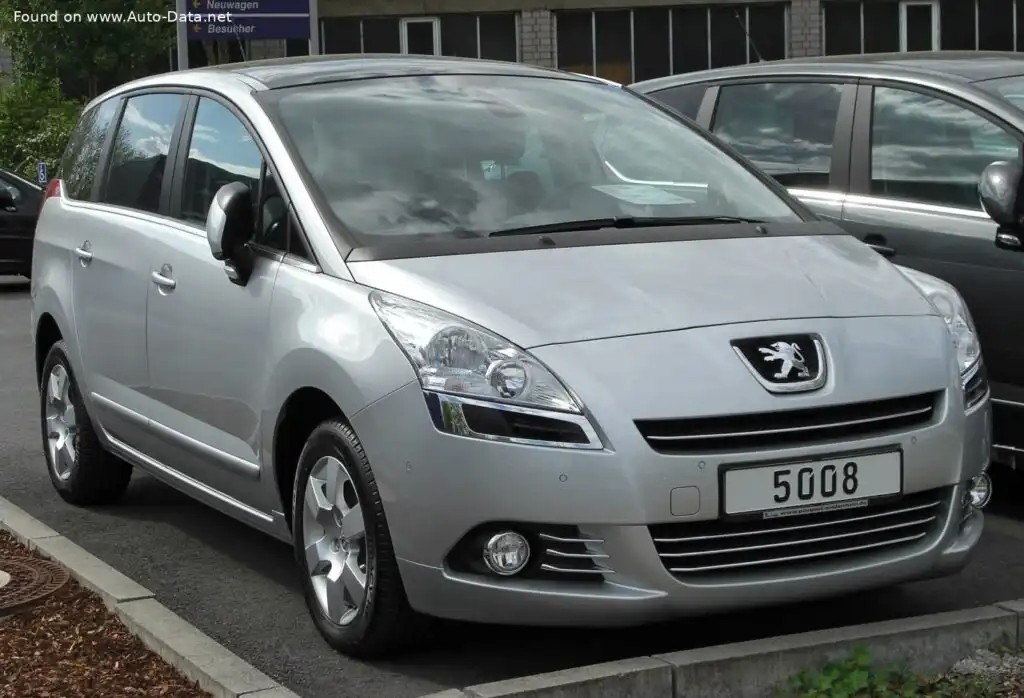
The Peugeot 5008, launched in 2009, represented Peugeot’s entry into the increasingly popular compact MPV (Multi-Purpose Vehicle) segment. The first generation, designated the 5008 I (Phase I), was produced from 2009 to 2013 and offered a practical and family-oriented alternative to traditional hatchbacks and small SUVs. Within the 5008 range, the 1.6 VTi 120 horsepower variant occupied a key position as the entry-level petrol engine option, aimed at buyers prioritizing affordability and fuel efficiency over outright performance. It was positioned below the more powerful 1.6 THP and diesel variants, catering to a broader customer base seeking a versatile and economical vehicle.
Technical Specifications
| Brand | Peugeot |
| Model | 5008 |
| Generation | 5008 I (Phase I, 2009) |
| Type (Engine) | 1.6 VTi (120 Hp) |
| Start of production | 2009 |
| End of production | 2013 |
| Powertrain Architecture | Internal Combustion engine |
| Body type | MPV |
| Seats | 5 |
| Doors | 5 |
| Fuel consumption (urban) | 9.4 l/100 km (25 US mpg, 30.1 UK mpg, 10.6 km/l) |
| Fuel consumption (extra urban) | 5.5 l/100 km (42.8 US mpg, 51.4 UK mpg, 18.2 km/l) |
| Fuel consumption (combined) | 6.9 l/100 km (34.1 US mpg, 40.9 UK mpg, 14.5 km/l) |
| Fuel Type | Petrol (Gasoline) |
| Acceleration 0 – 100 km/h | 12.2 sec |
| Acceleration 0 – 62 mph | 12.2 sec |
| Acceleration 0 – 60 mph | 11.6 sec |
| Maximum speed | 187 km/h (116.2 mph) |
| Emission standard | Euro 5 |
| Weight-to-power ratio | 11.7 kg/Hp, 85.4 Hp/tonne |
| Weight-to-torque ratio | 8.8 kg/Nm, 113.9 Nm/tonne |
| Power | 120 Hp @ 6000 rpm |
| Power per litre | 75.1 Hp/l |
| Torque | 160 Nm @ 4250 rpm (118.01 lb.-ft. @ 4250 rpm) |
| Engine layout | Front, Transverse |
| Engine Model/Code | 5FW EP6 |
| Engine displacement | 1598 cm3 (97.52 cu. in.) |
| Number of cylinders | 4 |
| Engine configuration | Inline |
| Number of valves per cylinder | 4 |
| Fuel injection system | Multi-port manifold injection |
| Engine aspiration | Naturally aspirated engine |
| Engine oil capacity | 4.25 l (4.49 US qt | 3.74 UK qt) |
| Coolant capacity | 6 l (6.34 US qt | 5.28 UK qt) |
| Kerb Weight | 1405 kg (3097.49 lbs.) |
| Max. weight | 2000 kg (4409.25 lbs.) |
| Max load | 595 kg (1311.75 lbs.) |
| Trunk (boot) space – minimum | 679 l (23.98 cu. ft.) |
| Trunk (boot) space – maximum | 1754 l (61.94 cu. ft.) |
| Fuel tank capacity | 60 l (15.85 US gal | 13.2 UK gal) |
| Length | 4529 mm (178.31 in.) |
| Width | 1888 mm (74.33 in.) |
| Height | 1647 mm (64.84 in.) |
| Wheelbase | 2727 mm (107.36 in.) |
| Minimum turning circle | 11.1 m (36.42 ft.) |
| Drivetrain Architecture | Front wheel drive |
| Number of gears | 5 |
| Gearbox type | Manual transmission |
| Front suspension | Independent type McPherson |
| Rear suspension | Semi-independent, coil spring |
| Front brakes | Ventilated discs |
| Rear brakes | Disc |
| Assisting systems | ABS (Anti-lock braking system) |
| Steering type | Steering rack and pinion |
| Tires size | 215/55 R16; 215/50 R17 |
| Wheel rims size | 16; 17 |
Powertrain & Engine Architecture
The 5008 1.6 VTi utilized Peugeot’s 5FW (EP6) engine, a 1.6-liter naturally aspirated inline-four cylinder petrol engine. This engine was part of the Prince engine family, co-developed with BMW. The EP6 featured a multi-point fuel injection system and a double overhead camshaft (DOHC) valvetrain with four valves per cylinder. This configuration allowed for reasonable power output and efficiency. The engine produced 120 horsepower at 6000 rpm and 160 Nm (118 lb-ft) of torque at 4250 rpm. The engine was paired with a five-speed manual transmission, which was the standard offering for this variant. While an automatic transmission was available on other 5008 models, it was not offered with the 1.6 VTi 120 hp engine.
Driving Characteristics
The 1.6 VTi engine, coupled with the five-speed manual gearbox, provided adequate performance for everyday driving. Acceleration from 0 to 100 km/h (0-62 mph) took approximately 12.2 seconds, and top speed was rated at 187 km/h (116 mph). Compared to the more powerful 1.6 THP turbocharged engine or the diesel options, the 1.6 VTi felt less responsive, particularly during overtaking maneuvers. The gear ratios were tuned for fuel economy rather than outright performance. The engine needed to be revved to extract its maximum potential, and the lack of a turbocharger meant that peak torque was only available at higher engine speeds. However, the engine was smooth and relatively refined, making it suitable for long journeys.
Equipment & Trim Levels
The 1.6 VTi 120 hp 5008 typically came with a reasonable level of standard equipment. This included air conditioning, electric front windows, a CD stereo with MP3 compatibility, and ABS brakes. Higher trim levels, such as the Active and Allure, added features like alloy wheels, rear parking sensors, cruise control, and a more sophisticated infotainment system. Interior upholstery was typically cloth, with options for upgraded materials on higher trims. The dashboard layout was functional and user-friendly, with a focus on practicality. Optional extras included a panoramic sunroof, navigation system, and leather upholstery.
Chassis & Braking
The 5008 featured a McPherson strut front suspension and a semi-independent coil spring rear suspension. This setup provided a comfortable ride quality, although it wasn’t particularly sporty. The front brakes were ventilated discs, while the rear brakes were solid discs. ABS (Anti-lock Braking System) was standard, providing enhanced braking performance and stability. The steering was a rack and pinion system, offering reasonable precision and feedback. The 5008’s weight of around 1405 kg (3097 lbs) contributed to its moderate handling characteristics.
Market Reception & Comparison
The Peugeot 5008 1.6 VTi was generally well-received by critics as a practical and affordable MPV. It was praised for its spacious interior, comfortable ride, and fuel efficiency. However, some reviewers noted that the 1.6 VTi engine lacked the punch of the more powerful alternatives. Compared to the 1.6 THP, the 1.6 VTi offered lower running costs but less exciting performance. The diesel variants provided even better fuel economy but came with a higher purchase price. The 1.6 VTi appealed to buyers who prioritized value for money and practicality over performance.
Legacy
The Peugeot 5008 1.6 VTi has proven to be a relatively reliable vehicle, with the EP6 engine generally considered durable. Common issues are typically related to wear and tear, such as clutch replacement and routine maintenance items. The engine’s simplicity, compared to turbocharged alternatives, contributes to its longevity. In the used car market, the 1.6 VTi 5008 represents a good value proposition for buyers seeking a spacious and economical MPV. While it may not be the most exciting vehicle to drive, it offers a practical and reliable solution for families.
