
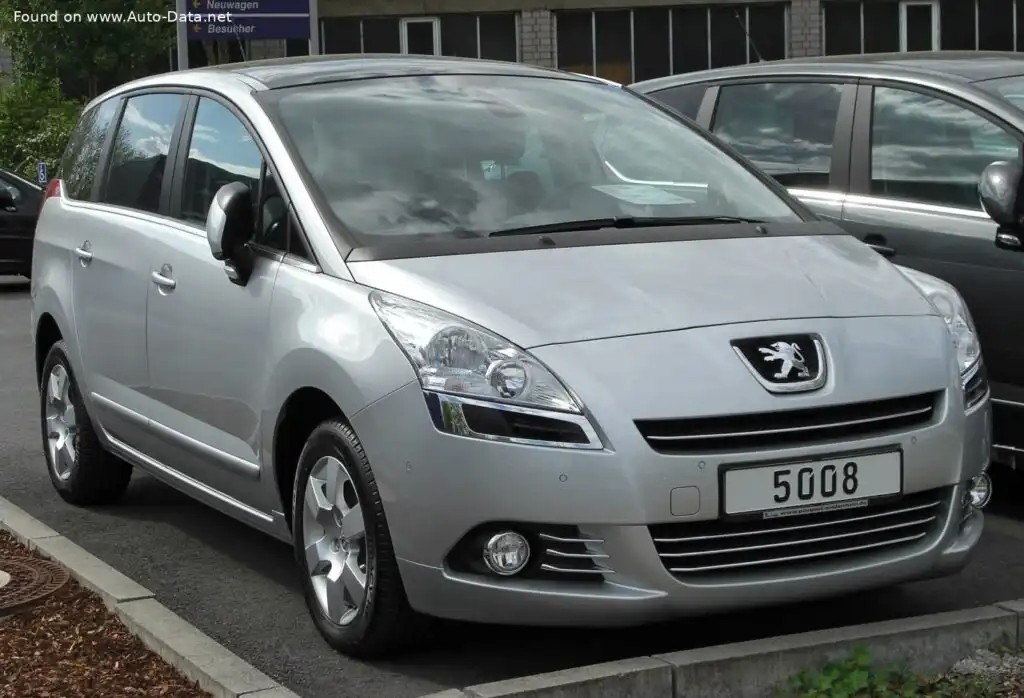
The Peugeot 5008, launched in 2009, represented Peugeot’s entry into the increasingly popular compact Multi-Purpose Vehicle (MPV) segment. The first generation, designated the 5008 I (Phase I), was produced from 2009 to 2013 and offered a practical and versatile option for families. Among the engine options available, the 1.6 VTi producing 120 horsepower with a five-speed manual transmission and seven-seat configuration was a significant offering, positioned as a value-oriented choice within the lineup. This variant aimed to balance affordability with the 5008’s core strengths: spaciousness and practicality.
Technical Specifications
| Brand | Peugeot |
| Model | 5008 |
| Generation | 5008 I (Phase I, 2009) |
| Type (Engine) | 1.6 VTi (120 Hp) 7 seats |
| Start of production | 2009 |
| End of production | 2013 |
| Powertrain Architecture | Internal Combustion engine |
| Body type | MPV |
| Seats | 7 |
| Doors | 5 |
| Fuel consumption (urban) | 9.4 l/100 km (25 US mpg, 30.1 UK mpg, 10.6 km/l) |
| Fuel consumption (extra urban) | 5.5 l/100 km (42.8 US mpg, 51.4 UK mpg, 18.2 km/l) |
| Fuel consumption (combined) | 6.9 l/100 km (34.1 US mpg, 40.9 UK mpg, 14.5 km/l) |
| Fuel Type | Petrol (Gasoline) |
| Acceleration 0 – 100 km/h | 12.3 sec |
| Acceleration 0 – 62 mph | 12.3 sec |
| Acceleration 0 – 60 mph | 11.7 sec |
| Maximum speed | 187 km/h (116.2 mph) |
| Emission standard | Euro 5 |
| Weight-to-power ratio | 11.9 kg/Hp, 83.9 Hp/tonne |
| Weight-to-torque ratio | 8.9 kg/Nm, 111.9 Nm/tonne |
| Power | 120 Hp @ 6000 rpm |
| Power per litre | 75.1 Hp/l |
| Torque | 160 Nm @ 4250 rpm (118.01 lb.-ft. @ 4250 rpm) |
| Engine layout | Front, Transverse |
| Engine Model/Code | 5FW EP6 |
| Engine displacement | 1598 cm3 (97.52 cu. in.) |
| Number of cylinders | 4 |
| Engine configuration | Inline |
| Number of valves per cylinder | 4 |
| Fuel injection system | Multi-port manifold injection |
| Engine aspiration | Naturally aspirated engine |
| Engine oil capacity | 4.25 l (4.49 US qt | 3.74 UK qt) |
| Coolant capacity | 6 l (6.34 US qt | 5.28 UK qt) |
| Kerb Weight | 1430 kg (3152.61 lbs.) |
| Max. weight | 2190 kg (4828.12 lbs.) |
| Max load | 760 kg (1675.51 lbs.) |
| Trunk (boot) space – minimum | 679 l (23.98 cu. ft.) |
| Trunk (boot) space – maximum | 1754 l (61.94 cu. ft.) |
| Fuel tank capacity | 60 l (15.85 US gal | 13.2 UK gal) |
| Length | 4529 mm (178.31 in.) |
| Width | 1888 mm (74.33 in.) |
| Height | 1622 mm (63.86 in.) |
| Wheelbase | 2727 mm (107.36 in.) |
| Minimum turning circle | 11.1 m (36.42 ft.) |
| Drivetrain Architecture | The Internal combustion engine (ICE) drives the front wheels of the vehicle. |
| Drive wheel | Front wheel drive |
| Number of gears | 5 gears, manual transmission |
| Front suspension | Independent type McPherson |
| Rear suspension | Semi-independent, coil spring |
| Front brakes | Ventilated discs |
| Rear brakes | Disc |
| Assisting systems | ABS (Anti-lock braking system) |
| Steering type | Steering rack and pinion |
| Tires size | 215/55 R16; 215/50 R17 |
| Wheel rims size | 16; 17 |
INTRODUCTION
The Peugeot 5008 1.6 VTi 7-seat variant, introduced in 2009, was a key component of Peugeot’s strategy to capture a larger share of the family vehicle market. Built on the EMP2 platform (though early models utilized a modified version of the PF2 platform), the 5008 offered a compelling blend of practicality, comfort, and affordability. The 1.6 VTi engine, part of Peugeot’s Prince engine family, was chosen for its balance of fuel efficiency and adequate performance for everyday driving. This trim level served as an accessible entry point into the 5008 range, appealing to buyers prioritizing space and versatility over outright performance.
Powertrain & Engine Architecture
The heart of this 5008 variant is the 1.6-liter (1598cc) naturally aspirated inline-four cylinder engine, designated the 5FW EP6. This engine belongs to the Prince engine family, co-developed with BMW. It features a multi-point fuel injection system and four valves per cylinder, contributing to its relatively efficient operation. The engine produces 120 horsepower at 6000 rpm and 160 Nm (118 lb-ft) of torque at 4250 rpm. The five-speed manual transmission was the standard offering, providing a straightforward driving experience. The transmission’s gear ratios were tuned for fuel economy and drivability rather than sporty acceleration. The engine’s design prioritized refinement and reduced noise, vibration, and harshness (NVH) levels, making it suitable for long family journeys.
Driving Characteristics
The 1.6 VTi engine, paired with the five-speed manual transmission, delivered adequate, but not exhilarating, performance. Acceleration from 0 to 60 mph took approximately 11.7 seconds, and the top speed was around 116 mph. The engine felt somewhat strained when fully loaded with passengers and luggage, particularly on inclines. The gear ratios were spaced to prioritize fuel efficiency, meaning frequent downshifts were often necessary to maintain momentum. Compared to the more powerful 2.0-liter HDi diesel variants, the 1.6 VTi felt noticeably less responsive. However, the lighter engine weight contributed to slightly more agile handling compared to its diesel counterparts. The steering was light and precise, making it easy to maneuver in urban environments.
Equipment & Trim Levels
The 1.6 VTi 7-seat model typically came equipped with a reasonable level of standard features. These included air conditioning, electric front windows, a CD stereo system, and ABS brakes. Safety features such as front and side airbags were also standard. Higher trim levels, such as the Sport or Allure, added features like alloy wheels, rear parking sensors, automatic headlights and rain-sensing wipers, and a more sophisticated infotainment system. Interior upholstery was typically cloth, with a functional and durable design. Optional extras included a panoramic sunroof, satellite navigation, and leather upholstery.
Chassis & Braking
The 5008’s chassis featured an independent McPherson strut suspension at the front and a semi-independent coil spring suspension at the rear. This setup provided a comfortable ride quality, absorbing bumps and imperfections in the road surface effectively. The front brakes were ventilated discs, while the rear brakes were solid discs. ABS (Anti-lock Braking System) was standard, enhancing braking performance and stability. The suspension was tuned for comfort rather than sporty handling, prioritizing a smooth and controlled ride for passengers. The steering utilized a rack and pinion system, providing precise and responsive steering feel.
Market Reception & Comparison
The Peugeot 5008 1.6 VTi 7-seat variant was generally well-received by critics as a practical and affordable family vehicle. However, some reviewers noted the engine’s lack of outright power, particularly when fully loaded. Fuel economy was considered respectable, averaging around 34.1 US mpg in combined driving conditions. Compared to the diesel variants, the 1.6 VTi offered lower running costs in terms of fuel, but potentially higher maintenance costs due to the complexities of the gasoline engine. The 1.6 VTi appealed to buyers who primarily used their vehicle for short to medium-distance journeys and prioritized affordability over performance.
Legacy
The Peugeot 5008 1.6 VTi, while not the most powerful or dynamic version of the 5008, remains a popular choice in the used car market. The Prince engine family, while known for some timing chain issues in certain applications, has generally proven to be reliable when properly maintained. The 5008’s spacious interior, versatile seating configuration, and comfortable ride continue to appeal to families seeking a practical and affordable MPV. The availability of affordable spare parts and a relatively simple mechanical design contribute to its ongoing appeal as a dependable and cost-effective vehicle.
