
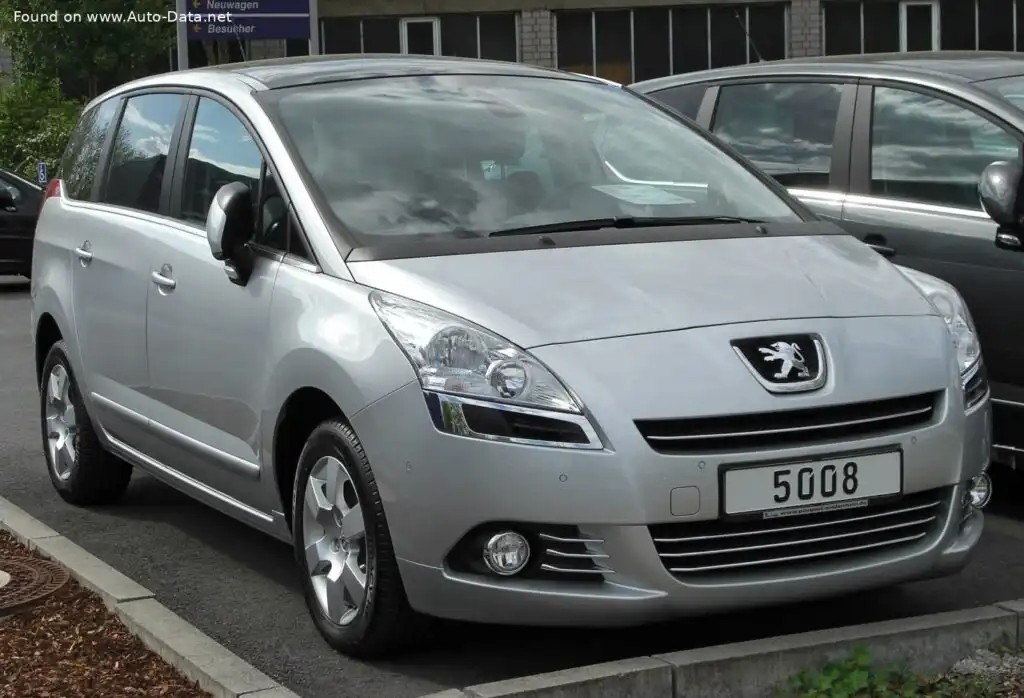
The Peugeot 5008, launched in 2009, represented Peugeot’s entry into the increasingly popular compact Multi-Purpose Vehicle (MPV) segment. The first generation, designated the 5008 I (Phase I), was produced from 2009 to 2013 and offered a practical and versatile option for families. Among the engine options available, the 2.0 HDi 150 horsepower variant with a manual transmission was a popular choice, particularly in European markets. This model aimed to balance fuel efficiency, reasonable performance, and affordability within the 5008 lineup.
Technical Specifications
| Brand | Peugeot |
| Model | 5008 |
| Generation | 5008 I (Phase I, 2009) |
| Type (Engine) | 2.0 HDi (150 Hp) FAP |
| Start of production | 2009 |
| End of production | 2013 |
| Powertrain Architecture | Internal Combustion engine |
| Body type | MPV |
| Seats | 5 |
| Doors | 5 |
| Fuel consumption (urban) | 7.6 l/100 km (30.9 US mpg, 37.2 UK mpg, 13.2 km/l) |
| Fuel consumption (extra urban) | 4.9 l/100 km (48 US mpg, 57.6 UK mpg, 20.4 km/l) |
| Fuel consumption (combined) | 5.9 l/100 km (39.9 US mpg, 47.9 UK mpg, 16.9 km/l) |
| Fuel Type | Diesel |
| Acceleration 0 – 100 km/h | 9.9 sec |
| Acceleration 0 – 62 mph | 9.9 sec |
| Acceleration 0 – 60 mph | 9.4 sec |
| Maximum speed | 195 km/h (121.17 mph) |
| Emission standard | Euro 5 |
| Weight-to-power ratio | 10.4 kg/Hp, 96 Hp/tonne |
| Weight-to-torque ratio | 4.6 kg/Nm, 217.5 Nm/tonne |
| Power | 150 Hp @ 3750 rpm |
| Power per litre | 75.1 Hp/l |
| Torque | 340 Nm @ 2000 rpm (250.77 lb.-ft. @ 2000 rpm) |
| Engine layout | Front, Transverse |
| Engine Model/Code | RHE DW10CTED4 |
| Engine displacement | 1997 cm3 (121.86 cu. in.) |
| Number of cylinders | 4 |
| Engine configuration | Inline |
| Number of valves per cylinder | 4 |
| Fuel injection system | Diesel Commonrail |
| Engine aspiration | Turbocharger, Intercooler |
| Engine oil capacity | 5 l (5.28 US qt | 4.4 UK qt) |
| Coolant capacity | 8.4 l (8.88 US qt | 7.39 UK qt) |
| Kerb Weight | 1563 kg (3445.83 lbs.) |
| Max. weight | 2125 kg (4684.82 lbs.) |
| Max load | 562 kg (1239 lbs.) |
| Trunk (boot) space – minimum | 679 l (23.98 cu. ft.) |
| Trunk (boot) space – maximum | 1754 l (61.94 cu. ft.) |
| Fuel tank capacity | 60 l (15.85 US gal | 13.2 UK gal) |
| Length | 4529 mm (178.31 in.) |
| Width | 1888 mm (74.33 in.) |
| Height | 1647 mm (64.84 in.) |
| Wheelbase | 2727 mm (107.36 in.) |
| Minimum turning circle | 11.9 m (39.04 ft.) |
| Drivetrain Architecture | Front wheel drive |
| Number of gears | 6 gears, manual transmission |
| Front suspension | Independent type McPherson |
| Rear suspension | Semi-independent, coil spring |
| Front brakes | Ventilated discs |
| Rear brakes | Disc |
| Assisting systems | ABS (Anti-lock braking system) |
| Steering type | Steering rack and pinion |
| Tires size | 215/55 R16; 215/50 R17; 215/45 R18 |
| Wheel rims size | 16; 17; 18 |
INTRODUCTION
The Peugeot 5008 I (Phase I) 2.0 HDi 150, produced between 2009 and 2013, was a key variant within the first generation of Peugeot’s popular MPV. Positioned as a mid-range offering, it slotted between the lower-powered 1.6 HDi versions and the more expensive, higher-performance 2.0 HDi 163 hp model. Built on the PSA Group’s EMP2 platform (though often referred to as the 1HX0/A3 platform), the 5008 aimed to provide a spacious and practical vehicle for families, combining the comfort of a passenger car with the versatility of an MPV. It was primarily sold in Europe, where the demand for compact MPVs was strong.
Powertrain & Engine Architecture
The heart of this 5008 variant is the DW10CTED4 engine, a 2.0-liter four-cylinder diesel engine. This engine is a common sight in PSA Group vehicles of the era, known for its robust construction and relatively good fuel economy. The ‘DW10’ designation indicates the engine family, while ‘CTED4’ signifies a common rail direct injection system with four valves per cylinder and a turbocharger with intercooler. The engine utilizes a common rail diesel injection system, delivering fuel at extremely high pressure for improved combustion efficiency and reduced emissions. The turbocharger provides a boost in power, helping to overcome the inherent limitations of a naturally aspirated diesel engine. The engine produces 150 horsepower at 3750 rpm and 340 Nm (250.77 lb.-ft.) of torque at 2000 rpm. This torque output is a key characteristic of diesel engines, providing strong pulling power at lower engine speeds. The engine is paired with a six-speed manual transmission, offering a good balance between fuel efficiency and driver control.
Driving Characteristics
The 2.0 HDi 150 hp version of the 5008 offered a comfortable and capable driving experience. While not particularly sporty, the engine provided sufficient power for everyday driving and long-distance journeys. Acceleration from 0-60 mph took around 9.4 seconds, and the top speed was approximately 121 mph. The six-speed manual transmission allowed drivers to keep the engine in its optimal power band, maximizing fuel efficiency and responsiveness. Compared to the lower-powered 1.6 HDi, the 2.0 HDi offered noticeably more punch, especially when fully loaded with passengers and luggage. However, it didn’t quite match the performance of the 163 hp version. The gear ratios were well-chosen for both urban and highway driving, providing smooth and effortless cruising. The steering was light and precise, making it easy to maneuver in tight spaces.
Equipment & Trim Levels
The 5008 2.0 HDi 150 typically came equipped with a reasonable level of standard features. These included air conditioning, electric front windows, a CD stereo system, and ABS brakes. Higher trim levels, such as the ‘Sport’ or ‘Allure’ variants, added features like alloy wheels, rear parking sensors, cruise control, and a more sophisticated infotainment system. Interior upholstery was typically cloth, with options for leather upgrades on higher trims. The dashboard layout was functional and user-friendly, with clearly labeled controls. Optional extras included a panoramic sunroof, satellite navigation, and a rear entertainment system.
Chassis & Braking
The 5008’s chassis was designed to provide a comfortable ride and stable handling. The front suspension utilized independent McPherson struts, while the rear suspension employed a semi-independent coil spring setup. This configuration offered a good balance between ride comfort and handling precision. The brakes consisted of ventilated discs on the front wheels and solid discs on the rear. ABS (Anti-lock Braking System) was standard, providing enhanced braking performance and stability in emergency situations. The steering was a rack and pinion system, offering precise and responsive steering feel.
Market Reception & Comparison
The Peugeot 5008 2.0 HDi 150 was generally well-received by automotive critics. It was praised for its spacious interior, comfortable ride, and fuel efficiency. The 2.0 HDi engine was considered a good compromise between performance and economy. Compared to the 1.6 HDi, the 2.0 HDi offered a noticeable improvement in performance, making it a more suitable choice for those who frequently carried passengers or luggage. However, the 1.6 HDi was more affordable and offered even better fuel economy. The 2.0 HDi 163 hp version provided even more power, but at a higher price point. Fuel economy figures were typically around 39.9 US mpg on the combined cycle, making it a relatively economical vehicle to run.
Legacy
The Peugeot 5008 I (Phase I) 2.0 HDi 150 has proven to be a reliable and durable vehicle. The DW10CTED4 engine is known for its longevity, and with regular maintenance, it can cover high mileages without major issues. However, like all diesel engines, it is susceptible to issues with the diesel particulate filter (DPF) if not driven on longer journeys regularly. In the used car market, these 5008s remain a popular choice for families seeking a practical and affordable MPV. They offer a good balance of space, comfort, and fuel efficiency, making them a sensible option for those who need a versatile vehicle.
