
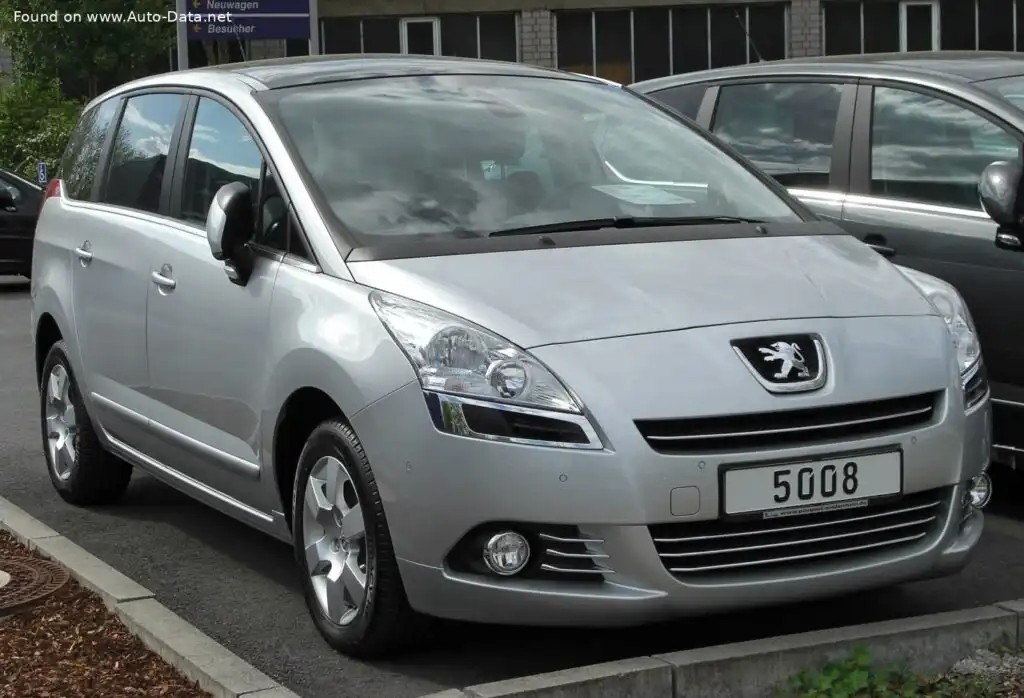
The Peugeot 5008, launched in 2009, represented Peugeot’s entry into the increasingly popular compact Multi-Purpose Vehicle (MPV) segment. The first generation, designated the 5008 I (Phase I), was produced from 2009 to 2013 and offered a versatile package appealing to families. Among the engine options available, the 2.0 HDI (163 horsepower) with a six-speed automatic transmission and seven-seat configuration was a significant offering, particularly in European markets. This variant aimed to balance fuel efficiency, practicality, and a more relaxed driving experience compared to its manual transmission counterparts.
Technical Specifications
| Brand | Peugeot |
| Model | 5008 |
| Generation | 5008 I (Phase I, 2009) |
| Type (Engine) | 2.0 HDI (163 Hp) FAP Automatic 7 seats |
| Start of production | 2009 |
| End of production | 2013 |
| Powertrain Architecture | Internal Combustion engine |
| Body type | MPV |
| Seats | 7 |
| Doors | 5 |
| Fuel consumption (urban) | 8.8 l/100 km (26.7 US mpg, 32.1 UK mpg, 11.4 km/l) |
| Fuel consumption (extra urban) | 5.7 l/100 km (41.3 US mpg, 49.6 UK mpg, 17.5 km/l) |
| Fuel consumption (combined) | 6.8 l/100 km (34.6 US mpg, 41.5 UK mpg, 14.7 km/l) |
| Fuel Type | Diesel |
| Acceleration 0 – 100 km/h | 10.5 sec |
| Acceleration 0 – 62 mph | 10.5 sec |
| Acceleration 0 – 60 mph | 10 sec |
| Maximum speed | 190 km/h (118.06 mph) |
| Emission standard | Euro 5 |
| Weight-to-power ratio | 9.9 kg/Hp, 100.7 Hp/tonne |
| Weight-to-torque ratio | 4.8 kg/Nm, 210 Nm/tonne |
| Power | 163 Hp @ 3750 rpm |
| Power per litre | 81.6 Hp/l |
| Torque | 340 Nm @ 2000 rpm (250.77 lb.-ft. @ 2000 rpm) |
| Engine layout | Front, Transverse |
| Engine Model/Code | RHH DW10CTED4 |
| Engine displacement | 1997 cm3 (121.86 cu. in.) |
| Number of cylinders | 4 |
| Engine configuration | Inline |
| Number of valves per cylinder | 4 |
| Fuel injection system | Diesel Commonrail |
| Engine aspiration | Turbocharger, Intercooler |
| Engine oil capacity | 5 l (5.28 US qt | 4.4 UK qt) |
| Coolant capacity | 8.6 l (9.09 US qt | 7.57 UK qt) |
| Kerb Weight | 1619 kg (3569.28 lbs.) |
| Max. weight | 2330 kg (5136.77 lbs.) |
| Max load | 711 kg (1567.49 lbs.) |
| Trunk (boot) space – minimum | 679 l (23.98 cu. ft.) |
| Trunk (boot) space – maximum | 1754 l (61.94 cu. ft.) |
| Fuel tank capacity | 60 l (15.85 US gal | 13.2 UK gal) |
| Length | 4529 mm (178.31 in.) |
| Width | 1888 mm (74.33 in.) |
| Height | 1622 mm (63.86 in.) |
| Wheelbase | 2727 mm (107.36 in.) |
| Minimum turning circle | 11.9 m (39.04 ft.) |
| Drivetrain Architecture | Front wheel drive |
| Number of gears | 6 |
| Gearbox type | Automatic transmission |
| Front suspension | Independent type McPherson |
| Rear suspension | Semi-independent, coil spring |
| Front brakes | Ventilated discs |
| Rear brakes | Disc |
| Assisting systems | ABS (Anti-lock braking system) |
| Steering type | Steering rack and pinion |
| Tires size | 215/55 R16; 215/50 R17; 215/45 R18 |
| Wheel rims size | 16; 17; 18 |
Powertrain & Engine Architecture
The heart of this 5008 variant is the DW10CTED4 engine, a 2.0-liter four-cylinder diesel engine. This engine, commonly found in various PSA Group (Peugeot-Citroën) vehicles, utilizes a common rail direct injection system, delivering fuel at extremely high pressure for optimized combustion. The RHH engine code specifically denotes a version equipped with a Diesel Particulate Filter (DPF), or FAP in Peugeot terminology, to meet stringent Euro 5 emission standards. A turbocharger with an intercooler further enhances performance by forcing more air into the cylinders. The engine produces 163 horsepower at 3750 rpm and a substantial 340 Nm (250.77 lb-ft) of torque at 2000 rpm. This torque output is a key characteristic of modern diesel engines, providing strong pulling power at lower engine speeds. The engine is transversely mounted in the front of the vehicle. The six-speed automatic transmission, while offering convenience, was a conventional torque converter type, not a dual-clutch system, and was chosen for its smoothness and reliability.
Driving Characteristics
The 2.0 HDI automatic 5008 offered a comfortable and relaxed driving experience. While not particularly sporty, the engine’s torque allowed for effortless cruising and confident overtaking. The automatic transmission, while smooth, wasn’t known for its rapid shifts. Compared to the six-speed manual version of the same engine, acceleration was slightly slower, with a 0-62 mph time of 10.5 seconds. The automatic transmission’s gear ratios were tuned for fuel efficiency and smooth operation rather than outright performance. The 5008’s weight, around 3569 lbs, did impact acceleration, but the engine’s torque helped mitigate this. The focus was on providing a practical and easy-to-drive MPV, and this powertrain configuration delivered on that promise.
Equipment & Trim Levels
The 2.0 HDI automatic 7-seat 5008 typically came with a reasonable level of standard equipment. This included air conditioning, electric front and rear windows, a CD stereo with steering wheel-mounted controls, and ABS brakes. Higher trim levels, such as Sport or Allure, added features like alloy wheels, rear parking sensors, automatic headlights and wipers, and a more sophisticated infotainment system. Interior upholstery was typically cloth, with options for leather upgrades. A panoramic sunroof was also available as an option, enhancing the spacious feel of the cabin. The seven-seat configuration offered flexibility, with the rear seats folding flat to maximize cargo space.
Chassis & Braking
The 5008 utilized a McPherson strut front suspension and a semi-independent coil spring rear suspension. This setup provided a comfortable ride, although it wasn’t particularly sporty. Front brakes were ventilated discs, while rear brakes were solid discs. ABS (Anti-lock Braking System) was standard, providing enhanced braking performance and stability. Steering was via a rack and pinion system, offering reasonable precision. Tire sizes varied depending on the trim level, ranging from 215/55 R16 to 215/45 R18.
Market Reception & Comparison
The Peugeot 5008 2.0 HDI automatic was generally well-received by critics as a practical and comfortable family vehicle. The automatic transmission was praised for its smoothness, making it a popular choice for drivers who preferred convenience over sporty driving dynamics. Fuel economy was a strong point, with combined figures around 34.6 US mpg. Compared to the 1.6 HDI versions, the 2.0 HDI offered significantly more power and torque, making it better suited for carrying a full load of passengers and luggage. However, it was also more expensive to purchase and potentially maintain. The 2.0 HDI automatic was positioned as a mid-range option within the 5008 lineup, offering a good balance of features and performance.
Legacy
The DW10CTED4 engine, in general, has proven to be a relatively reliable unit, although the DPF (Diesel Particulate Filter) can be a potential source of issues if not properly maintained. Regular servicing and the use of high-quality diesel fuel are crucial for ensuring the longevity of the engine and the DPF. The six-speed automatic transmission is also generally reliable, but like any automatic transmission, it requires regular fluid changes. Today, used examples of the 5008 2.0 HDI automatic are readily available and represent a relatively affordable option for families seeking a spacious and practical MPV. However, potential buyers should carefully inspect the vehicle’s service history and be aware of the potential costs associated with maintaining a diesel vehicle with a DPF.
