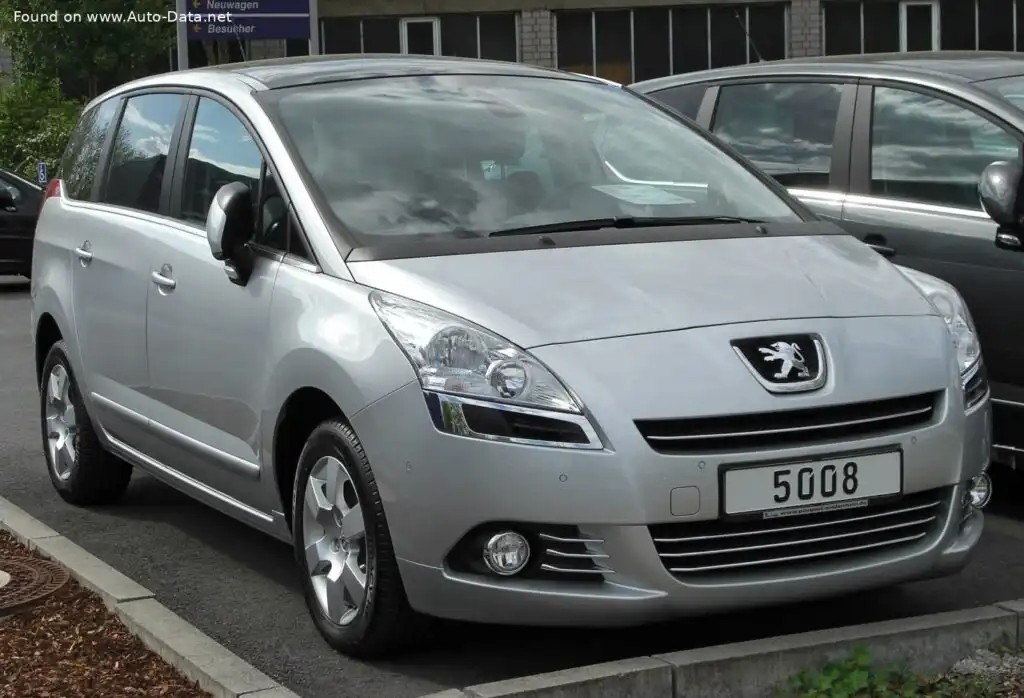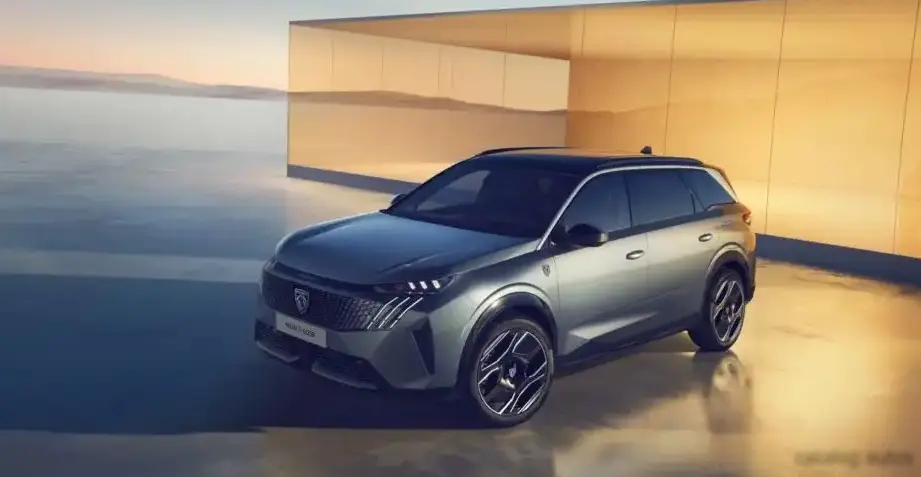
The Peugeot 5008 III, launched in March 2024, represents the third generation of Peugeot’s mid-size SUV. This iteration, designated as Phase I, marked a significant departure from its predecessors, adopting a more modern and streamlined design. Within the 5008 III range, the 1.2 PureTech 136 hp Mild Hybrid e-DCS variant occupied a key position as an entry-to-mid-range offering, balancing fuel efficiency with practicality for family use. Production of this specific configuration ran from March 2024 to March 2025. The 5008 III is built on the EMP2 platform, shared with other Stellantis vehicles like the Opel Grandland and Citroën C5 Aircross, and is primarily aimed at the European market, offering a seven-seat configuration as standard.
Technical Specifications
| Brand | Peugeot |
| Model | 5008 |
| Generation | 5008 III (Phase I, 2024) |
| Type (Engine) | 1.2 (136 Hp) Mild Hybrid e-DCS |
| Start of production | March, 2024 |
| End of production | March, 2025 |
| Powertrain Architecture | MHEV (Mild Hybrid Electric Vehicle) |
| Body type | SUV |
| Seats | 7 |
| Doors | 5 |
| Combined fuel consumption (WLTP) | 5.8 l/100 km (40.6 US mpg, 48.7 UK mpg, 17.2 km/l) |
| CO2 emissions (WLTP) | 131 g/km |
| Fuel Type | Petrol (Gasoline) |
| Acceleration 0 – 100 km/h | 11.3 sec |
| Acceleration 0 – 62 mph | 11.3 sec |
| Acceleration 0 – 60 mph | 10.7 sec |
| Maximum speed | 200 km/h (124.27 mph) |
| Weight-to-power ratio | 12.5 kg/Hp, 79.8 Hp/tonne |
| Weight-to-torque ratio | 7.4 kg/Nm, 134.9 Nm/tonne |
| Net (usable) battery capacity | 0.43 kWh |
| Battery voltage | 48 V |
| Battery technology | Lithium nickel manganese cobalt oxides (Li-NMC) |
| Battery weight | 12 kg (26.46 lbs) |
| Battery location | Below the floor, under the front seats |
| Power | 136 Hp @ 5500 rpm |
| Power per litre | 113.4 Hp/l |
| Torque | 230 Nm @ 1750 rpm (169.64 lb.-ft. @ 1750 rpm) |
| Engine layout | Front, Transverse |
| Engine displacement | 1199 cm3 (73.17 cu. in.) |
| Number of cylinders | 3 |
| Engine configuration | Inline |
| Number of valves per cylinder | 4 |
| Fuel injection system | Direct injection |
| Engine aspiration | Turbocharger, Intercooler |
| Engine oil capacity | 3.5 l (3.7 US qt | 3.08 UK qt) |
| Kerb Weight | 1705 kg (3758.88 lbs) |
| Max. weight | 2350 kg (5180.86 lbs) |
| Max load | 645 kg (1421.98 lbs) |
| Trunk (boot) space – minimum | 259 l (9.15 cu. ft.) |
| Trunk (boot) space – maximum | 1815 l (64.1 cu. ft.) |
| Permitted trailer load with brakes (12%) | 1000 kg (2204.62 lbs) |
| Length | 4791 mm (188.62 in) |
| Width | 1895 mm (74.61 in) |
| Height | 1694 mm (66.69 in) |
| Wheelbase | 2901 mm (114.21 in) |
| Front track | 1630 mm (64.17 in) |
| Rear (Back) track | 1636 mm (64.41 in) |
| Front overhang | 940 mm (37.01 in) |
| Rear overhang | 950 mm (37.4 in) |
| Ride height (ground clearance) | 194 mm (7.64 in) |
| Minimum turning circle | 11.2 m (36.75 ft) |
| Drivetrain Architecture | Front wheel drive, MHEV |
| Number of gears and type of gearbox | 6 gears, automatic transmission e-DCS |
| Front suspension | Independent type McPherson |
| Rear suspension | Torsion |
| Front brakes | Ventilated discs, 330×30 mm |
| Rear brakes | Ventilated discs, 330×14 mm |
| Tires size | 225/55 R19 |
| Wheel rims size | 19 |
INTRODUCTION
The Peugeot 5008 III 1.2 PureTech 136 hp Mild Hybrid e-DCS, introduced in 2024, represents a significant step towards electrification for Peugeot’s popular SUV. This variant utilizes a 48-volt mild hybrid system to enhance fuel economy and reduce emissions while maintaining a reasonable level of performance. Positioned as a mid-range option, it caters to families seeking a spacious and practical vehicle with lower running costs. The ‘e-DCS’ transmission is a dual-clutch automated manual gearbox, offering a balance between efficiency and driving convenience. This model builds upon the success of the second-generation 5008, retaining its seven-seat capability and focusing on improved technology and comfort.
Powertrain & Engine Architecture
At the heart of the 5008 III 1.2 PureTech MHEV lies the EP1.2FBN engine, a 1.2-liter turbocharged three-cylinder petrol engine. This engine, part of Peugeot’s PureTech family, is known for its compact size and efficiency. It produces 136 horsepower at 5500 rpm and 230 Nm (169.64 lb-ft) of torque at 1750 rpm. The engine features direct fuel injection and a turbocharger with an intercooler to optimize performance. The mild hybrid system consists of a 48V electric motor and a small battery (0.43 kWh Li-NMC) that provides assistance during acceleration and allows for regenerative braking. The e-DCS (Efficient Dual Clutch System) 6-speed automatic transmission is a key component, offering smooth gear changes and contributing to the vehicle’s fuel efficiency. Unlike a full hybrid, the electric motor cannot power the vehicle on its own; it primarily assists the petrol engine to reduce load and improve responsiveness.
Driving Characteristics
The 1.2 PureTech 136 hp MHEV variant of the 5008 offers a comfortable and refined driving experience, prioritizing fuel economy over outright performance. Acceleration from 0-100 km/h (0-62 mph) takes approximately 11.3 seconds. While not particularly sporty, the engine provides adequate power for everyday driving situations, including highway cruising and overtaking. The e-DCS transmission contributes to smooth gear changes, although some drivers may notice slight hesitation at lower speeds. The mild hybrid system provides a subtle boost during acceleration, improving responsiveness. Compared to higher-powered versions of the 5008, such as those with larger engines, this variant feels less energetic, but it compensates with significantly improved fuel economy. The gear ratios are tuned for efficiency, prioritizing higher gears at cruising speeds.
Equipment & Trim Levels
The 5008 III 1.2 PureTech 136 hp MHEV typically comes equipped with a generous level of standard features. These include a touchscreen infotainment system with Apple CarPlay and Android Auto compatibility, a digital instrument cluster, automatic climate control, and a suite of safety features such as automatic emergency braking, lane departure warning, and traffic sign recognition. Interior upholstery is typically cloth, with options for leather upgrades. Higher trim levels offer additional features such as a panoramic sunroof, adaptive cruise control, and a premium sound system. The seven-seat configuration is standard, providing flexibility for families. Optional extras include metallic paint, parking sensors, and a 360-degree camera system.
Chassis & Braking
The 5008 III utilizes a McPherson strut front suspension and a torsion beam rear suspension. This setup provides a good balance between ride comfort and handling. The front brakes are ventilated discs measuring 330×30 mm, while the rear brakes are also ventilated discs at 330×14 mm. The steering is electric power-assisted, providing a light and responsive feel. The vehicle’s weight (1705 kg / 3758.88 lbs) is relatively high for a 1.2-liter engine, which impacts performance but also contributes to stability. ABS (Anti-lock Braking System) is standard, along with electronic stability control.
Market Reception & Comparison
The Peugeot 5008 III 1.2 PureTech MHEV has been generally well-received by critics, praised for its fuel efficiency, spacious interior, and comfortable ride. However, some reviewers have noted that the engine can feel underpowered when fully loaded or driving uphill. Compared to the diesel variants of the 5008, the 1.2 PureTech offers lower emissions but slightly less torque. Against competitors like the Volkswagen Tiguan and Hyundai Tucson, the 5008 stands out with its distinctive styling and seven-seat capability. Fuel economy figures of around 5.8 l/100 km (40.6 US mpg) are competitive within its class.
Legacy
The EP1.2FBN engine, used in the 5008 III 1.2 PureTech MHEV, has proven to be a reliable unit, although early versions of the PureTech engine experienced some issues with timing chain wear. Peugeot has addressed these concerns with updated engine designs. The e-DCS transmission has also demonstrated good reliability. In the used car market, the 5008 III 1.2 PureTech MHEV is likely to hold its value reasonably well, particularly due to its fuel efficiency and practicality. The mild hybrid technology represents a step towards a more sustainable future for Peugeot, and this variant will likely be seen as a transitional model in the company’s electrification strategy.