Technical Specifications
| Brand | Peugeot |
| Model | 508 |
| Generation | 508 I RXH (Phase I, 2011) |
| Type (Engine) | 2.0 HDi (200 Hp) Hybrid4 4×4 EGS6 |
| Start of production | 2011 |
| End of production | 2014 |
| Powertrain Architecture | FHEV (Full Hybrid Electric Vehicle) |
| Body type | Crossover |
| Seats | 5 |
| Doors | 5 |
| Fuel consumption (urban) | 3.8 l/100 km (61.9 US mpg, 74.3 UK mpg, 26.3 km/l) |
| Fuel consumption (extra urban) | 4.1 l/100 km (57.4 US mpg, 68.9 UK mpg, 24.4 km/l) |
| Fuel consumption (combined) | 4 l/100 km (58.8 US mpg, 70.6 UK mpg, 25 km/l) |
| CO2 emissions | 104 g/km |
| Fuel Type | Diesel |
| Acceleration 0 – 100 km/h | 8.8 sec |
| Acceleration 0 – 62 mph | 8.8 sec |
| Acceleration 0 – 60 mph | 8.4 sec |
| Maximum speed | 213 km/h (132.35 mph) |
| Emission standard | Euro 5 |
| Weight-to-power ratio | 8.9 kg/Hp, 113 Hp/tonne |
| Weight-to-torque ratio | 5.9 kg/Nm, 169.5 Nm/tonne |
| Battery technology | Nickel-metal hydride (NiMH) |
| All-electric range | 5 km (3.11 mi) |
| Max speed (electric) | 50 km/h (31.07 mph) |
| Electric motor power | 37 Hp @ 2500 rpm |
| Electric motor Torque | 200 Nm @ 1290 rpm (147.51 lb.-ft. @ 1290 rpm) |
| Electric motor location | Rear, Transverse |
| System power | 200 Hp |
| Internal combustion engine power | 163 Hp @ 3850 rpm |
| Power per litre | 81.6 Hp/l |
| Torque | 300 Nm @ 1750 rpm (221.27 lb.-ft. @ 1750 rpm) |
| Engine layout | Front, Transverse |
| Engine Model/Code | DW10CTED4 |
| Engine displacement | 1997 cm3 (121.86 cu. in.) |
| Number of cylinders | 4 |
| Engine configuration | Inline |
| Cylinder Bore | 85 mm (3.35 in.) |
| Piston Stroke | 88 mm (3.46 in.) |
| Number of valves per cylinder | 4 |
| Fuel injection system | Diesel Commonrail |
| Engine aspiration | Turbocharger, Intercooler |
| Valvetrain | DOHC |
| Engine oil capacity | 5.5 l (5.81 US qt | 4.84 UK qt) |
| Coolant capacity | 10 l (10.57 US qt | 8.8 UK qt) |
| Kerb Weight | 1770 kg (3902.18 lbs.) |
| Max. weight | 2325 kg (5125.75 lbs.) |
| Max load | 555 kg (1223.57 lbs.) |
| Trunk (boot) space – minimum | 400 l (14.13 cu. ft.) |
| Trunk (boot) space – maximum | 973 l (34.36 cu. ft.) |
| Fuel tank capacity | 70 l (18.49 US gal | 15.4 UK gal) |
| Max. roof load | 75 kg (165.35 lbs.) |
| Permitted trailer load with brakes (12%) | 1100 kg (2425.08 lbs.) |
| Permitted trailer load without brakes | 750 kg (1653.47 lbs.) |
| Permitted towbar download | 75 kg (165.35 lbs.) |
| Length | 4823 mm (189.88 in.) |
| Width | 1864 mm (73.39 in.) |
| Width with mirrors folded | 1920 mm (75.59 in.) |
| Width including mirrors | 2068 mm (81.42 in.) |
| Height | 1521 mm (59.88 in.) |
| Wheelbase | 2815 mm (110.83 in.) |
| Front track | 1592 mm (62.68 in.) |
| Rear track | 1564 mm (61.57 in.) |
| Front overhang | 987 mm (38.86 in.) |
| Rear overhang | 1021 mm (40.2 in.) |
| Ride height (ground clearance) | 184 mm (7.24 in.) |
| Minimum turning circle | 11.8 m (38.71 ft.) |
| Approach angle | 15.6° |
| Departure angle | 19.8° |
| Drivetrain Architecture | The Internal combustion engine (ICE) permanently drives the front wheels of the vehicle, the electric motor drives the rear wheels of the vehicle, capable of running in full electric mode, only by the Internal combustion engine (ICE) or in mixed mode. |
| Drive wheel | All wheel drive (4×4) |
| Number of gears | 6 |
| Gearbox type | automatic transmission EGS |
| Front suspension | Independent type McPherson |
| Rear suspension | Independent multi-link suspension |
| Front brakes | Ventilated discs |
| Rear brakes | Disc |
| Assisting systems | ABS (Anti-lock braking system) |
| Steering type | Steering rack and pinion |
| Power steering | Electric Steering |
| Tires size | 245/45 R18; 225/55 R17 |
| Wheel rims size | 8J x 18; 7.5J x 17 |
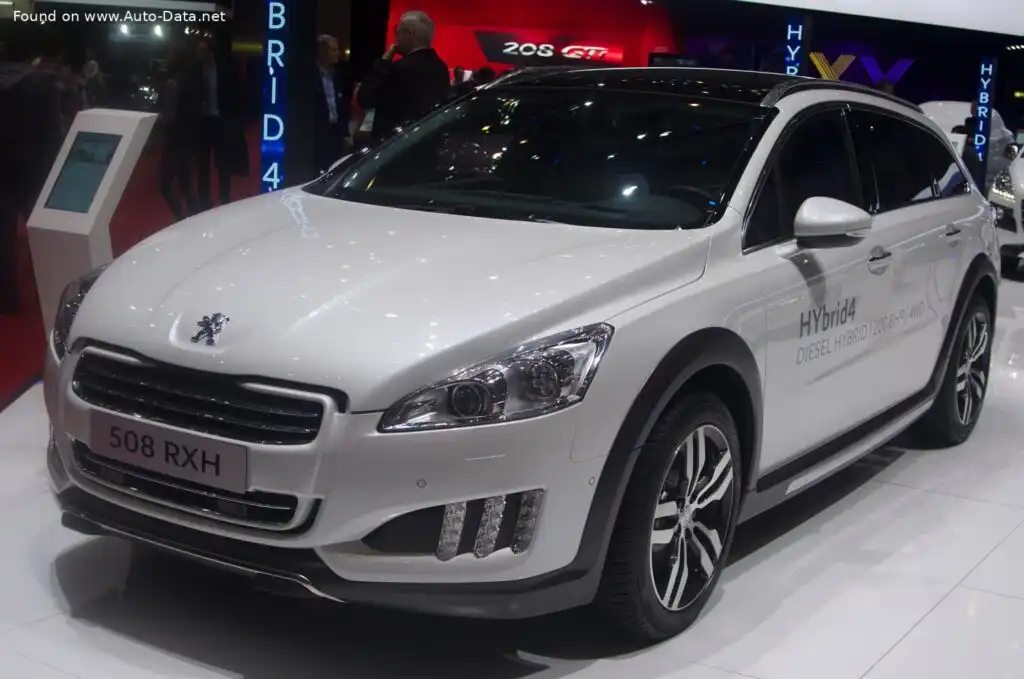
The Peugeot 508 RXH, launched in 2011 as part of the first generation (T8) 508 range, represented Peugeot’s foray into the premium crossover segment with a focus on hybrid technology. Specifically, the 2.0 HDi Hybrid4 4×4 EGS6 variant, produced from 2011 to 2014, combined a diesel engine with an electric motor to deliver all-wheel drive capability and improved fuel efficiency. Positioned as a more rugged and technologically advanced alternative to the standard 508 saloon and SW (estate), the RXH aimed to appeal to buyers seeking a distinctive and environmentally conscious vehicle.
Powertrain & Engine Architecture
At the heart of the 508 RXH was Peugeot’s DW10CTED4 2.0-liter four-cylinder diesel engine. This engine produced 163 horsepower at 3850 rpm and 300 Nm (221 lb-ft) of torque at 1750 rpm. It featured a turbocharger with an intercooler and a diesel common rail fuel injection system. Crucially, this engine was paired with a 37 horsepower electric motor located on the rear axle. This configuration allowed for all-wheel drive, with the diesel engine powering the front wheels and the electric motor driving the rear wheels. The electric motor also provided 200 Nm (147 lb-ft) of torque, available from just 1290 rpm. The combined system output was 200 horsepower. The transmission was a six-speed automatic gearbox designated EGS (Electronically Governed Sequential). This wasn’t a traditional torque converter automatic, but rather an automated manual transmission, offering quicker shifts but sometimes exhibiting less smoothness than a conventional automatic. The hybrid system utilized a Nickel-metal hydride (NiMH) battery pack, providing an all-electric range of approximately 5 kilometers (3.1 miles).
Driving Characteristics
The 508 RXH 2.0 HDi Automatic offered a unique driving experience. In standard driving conditions, the vehicle operated primarily on the diesel engine, with the electric motor assisting during acceleration or when extra power was needed. The EGS6 transmission, while efficient, could feel somewhat jerky at low speeds compared to a traditional automatic. The all-wheel drive system provided enhanced traction, particularly in adverse weather conditions. The electric motor’s instant torque contributed to brisk acceleration, with a 0-60 mph time of around 8.4 seconds. The hybrid system allowed for a limited all-electric driving range, suitable for short urban commutes. Compared to the standard 508 2.0 HDi with a manual transmission, the RXH offered improved acceleration and all-weather capability, but at the cost of increased weight and complexity. Higher-output petrol versions of the 508 offered more outright performance, but lacked the RXH’s fuel efficiency and hybrid technology.
Equipment & Trim Levels
The RXH trim level was generally well-equipped, reflecting its positioning as a premium offering. Standard features typically included alloy wheels, automatic climate control, a touchscreen infotainment system, and parking sensors. Interior upholstery was usually a combination of cloth and leather. Optional extras included a panoramic sunroof, navigation system, and upgraded audio system. The dashboard design was similar to other 508 models, but with unique trim elements to differentiate the RXH. The interior focused on providing a comfortable and modern environment, with a focus on practicality and usability.
Chassis & Braking
The 508 RXH featured an independent suspension system, with McPherson struts at the front and a multi-link setup at the rear. This provided a comfortable ride quality and good handling characteristics. The RXH’s increased weight compared to standard 508 models necessitated a more robust braking system. The front brakes were ventilated discs, while the rear brakes were solid discs. Anti-lock braking system (ABS) was standard. Stabilizer bars were fitted to both the front and rear axles to reduce body roll during cornering.
Market Reception & Comparison
The Peugeot 508 RXH received mixed reviews from automotive critics. It was praised for its innovative hybrid technology, all-wheel drive capability, and distinctive styling. However, the EGS6 transmission was often criticized for its lack of smoothness. Fuel economy was generally considered good, particularly for a vehicle of its size and weight. Compared to other hybrid and diesel options in the European market, the RXH offered a unique combination of performance, efficiency, and practicality. The RXH was generally more expensive than the standard 508 models, reflecting its advanced technology and premium features. Competitors included vehicles like the Volvo XC60 and Audi Q5, which offered similar levels of luxury and performance.
Legacy
The Peugeot 508 RXH, while not a massive sales success, represented an important step in Peugeot’s development of hybrid technology. The DW10CTED4 engine proved to be relatively reliable, although the hybrid system components could require more specialized maintenance. Today, used examples of the 508 RXH are relatively rare, and values vary depending on condition and mileage. The vehicle remains a unique and interesting option for buyers seeking a distinctive and environmentally conscious crossover. The powertrain, while complex, has proven reasonably durable with proper maintenance, and the RXH continues to offer a compelling blend of performance, efficiency, and all-weather capability.