
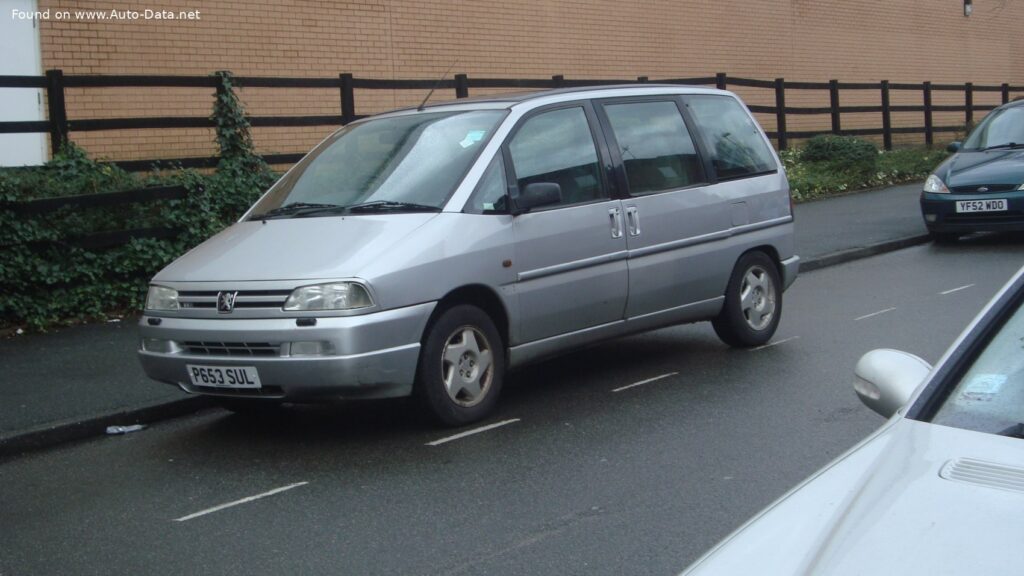
The Peugeot 806 is a large multi-purpose vehicle (MPV) produced by the French manufacturer Peugeot between 1994 and 2002. Representing Peugeot’s entry into the rapidly growing MPV segment of the 1990s, the 806 was designed to compete with vehicles like the Renault Espace, Citroën Evasion (which shared much of its engineering), and the Volkswagen Sharan. The 806 (221) 2.0 16V Automatic, produced from 1998 to 2000, represents a mid-cycle refinement of the original model, offering a balance of practicality, comfort, and a relatively efficient powertrain for its size. While never officially sold in the United States, the 806 was a popular choice for families in Europe seeking a spacious and versatile vehicle.
Peugeot 806 (221) 2.0 16V: An Overview
The 806 (221) designation refers to a specific iteration of the model, incorporating updates to the engine and trim levels. The 2.0 16V engine, coupled with an automatic transmission, was a common configuration, aimed at providing a comfortable driving experience for long journeys and family transport. The vehicle’s core appeal lay in its modular interior, offering flexible seating arrangements and a substantial cargo capacity. The 806 was notable for its time for offering a relatively high level of standard equipment, including features like power steering, ABS brakes, and multiple airbags, contributing to its appeal as a safe and practical family vehicle.
Engine & Performance
The Peugeot 806 (221) 2.0 16V Automatic is powered by a 1,997 cc (121.86 cubic inches) inline-four cylinder gasoline engine. This engine, identified by the code RFN EW10J4, produces 136 horsepower (Hp) at 6,000 rpm and 190 Newton-meters (140.14 lb.-ft.) of torque at 4,100 rpm. The engine features multi-port fuel injection and a naturally aspirated design. Power is delivered to the front wheels via a four-speed automatic transmission. Performance figures include a 0-100 km/h (0-62 mph) acceleration time of 11.9 seconds and a top speed of 186 km/h (115.58 mph). The weight-to-power ratio is 11.8 kg/Hp, and the weight-to-torque ratio is 8.4 kg/Nm. Fuel consumption is rated at 9.2 liters per 100 kilometers (25.6 US mpg), offering reasonable efficiency for a vehicle of its size and class.
Design & Features
The Peugeot 806 is a five-door minivan with a spacious interior designed to accommodate up to five passengers. Its body style prioritizes practicality and versatility. A key feature of the 806 is its modular seating arrangement, allowing for various configurations to maximize passenger space or cargo capacity. The rear seats can be folded, tumbled, or even removed entirely, providing a flexible interior layout. The trunk offers a minimum capacity of 340 liters (12.01 cubic feet), expanding to a substantial 3,300 liters (116.54 cubic feet) with the rear seats folded. The vehicle’s design, while functional, reflects the styling trends of the mid-1990s, with a relatively boxy silhouette and a focus on maximizing interior space. Safety features included ABS (Anti-lock Braking System) and multiple airbags, representing a significant step forward in safety standards for family vehicles of the era. The 806 also features hydraulic power steering for ease of maneuverability.
Technical Specifications
| Brand | Peugeot |
| Model | 806 |
| Generation | 806 (221) |
| Type (Engine) | 2.0 16V (136 Hp) Automatic |
| Start of production | 1998 |
| End of production | 2000 |
| Powertrain Architecture | Internal Combustion engine |
| Body type | Minivan |
| Seats | 5 |
| Doors | 5 |
| Fuel consumption (combined) | 9.2 l/100 km |
| Fuel consumption (US mpg) | 25.6 US mpg |
| Fuel consumption (UK mpg) | 30.7 UK mpg |
| Fuel consumption (km/l) | 10.9 km/l |
| Fuel Type | Petrol (Gasoline) |
| Acceleration 0 – 100 km/h | 11.9 sec |
| Acceleration 0 – 62 mph | 11.9 sec |
| Acceleration 0 – 60 mph | 11.3 sec |
| Maximum speed | 186 km/h |
| Maximum speed (mph) | 115.58 mph |
| Weight-to-power ratio | 11.8 kg/Hp |
| Weight-to-torque ratio | 8.4 kg/Nm |
| Power | 136 Hp @ 6000 rpm |
| Power per litre | 68.1 Hp/l |
| Torque | 190 Nm @ 4100 rpm |
| Torque (lb.-ft.) | 140.14 lb.-ft. @ 4100 rpm |
| Engine layout | Front, Transverse |
| Engine Model/Code | RFN EW10J4 |
| Engine displacement | 1997 cm3 |
| Engine displacement (cu. in.) | 121.86 cu. in. |
| Number of cylinders | 4 |
| Engine configuration | Inline |
| Cylinder Bore | 85 mm |
| Cylinder Bore (in.) | 3.35 in. |
| Piston Stroke | 88 mm |
| Piston Stroke (in.) | 3.46 in. |
| Compression ratio | 10.8:1 |
| Number of valves per cylinder | 4 |
| Fuel injection system | Multi-port manifold injection |
| Engine aspiration | Naturally aspirated engine |
| Engine oil capacity | 4.25 l |
| Engine oil capacity (US qt) | 4.49 US qt |
| Engine oil capacity (UK qt) | 3.74 UK qt |
| Kerb Weight | 1600 kg |
| Kerb Weight (lbs) | 3527.4 lbs |
| Max. weight | 2315 kg |
| Max. weight (lbs) | 5103.7 lbs |
| Max load | 715 kg |
| Max load (lbs) | 1576.31 lbs |
| Trunk (boot) space – minimum | 340 l |
| Trunk (boot) space – minimum (cu. ft.) | 12.01 cu. ft. |
| Trunk (boot) space – maximum | 3300 l |
| Trunk (boot) space – maximum (cu. ft.) | 116.54 cu. ft. |
| Fuel tank capacity | 80 l |
| Fuel tank capacity (US gal) | 21.13 US gal |
| Fuel tank capacity (UK gal) | 17.6 UK gal |
| Length | 4454 mm |
| Length (in.) | 175.35 in. |
| Width | 1834 mm |
| Width (in.) | 72.2 in. |
| Height | 1714 mm |
| Height (in.) | 67.48 in. |
| Wheelbase | 2824 mm |
| Wheelbase (in.) | 111.18 in. |
| Front track | 1534 mm |
| Front track (in.) | 60.39 in. |
| Rear (Back) track | 1540 mm |
| Rear (Back) track (in.) | 60.63 in. |
| Drivetrain Architecture | The Internal combustion engine (ICE) drives the front wheels of the vehicle. |
| Drive wheel | Front wheel drive |
| Number of gears and type of gearbox | 4 gears, automatic transmission |
| Front suspension | Wishbone |
| Rear suspension | Coil spring |
| Front brakes | Ventilated discs |
| Rear brakes | Disc |
| Assisting systems | ABS (Anti-lock braking system) |
| Steering type | Steering rack and pinion |
| Power steering | Hydraulic Steering |
| Tires size | 205/65 R15 |
| Wheel rims size | 15 |
