
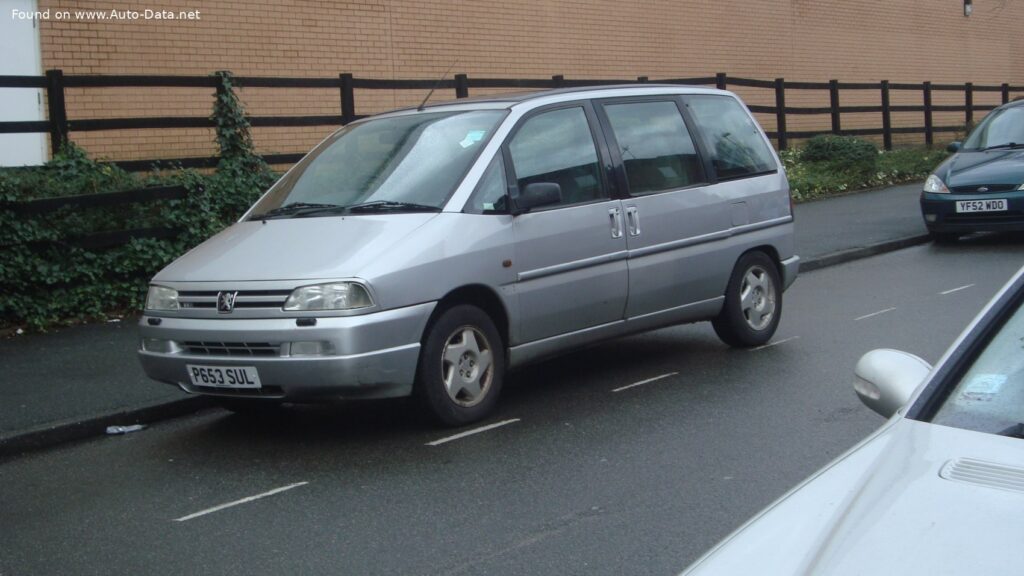
The Peugeot 806, produced between 1994 and 2002, was a large multi-purpose vehicle (MPV) designed to compete in the growing European minivan market. Developed in collaboration with Fiat and Lancia – resulting in the Fiat Ulysse and Lancia Zeta respectively – the 806 aimed to provide a spacious and versatile vehicle for families and those requiring significant cargo capacity. While never officially sold in the United States, the 806 represents a significant example of European MPV design and engineering of the 1990s, prioritizing practicality and modularity. The 2.0 Turbo variant, equipped with a 147 horsepower engine, was a popular choice offering a balance of performance and fuel economy within the 806 range.
Peugeot 806 (221) 2.0 Turbo: Overview
The 806 (designated 221 for certain models) was Peugeot’s entry into the large MPV segment, a category rapidly gaining popularity in Europe as families sought alternatives to traditional station wagons and larger sedans. Its key selling points were its spacious interior, configurable seating arrangements, and relatively compact footprint for a vehicle offering so much space. The 2.0 Turbo model, featuring a turbocharged gasoline engine, provided a more spirited driving experience compared to the naturally aspirated engine options available. The vehicle’s design emphasized functionality, with a focus on maximizing interior space and ease of use.
Engine & Performance
The heart of the Peugeot 806 2.0 Turbo is the RGX XU10J2TE 1.998-liter inline-four cylinder engine. This engine, equipped with a turbocharger and multi-port fuel injection, produces 147 horsepower at 5300 rpm and 235 Newton-meters (173.33 lb.-ft.) of torque at 2500 rpm. The turbocharger significantly enhances performance, providing increased power and responsiveness compared to naturally aspirated versions of the same engine. Power per liter is rated at 73.6 hp/l. The engine is transversely mounted at the front of the vehicle, driving the front wheels through a five-speed manual transmission. Acceleration from 0 to 100 km/h (0-62 mph) takes 10.1 seconds, while 0-60 mph is achieved in approximately 9.6 seconds. The 806 2.0 Turbo has a maximum speed of 195 km/h (121.17 mph). The weight-to-power ratio is 10.7 kg/Hp, and the weight-to-torque ratio is 6.7 kg/Nm.
Design & Features
The Peugeot 806 is a five-door minivan with a practical and functional design. It offers seating for five passengers, although some configurations allowed for up to seven with the addition of a rear bench seat. The interior is characterized by its modularity, with seats that can be folded, tumbled, or even removed entirely to create a large, flat cargo area. Trunk space ranges from a minimum of 400 liters (14.13 cu. ft.) with all seats in place to a maximum of 1700 liters (60.03 cu. ft.) with the rear seats folded.
Safety features for the era included an Anti-lock Braking System (ABS) as standard equipment. The vehicle’s construction focused on providing a robust and protective passenger cell. Other notable features included hydraulic power steering, ventilated front disc brakes, and disc brakes on the rear axle. The suspension utilizes a wishbone setup at the front and coil springs at the rear, providing a comfortable ride quality. The 806’s design prioritized practicality and usability, making it a popular choice for families and those needing a versatile vehicle.
Technical Specifications
| Brand | Peugeot |
| Model | 806 |
| Generation | 806 (221) |
| Type (Engine) | 2.0 Turbo (147 Hp) |
| Start of production | 1994 |
| End of production | 2002 |
| Powertrain Architecture | Internal Combustion engine |
| Body type | Minivan |
| Seats | 5 |
| Doors | 5 |
| Fuel consumption (combined) | 10.1 l/100 km |
| Fuel consumption (US mpg) | 23.3 US mpg |
| Fuel consumption (UK mpg) | 28 UK mpg |
| Fuel consumption (km/l) | 9.9 km/l |
| Fuel Type | Petrol (Gasoline) |
| Acceleration 0 – 100 km/h | 10.1 sec |
| Acceleration 0 – 62 mph | 10.1 sec |
| Acceleration 0 – 60 mph | 9.6 sec |
| Maximum speed | 195 km/h (121.17 mph) |
| Weight-to-power ratio | 10.7 kg/Hp |
| Weight-to-torque ratio | 6.7 kg/Nm |
| Power | 147 Hp @ 5300 rpm |
| Power per litre | 73.6 Hp/l |
| Torque | 235 Nm @ 2500 rpm (173.33 lb.-ft. @ 2500 rpm) |
| Engine layout | Front, Transverse |
| Engine Model/Code | RGX XU10J2TE |
| Engine displacement | 1998 cm3 (121.93 cu. in.) |
| Number of cylinders | 4 |
| Engine configuration | Inline |
| Cylinder Bore | 86 mm (3.39 in.) |
| Piston Stroke | 86 mm (3.39 in.) |
| Compression ratio | 8.5:1 |
| Number of valves per cylinder | 2 |
| Fuel injection system | Multi-port manifold injection |
| Engine aspiration | Turbocharger |
| Valvetrain | OHC |
| Engine oil capacity | 4.5 l (4.76 US qt | 3.96 UK qt) |
| Coolant | 8.5 l (8.98 US qt | 7.48 UK qt) |
| Kerb Weight | 1575 kg (3472.28 lbs.) |
| Max. weight | 2340 kg (5158.82 lbs.) |
| Max load | 765 kg (1686.54 lbs.) |
| Trunk (boot) space – minimum | 400 l (14.13 cu. ft.) |
| Trunk (boot) space – maximum | 1700 l (60.03 cu. ft.) |
| Fuel tank capacity | 80 l (21.13 US gal | 17.6 UK gal) |
| Length | 4454 mm (175.35 in.) |
| Width | 1834 mm (72.2 in.) |
| Height | 1714 mm (67.48 in.) |
| Wheelbase | 2824 mm (111.18 in.) |
| Front track | 1534 mm (60.39 in.) |
| Rear (Back) track | 1540 mm (60.63 in.) |
| Drivetrain Architecture | Front wheel drive |
| Number of gears and type of gearbox | 5 gears, manual transmission |
| Front suspension | Wishbone |
| Rear suspension | Coil spring |
| Front brakes | Ventilated discs |
| Rear brakes | Disc |
| Assisting systems | ABS (Anti-lock braking system) |
| Steering type | Steering rack and pinion |
| Power steering | Hydraulic Steering |
| Tires size | 205/65 R15 |
