
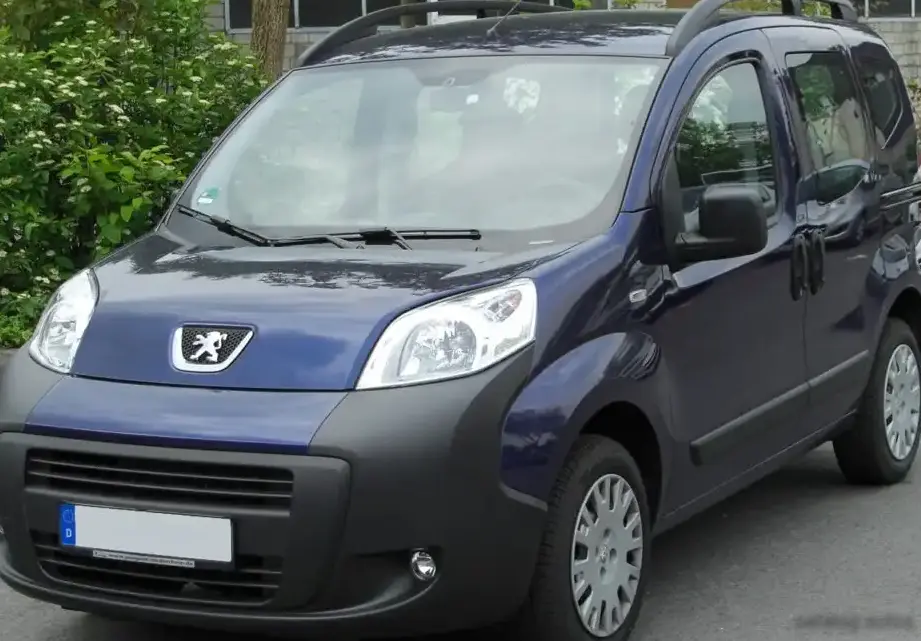
The Peugeot Bipper Tepee 1.4, producing 75 horsepower, was a compact, five-seater minivan produced by Peugeot between May 2008 and September 2010. It formed part of the first generation of the Bipper model, sharing its platform and much of its mechanical underpinnings with the Fiat Fiorino and Citroën Nemo – a collaborative effort between the PSA Group (Peugeot and Citroën) and Fiat. Positioned as an entry-level vehicle, the 1.4-liter engine and five-speed manual transmission combination aimed to provide affordable and practical transportation, primarily targeting urban drivers and small families. The Bipper Tepee was intended to compete with other small MPVs like the Renault Kangoo and Opel Combo, offering a versatile interior within a relatively small footprint.
Technical Specifications
| Brand | Peugeot |
| Model | Bipper |
| Generation | Bipper Tepee |
| Type (Engine) | 1.4 (75 Hp) |
| Start of production | May, 2008 |
| End of production | September, 2010 |
| Powertrain Architecture | Internal Combustion engine |
| Body type | Minivan |
| Seats | 5 |
| Doors | 5 |
| Fuel consumption (urban) | 8.2 l/100 km (28.7 US mpg) |
| Fuel consumption (extra urban) | 5.6 l/100 km (42 US mpg) |
| Fuel consumption (combined) | 6.6 l/100 km (35.6 US mpg) |
| Fuel Type | Petrol (Gasoline) |
| Acceleration 0 – 100 km/h | 16.2 sec |
| Acceleration 0 – 62 mph | 16.2 sec |
| Acceleration 0 – 60 mph | 15.4 sec |
| Maximum speed | 155 km/h (96.31 mph) |
| Emission standard | Euro 5 |
| Weight-to-power ratio | 15.5 kg/Hp |
| Weight-to-torque ratio | 9.9 kg/Nm |
| Power | 75 Hp @ 5200 rpm |
| Torque | 118 Nm @ 2600 rpm (87.03 lb.-ft. @ 2600 rpm) |
| Engine layout | Front, Transverse |
| Engine Model/Code | KFV TU3A |
| Engine displacement | 1360 cm3 (82.99 cu. in.) |
| Engine configuration | Inline |
| Cylinder Bore | 75 mm (2.95 in.) |
| Piston Stroke | 77 mm (3.03 in.) |
| Fuel injection system | Multi-port manifold injection |
| Engine aspiration | Naturally aspirated engine |
| Engine oil capacity | 3 l (3.17 US qt | 2.64 UK qt) |
| Coolant capacity | 5.6 l (5.92 US qt | 4.93 UK qt) |
| Kerb Weight | 1165 kg (2568.39 lbs.) |
| Max. weight | 1680 kg (3703.77 lbs.) |
| Max load | 515 kg (1135.38 lbs.) |
| Trunk (boot) space – minimum | 356 l (12.57 cu. ft.) |
| Trunk (boot) space – maximum | 884 l (31.22 cu. ft.) |
| Fuel tank capacity | 45 l (11.89 US gal | 9.9 UK gal) |
| Length | 3959 mm (155.87 in.) |
| Width | 1816 mm (71.5 in.) |
| Height | 1721 mm (67.76 in.) |
| Wheelbase | 2513 mm (98.94 in.) |
| Minimum turning circle | 11.8 m (38.71 ft.) |
| Drivetrain Architecture | Front wheel drive |
| Number of gears | 5 gears, manual transmission |
| Front suspension | Independent type McPherson |
| Rear suspension | Semi-independent, coil spring |
| Front brakes | Ventilated discs |
| Rear brakes | Drum |
| Assisting systems | ABS (Anti-lock braking system) |
| Steering type | Steering rack and pinion |
| Tires size | 185/65 R15 |
| Wheel rims size | 15 |
Powertrain & Engine Architecture
The Peugeot Bipper Tepee 1.4 utilized the KFV (also known as TU3A) engine, a 1.4-liter inline four-cylinder petrol engine. This engine was a common choice in small European vehicles of the era, known for its simplicity and relatively low production costs. It featured a single overhead camshaft (SOHC) valvetrain and multi-point fuel injection. The engine’s 75 horsepower output at 5200 rpm and 118 Nm (87 lb-ft) of torque at 2600 rpm were modest, but sufficient for the Bipper Tepee’s intended purpose. The engine was transversely mounted at the front of the vehicle, driving the front wheels. The five-speed manual transmission was a standard feature, providing a reasonable spread of gears for both urban and highway driving. The transmission was chosen for its affordability and efficiency, rather than outright performance.
Driving Characteristics
The 1.4-liter engine and manual transmission combination in the Bipper Tepee resulted in a driving experience focused on practicality and economy rather than performance. Acceleration was leisurely, taking approximately 16.2 seconds to reach 100 km/h (62 mph). The engine felt strained when climbing hills or carrying a full load. The five-speed gearbox was well-matched to the engine’s characteristics, allowing drivers to keep the engine in its optimal power band. Compared to potential higher-output engine options (which weren’t widely available on the Bipper Tepee), this variant prioritized fuel efficiency and ease of driving over spirited performance. The steering was light and easy, making it well-suited for maneuvering in tight urban environments. The suspension provided a comfortable ride, although it could feel somewhat bouncy when encountering larger bumps.
Equipment & Trim Levels
The Bipper Tepee 1.4 typically came with a basic level of equipment, reflecting its position as an entry-level model. Standard features generally included power steering, a driver’s airbag, central locking, and electric front windows. The interior was functional and durable, with hard-wearing plastics dominating the cabin. Upholstery was typically a simple cloth material. Optional extras included air conditioning, a passenger airbag, and a radio/CD player. Higher trim levels, if available, might have added features like alloy wheels, body-colored bumpers, and upgraded interior trim. The Bipper Tepee’s interior was designed with practicality in mind, offering a flexible seating arrangement and ample storage space for its size.
Chassis & Braking
The Bipper Tepee’s chassis was a typical small MPV design, prioritizing space efficiency and affordability. The front suspension utilized independent McPherson struts, providing a reasonable level of ride comfort and handling. The rear suspension employed a semi-independent twist beam setup, which was cost-effective but less sophisticated than a fully independent system. Braking was provided by ventilated discs on the front wheels and drum brakes on the rear. Anti-lock Braking System (ABS) was standard, enhancing safety during emergency braking situations. The steering system was a rack and pinion type, offering light and precise steering feel. The 15-inch wheels were fitted with 185/65 R15 tires, providing a balance of comfort and grip.
Market Reception & Comparison
The Peugeot Bipper Tepee 1.4 was generally well-received as an affordable and practical small MPV. Critics praised its spacious interior, fuel efficiency, and ease of driving. However, the 1.4-liter engine was often criticized for its lack of power, particularly when fully loaded. Compared to the Citroën Nemo and Fiat Fiorino – its platform siblings – the Bipper Tepee offered a slightly more refined interior and a more distinctive Peugeot styling. Fuel economy was a strong point, with combined fuel consumption figures around 6.6 l/100 km (35.6 US mpg). Reliability was generally good, although the simple engine design meant that maintenance costs were relatively low. The Bipper Tepee offered a compelling value proposition for buyers seeking a small, versatile, and economical vehicle.
Legacy
The Peugeot Bipper Tepee 1.4, while not a performance icon, has proven to be a relatively reliable and durable vehicle. The KFV/TU3A engine is known for its robustness and longevity, and with regular maintenance, it can provide many years of service. On the used car market, the Bipper Tepee 1.4 remains an affordable option for those seeking a practical and economical small MPV. Its simple construction and readily available parts contribute to its low running costs. While it may not offer the excitement of more powerful vehicles, the Bipper Tepee 1.4 continues to serve as a dependable and functional mode of transportation for many drivers.
