
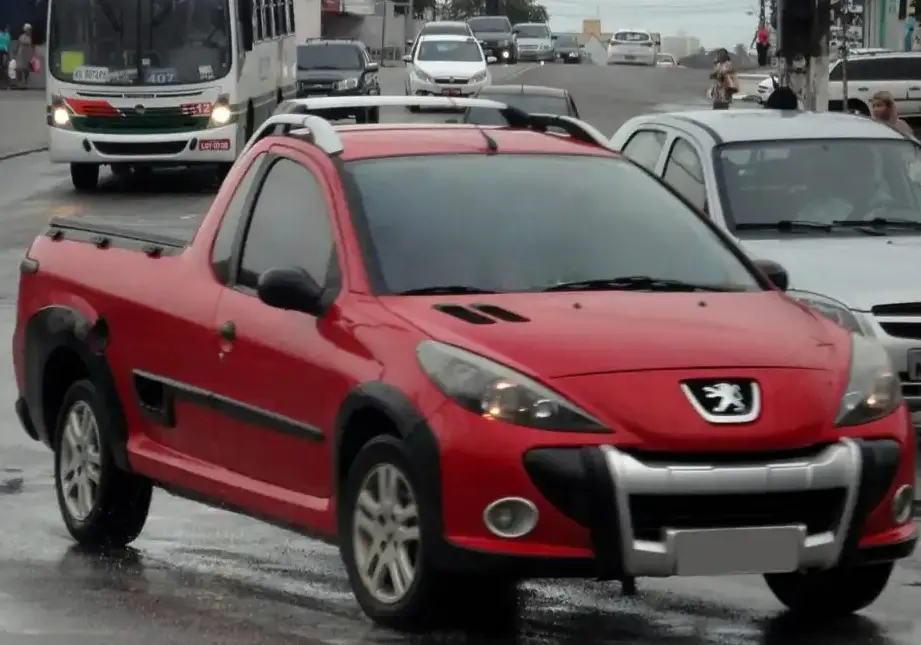
The Peugeot Hoggar 1.6, producing 106 horsepower, was a compact pickup truck manufactured by the French automaker Peugeot between 2010 and 2014. Derived from the Peugeot 207, the Hoggar was specifically designed and targeted towards the South American market, particularly Brazil and Argentina, where small, utilitarian pickups are popular. It represented Peugeot’s entry into this segment, offering a blend of practicality and affordability. The 1.6L engine variant occupied a mid-range position within the Hoggar lineup, offering a balance between performance and fuel economy compared to potential diesel options (which were not widely available in all markets). It was a two-door, two-seater vehicle built on a reinforced 207 platform.
Technical Specifications
| Brand | Peugeot |
| Model | Hoggar |
| Generation | Hoggar |
| Type (Engine) | 1.6 (106 Hp) |
| Start of production | 2010 |
| End of production | 2014 |
| Powertrain Architecture | Internal Combustion engine |
| Body type | Pick-up |
| Seats | 2 |
| Doors | 2 |
| Fuel consumption (economy) – extra urban | 7 l/100 km (33.6 US mpg, 40.4 UK mpg, 14.3 km/l) |
| Fuel consumption (economy) – combined | 7.9 l/100 km (29.8 US mpg, 35.8 UK mpg, 12.7 km/l) |
| Fuel Type | Petrol (Gasoline) |
| Acceleration 0 – 100 km/h | 14.5 sec |
| Acceleration 0 – 62 mph | 14.5 sec |
| Acceleration 0 – 60 mph | 13.8 sec |
| Maximum speed | 177 km/h (109.98 mph) |
| Weight-to-power ratio | 11.5 kg/Hp, 87 Hp/tonne |
| Weight-to-torque ratio | 8.3 kg/Nm, 119.9 Nm/tonne |
| Power | 106 Hp @ 5800 rpm |
| Power per litre | 66.8 Hp/l |
| Torque | 146 Nm @ 4000 rpm (107.68 lb.-ft. @ 4000 rpm) |
| Engine layout | Front, Transverse |
| Engine displacement | 1587 cm3 (96.84 cu. in.) |
| Number of cylinders | 4 |
| Engine configuration | Inline |
| Cylinder Bore | 78.5 mm (3.09 in.) |
| Piston Stroke | 82 mm (3.23 in.) |
| Number of valves per cylinder | 4 |
| Fuel injection system | Multi-port manifold injection |
| Engine aspiration | Naturally aspirated engine |
| Valvetrain | DOHC |
| Kerb Weight | 1218 kg (2685.23 lbs.) |
| Max. weight | 1868 kg (4118.24 lbs.) |
| Max load | 650 kg (1433 lbs.) |
| Trunk (boot) space – minimum | 1133 l (40.01 cu. ft.) |
| Fuel tank capacity | 55 l (14.53 US gal | 12.1 UK gal) |
| Length | 4526 mm (178.19 in.) |
| Width | 1668 mm (65.67 in.) |
| Width including mirrors | 1727 mm (67.99 in.) |
| Height | 1524 mm (60 in.) |
| Wheelbase | 2745 mm (108.07 in.) |
| Front track | 1423 mm (56.02 in.) |
| Rear (Back) track | 1446 mm (56.93 in.) |
| Front overhang | 819 mm (32.24 in.) |
| Rear overhang | 962 mm (37.87 in.) |
| Drivetrain Architecture | The Internal combustion engine (ICE) drives the front wheels of the vehicle. |
| Drive wheel | Front wheel drive |
| Number of gears and type of gearbox | 5 gears, manual transmission |
| Front suspension | Independent type McPherson |
| Rear suspension | Torsion |
| Front brakes | Ventilated discs |
| Rear brakes | Drum |
| Steering type | Steering rack and pinion |
| Power steering | Hydraulic Steering |
| Tires size | 175/65 R14; 175/70 R14; 185/65 R15 |
| Wheel rims size | 5.5J x 14; 6J x 15 |
Powertrain & Engine Architecture
The Peugeot Hoggar 1.6 utilized the ET3 engine code, a 1.6-liter inline-four cylinder gasoline engine. This engine was a common powerplant in various Peugeot and Citroën models of the era. It featured a multi-point fuel injection system and a double overhead camshaft (DOHC) valvetrain, contributing to reasonable efficiency and power output for its displacement. The engine’s design prioritized durability and ease of maintenance, reflecting its intended use in a work-oriented vehicle. The five-speed manual transmission was the standard offering for this variant, chosen for its simplicity and cost-effectiveness. The transmission was geared towards providing adequate torque for hauling loads, rather than outright acceleration. The engine’s 146 Nm (107.68 lb-ft) of torque, while not substantial, was sufficient for typical pickup truck duties in its target market.
Driving Characteristics
The 1.6L Hoggar offered modest performance. Acceleration from 0-60 mph took approximately 13.8 seconds, and its top speed was around 109.98 mph. The focus wasn’t on speed, but on usability. The manual transmission allowed for precise control, but the engine required frequent downshifting when carrying a load or tackling inclines. Compared to hypothetical diesel variants (which were less common in some markets), the 1.6L engine was noticeably less powerful and offered less low-end torque. However, it was generally smoother and quieter in operation. The gear ratios were optimized for fuel economy and load-carrying capacity, resulting in a somewhat sluggish feel at higher speeds. The front-wheel-drive configuration limited traction in slippery conditions, especially when loaded.
Equipment & Trim Levels
The Hoggar 1.6 typically came with a basic level of equipment, reflecting its utilitarian nature. Standard features included power steering, a basic audio system, and manually adjustable windows and mirrors. Air conditioning was often an optional extra. Interior upholstery was typically hard-wearing cloth. The dashboard layout was functional and straightforward, prioritizing ease of use over aesthetics. Higher trim levels, if available, might have included features like central locking, upgraded audio systems, and more comfortable seating. However, the Hoggar was generally positioned as a no-frills work vehicle.
Chassis & Braking
The Hoggar’s chassis was based on a reinforced version of the Peugeot 207 platform. The front suspension utilized an independent McPherson strut setup, providing a reasonable level of ride comfort. The rear suspension employed a torsion beam axle, which was a cost-effective solution for load-carrying applications. Braking duties were handled by ventilated discs at the front and drum brakes at the rear. The braking system was adequate for the vehicle’s weight and performance, but lacked the sophistication of more advanced systems. The steering was a rack and pinion system with hydraulic assistance, providing reasonable steering feel and maneuverability.
Market Reception & Comparison
The Peugeot Hoggar 1.6 was generally well-received in its target markets as an affordable and practical pickup truck. Critics praised its fuel efficiency and ease of driving, but noted its limited power and basic interior. Compared to competitors like the Fiat Strada, the Hoggar offered a similar level of functionality at a competitive price point. The 1.6L engine variant was often seen as a good compromise for buyers who didn’t require the extra power of a diesel engine but still needed a capable work vehicle. Fuel economy was a key selling point, with the Hoggar achieving around 29.8 US mpg in combined driving conditions.
Legacy
The Peugeot Hoggar, while not a long-lived model, established Peugeot as a player in the South American small pickup truck market. The 1.6L engine proved to be relatively reliable, with few major mechanical issues reported. On the used car market, the Hoggar 1.6 remains an affordable and practical option for those seeking a basic work vehicle. Maintenance costs are generally low, and parts availability is reasonable. However, potential buyers should be aware of the vehicle’s limited power and basic features. The Hoggar’s legacy lies in its contribution to Peugeot’s brand recognition in South America and its demonstration of the automaker’s ability to adapt to the specific needs of that market.
