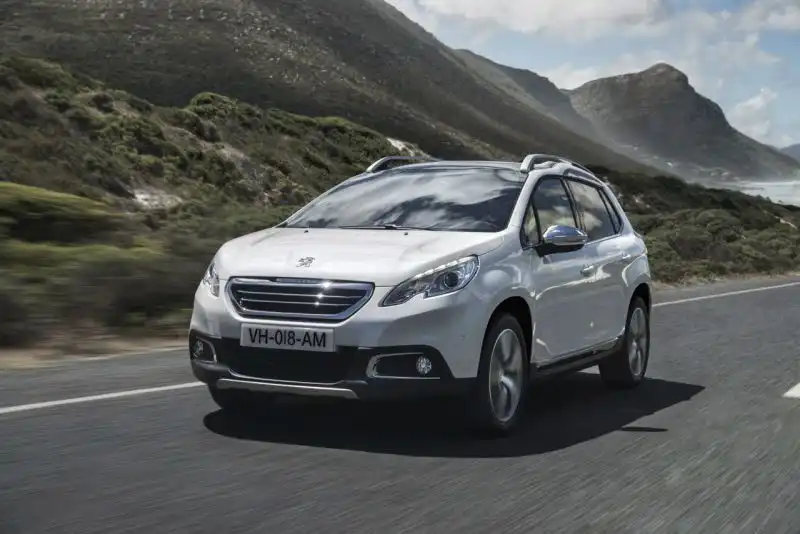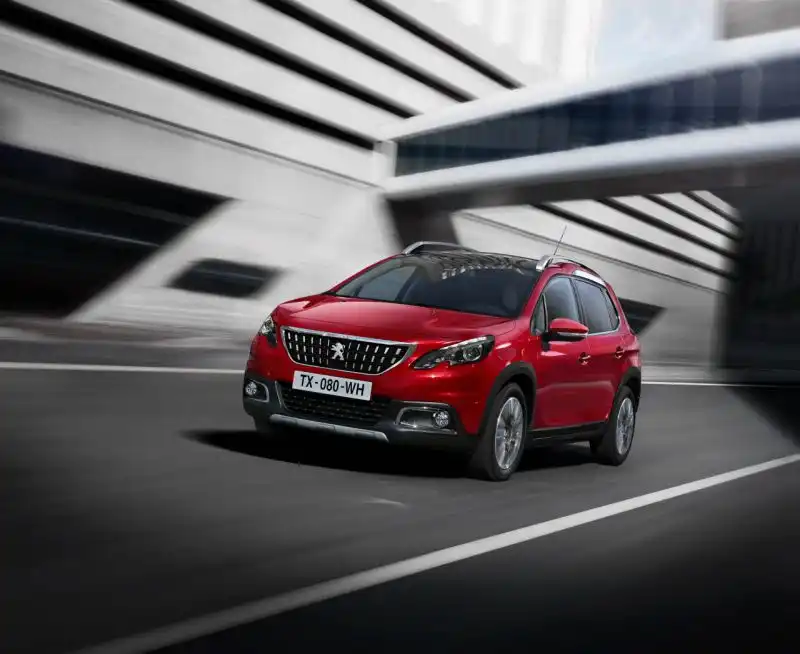
The Peugeot 2008 I (facelift 2016) 1.2 PureTech 110 Stop&Start is a front-wheel-drive subcompact crossover SUV produced by the French manufacturer Peugeot between 2016 and 2019. This variant occupied a key position in the 2008 lineup, offering a balance between fuel efficiency, affordability, and practicality. It represented a significant update to the original 2008, launched in 2013, with styling revisions and the introduction of Peugeot’s new PureTech engine family. The facelift aimed to enhance the 2008’s appeal in the increasingly competitive European B-segment crossover market, and later found some limited sales in other regions.
Technical Specifications
| Brand | Peugeot |
| Model | 2008 |
| Generation | 2008 I (facelift 2016) |
| Type (Engine) | 1.2 PureTech (110 Hp) start&stop STT |
| Start of production | 2016 |
| End of production | 2019 |
| Powertrain Architecture | Internal Combustion engine |
| Body type | SUV, Crossover |
| Seats | 5 |
| Doors | 5 |
| Fuel consumption (urban) | 5.3 l/100 km (44.4 US mpg, 53.3 UK mpg, 18.9 km/l) |
| Fuel consumption (extra urban) | 3.9 l/100 km (60.3 US mpg, 72.4 UK mpg, 25.6 km/l) |
| Fuel consumption (combined) | 4.4 l/100 km (53.5 US mpg, 64.2 UK mpg, 22.7 km/l) |
| CO2 emissions | 103 g/km |
| Fuel Type | Petrol (Gasoline) |
| Acceleration 0 – 100 km/h | 9.9 sec |
| Acceleration 0 – 62 mph | 9.9 sec |
| Acceleration 0 – 60 mph | 9.4 sec |
| Maximum speed | 191 km/h (118.68 mph) |
| Emission standard | Euro 6 |
| Weight-to-power ratio | 9.9 kg/Hp, 100.9 Hp/tonne |
| Weight-to-torque ratio | 5.3 kg/Nm, 188.1 Nm/tonne |
| Power | 110 Hp @ 5500 rpm |
| Power per litre | 91.7 Hp/l |
| Torque | 205 Nm @ 1750 rpm (151.2 lb.-ft. @ 1750 rpm) |
| Engine layout | Front, Transverse |
| Engine Model/Code | HNZ EB2DT |
| Engine displacement | 1199 cm3 (73.17 cu. in.) |
| Engine configuration | Inline |
| Fuel injection system | Direct injection |
| Engine aspiration | Turbocharger, Intercooler |
| Engine oil capacity | 3.5 l (3.7 US qt | 3.08 UK qt) |
| Kerb Weight | 1090 kg (2403.04 lbs.) |
| Trunk (boot) space – minimum | 350 l (12.36 cu. ft.) |
| Fuel tank capacity | 50 l (13.21 US gal | 11 UK gal) |
| Length | 4159 mm (163.74 in.) |
| Width | 1829 mm (72.01 in.) |
| Width including mirrors | 2004 mm (78.9 in.) |
| Height | 1556 mm (61.26 in.) |
| Wheelbase | 2537 mm (99.88 in.) |
| Front track | 1472-1482 mm (57.95 – 58.35 in.) |
| Rear (Back) track | 1482-1492 mm (58.35 – 58.74 in.) |
| Drivetrain Architecture | The Internal combustion engine (ICE) drives the front wheels of the vehicle. |
| Drive wheel | Front wheel drive |
| Number of gears and type of gearbox | 5 gears, manual transmission |
| Front suspension | Independent, type McPherson with coil spring and anti-roll bar |
| Rear suspension | Semi-independent, coil spring |
| Front brakes | Ventilated discs |
| Rear brakes | Disc |
| Assisting systems | ABS (Anti-lock braking system) |
| Steering type | Steering rack and pinion |
| Power steering | Electric Steering |
| Tires size | 195/60 R16; 205/50 R17 |
| Wheel rims size | 16; 17 |
INTRODUCTION
The 2008 I (facelift 2016) 1.2 PureTech 110 Stop&Start represented Peugeot’s attempt to capture a larger share of the burgeoning European crossover market. Positioned as a mid-range offering within the 2008 lineup, it slotted between the lower-powered 1.2 PureTech 82 hp version and the more expensive diesel options. The facelift brought a more assertive front-end design, updated interior trim, and the introduction of Peugeot’s i-Cockpit interior layout, featuring a smaller steering wheel and a raised instrument cluster. Built on the PF1 platform (also known as the 1HX0/A3 platform shared with the Citroën C4 Cactus and DS 3), the 2008 aimed to provide a stylish and practical alternative to traditional hatchbacks.
Powertrain & Engine Architecture
At the heart of this variant lies Peugeot’s 1.2-liter PureTech engine, specifically the HNZ EB2DT code. This is a three-cylinder, turbocharged gasoline engine featuring direct fuel injection. The engine utilizes a single-scroll turbocharger and an intercooler to boost power and efficiency. The direct injection system, coupled with a high compression ratio, contributes to improved fuel economy and reduced emissions. The 110 horsepower output is achieved at 5500 rpm, while peak torque of 205 Nm (151.2 lb-ft) is delivered at a low 1750 rpm, providing good responsiveness in everyday driving. The engine is paired with a five-speed manual transmission, chosen for its simplicity and cost-effectiveness. The Stop&Start system, denoted by the “STT” in the model name, automatically shuts off the engine when the vehicle comes to a halt, further enhancing fuel efficiency.
Driving Characteristics
The 1.2 PureTech 110 hp engine, while not exceptionally powerful, provides adequate performance for typical urban and highway driving. Acceleration from 0 to 60 mph takes approximately 9.4 seconds, and the top speed is around 118.68 mph. The turbocharger provides a noticeable boost in power, but the engine can feel slightly strained when pushed hard, particularly when fully loaded. The five-speed manual transmission is well-matched to the engine’s characteristics, with gear ratios optimized for fuel efficiency and drivability. Compared to the lower-powered 82 hp version, the 110 hp model offers a more relaxed driving experience, especially on the highway. However, it lacks the outright performance of the diesel variants. The relatively lightweight construction of the 2008 helps to mitigate the engine’s limitations, resulting in a reasonably agile and enjoyable driving experience.
Equipment & Trim Levels
The 1.2 PureTech 110 Stop&Start typically came equipped with a decent level of standard features. These included air conditioning, electric front windows, a touchscreen infotainment system with Bluetooth connectivity, and a leather-wrapped steering wheel. Higher trim levels, such as Allure and GT Line, added features like automatic climate control, rear parking sensors, a reversing camera, alloy wheels, and upgraded interior trim. Optional extras included a panoramic sunroof, navigation system, and safety features like blind spot monitoring and lane departure warning. Interior upholstery was typically cloth, with higher trims offering partial leather options. The i-Cockpit layout, with its small steering wheel and raised instrument cluster, was a defining feature of the 2008’s interior.
Chassis & Braking
The 2008 I (facelift 2016) utilizes a McPherson strut front suspension and a semi-independent coil spring rear suspension. This setup provides a comfortable ride quality, absorbing bumps and imperfections in the road surface effectively. The front suspension incorporates an anti-roll bar to reduce body roll during cornering. Braking duties are handled by ventilated discs at the front and solid discs at the rear. ABS (Anti-lock Braking System) is standard, providing enhanced braking performance and stability. The steering is electrically assisted, offering light and precise control. The 2008’s relatively low weight contributes to its agile handling characteristics.
Market Reception & Comparison
The Peugeot 2008 I (facelift 2016) 1.2 PureTech 110 Stop&Start was generally well-received by automotive critics. It was praised for its stylish design, comfortable ride, and fuel-efficient engine. However, some reviewers noted that the engine could feel underpowered when fully loaded or driving uphill. Compared to the diesel variants, the 1.2 PureTech offered lower running costs but less outright performance. Fuel economy figures of around 53.5 US mpg (combined) were competitive for the segment. Reliability reports suggest that the PureTech engine has been prone to some issues, including timing chain wear, although these problems appear to be more prevalent in earlier versions of the engine.
Legacy
The Peugeot 2008 I (facelift 2016) 1.2 PureTech 110 Stop&Start remains a popular choice in the used car market. Its combination of style, practicality, and fuel efficiency continues to appeal to buyers. However, potential buyers should be aware of the potential reliability issues associated with the PureTech engine and ensure that the vehicle has been properly maintained. The 2008 played a significant role in establishing Peugeot as a major player in the European crossover market, paving the way for the successful second-generation model launched in 2020. The 1.2 PureTech engine, despite its occasional issues, became a mainstay of the Peugeot lineup, demonstrating the brand’s commitment to downsizing and improving fuel efficiency.