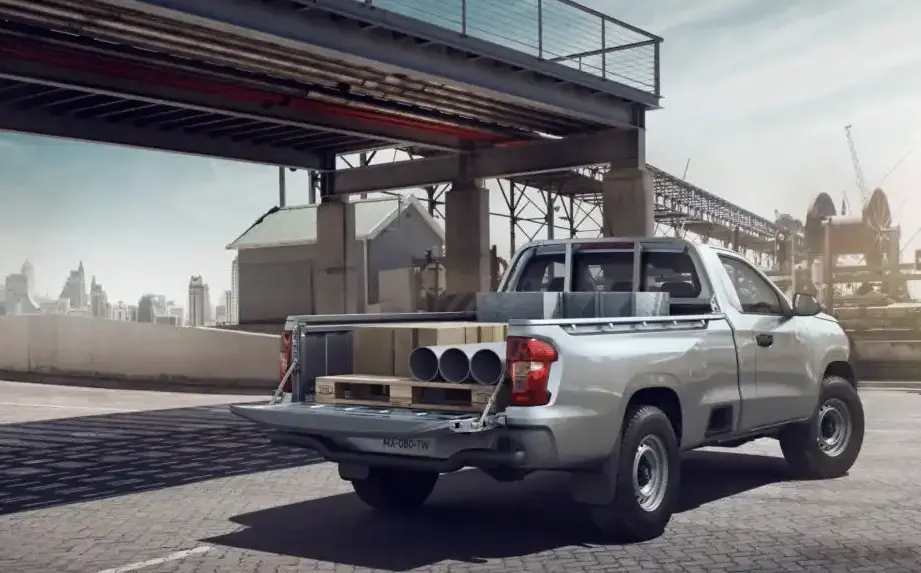
The Peugeot Landtrek Simple Cab 1.9d (150 Hp) 4×4 is a mid-size pickup truck introduced by Peugeot in February 2020. Designed primarily for markets outside of Europe, particularly in Latin America, Africa, and the Middle East, the Landtrek represents Peugeot’s entry into a highly competitive segment. The “Simple Cab” designation refers to the two-door body style with a separate cargo bed, offering a utilitarian and robust solution for commercial and personal use. This variant, powered by a 1.9-liter turbocharged diesel engine producing 150 horsepower, is positioned as a workhorse option within the Landtrek lineup, emphasizing practicality and durability over outright performance. It is built on a ladder-frame chassis, a common construction method for pickup trucks, and offers a four-wheel-drive system for enhanced off-road capability.
Technical Specifications
| Brand | Peugeot |
| Model | Landtrek |
| Generation | Landtrek Simple Cab |
| Type (Engine) | 1.9d (150 Hp) 4×4 |
| Start of production | February, 2020 |
| Powertrain Architecture | Internal Combustion engine |
| Body type | Pick-up |
| Seats | 3 |
| Doors | 2 |
| Fuel consumption (combined) | 8.1 l/100 km (29 US mpg, 34.9 UK mpg, 12.3 km/l) |
| CO2 emissions | 212 g/km |
| Fuel Type | Diesel |
| Acceleration 0 – 100 km/h | 15.8 sec |
| Acceleration 0 – 62 mph | 15.8 sec |
| Acceleration 0 – 60 mph | 15 sec |
| Maximum speed | 171 km/h (106.25 mph) |
| Emission standard | Euro 4 |
| Weight-to-power ratio | 13.7 kg/Hp, 72.8 Hp/tonne |
| Weight-to-torque ratio | 5.9 kg/Nm, 169.9 Nm/tonne |
| Power | 150 Hp @ 4000 rpm |
| Power per litre | 78.5 Hp/l |
| Torque | 350 Nm @ 1800-2800 rpm (258.15 lb.-ft. @ 1800-2800 rpm) |
| Engine layout | Front, Transverse |
| Engine Model/Code | D20TCID |
| Engine displacement | 1910 cm3 (116.56 cu. in.) |
| Number of cylinders | 4 |
| Engine configuration | Inline |
| Number of valves per cylinder | 4 |
| Fuel injection system | Diesel Commonrail |
| Engine aspiration | Turbocharger, Intercooler |
| Engine oil capacity | 5.5 l (5.81 US qt | 4.84 UK qt) |
| Kerb Weight | 2060 kg (4541.52 lbs.) |
| Fuel tank capacity | 80 l (21.13 US gal | 17.6 UK gal) |
| Length | 5390 mm (212.2 in.) |
| Width | 1963 mm (77.28 in.) |
| Width including mirrors | 2221 mm (87.44 in.) |
| Height | 1829-1835 mm (72.01 – 72.24 in.) |
| Wheelbase | 3180 mm (125.2 in.) |
| Front track | 1610 mm (63.39 in.) |
| Rear (Back) track | 1630 mm (64.17 in.) |
| Front overhang | 925 mm (36.42 in.) |
| Rear overhang | 1285 mm (50.59 in.) |
| Ride height (ground clearance) | 214-235 mm (8.43 – 9.25 in.) |
| Approach angle | 30.0° |
| Departure angle | 26.0° |
| Ramp-over (brakeover) angle | 25.0° |
| Wading depth | 600 mm (23.62 in.) |
| Drivetrain Architecture | The Internal combustion engine (ICE) drives the rear wheels permanently, and the front wheels are driven through an electrically or mechanically operated clutch if necessary. |
| Drive wheel | All wheel drive (4×4) |
| Number of gears and type of gearbox | 6 gears, manual transmission |
| Tires size | 265/65 R17 |
| Wheel rims size | 17 |
INTRODUCTION
The Peugeot Landtrek Simple Cab 1.9d (150 Hp) 4×4, launched in 2020, is a key component of Peugeot’s strategy to expand its presence in the global pickup truck market. Unlike Peugeot’s traditional focus on passenger vehicles in Europe, the Landtrek is specifically designed for regions where robust, affordable, and capable work vehicles are in high demand. The “Simple Cab” configuration, with its two doors and a dedicated cargo bed, caters to customers prioritizing functionality and cost-effectiveness. This model utilizes a ladder-frame chassis, a design choice common in pickup trucks for its strength and durability, and is equipped with a four-wheel-drive system to handle challenging terrains. The 1.9-liter diesel engine, while not the most powerful option in the Landtrek range, provides a balance of fuel efficiency and adequate torque for typical work applications.
Powertrain & Engine Architecture
At the heart of the Landtrek Simple Cab 1.9d 4×4 lies the D20TCID engine, a 1.9-liter inline-four cylinder diesel engine. This engine utilizes a common rail direct injection system, delivering fuel directly into the combustion chamber at high pressure for improved efficiency and reduced emissions. The engine is turbocharged and intercooled, enhancing power output and torque. The turbocharger forces more air into the engine, while the intercooler cools the compressed air, increasing its density and further improving combustion. The engine produces 150 horsepower at 4000 rpm and 350 Nm (258.15 lb.-ft.) of torque between 1800 and 2800 rpm. This torque band is particularly useful for hauling and towing. The Landtrek Simple Cab 1.9d 4×4 is equipped with a six-speed manual transmission. This transmission provides a good balance between fuel economy and performance, allowing the driver to select the optimal gear for various driving conditions. The transmission is coupled to a part-time four-wheel-drive system, allowing the driver to switch between two-wheel drive for normal road conditions and four-wheel drive for increased traction on slippery or uneven surfaces.
Driving Characteristics
The Landtrek Simple Cab 1.9d 4×4, with its 150 horsepower and 350 Nm of torque, offers adequate performance for most work-related tasks. Acceleration is not its strong suit, with a 0-100 km/h (0-62 mph) time of 15.8 seconds. However, the engine’s torque delivery provides sufficient pulling power for hauling loads and navigating challenging terrain. The six-speed manual transmission allows for precise control over gear selection, enabling the driver to optimize engine performance for different driving scenarios. Compared to higher-output versions of the Landtrek, such as those equipped with more powerful diesel engines, the 1.9d variant feels less responsive. However, it compensates with improved fuel economy and a lower purchase price. The ride quality is typical of a ladder-frame pickup truck – firm and somewhat bouncy, especially when unladen. The four-wheel-drive system provides enhanced traction on loose surfaces, making it suitable for off-road driving and challenging weather conditions.
Equipment & Trim Levels
The Landtrek Simple Cab 1.9d 4×4 is positioned as a more basic, utilitarian version of the Landtrek. Standard equipment typically includes air conditioning, power steering, and a basic audio system. The interior features durable, easy-to-clean materials, reflecting its work-oriented design. The dashboard layout is functional and straightforward, with clearly labeled controls. Optional extras may include features such as alloy wheels, a more advanced audio system with touchscreen display, and additional safety equipment. The “Simple Cab” configuration means the vehicle has only two doors and a bench seat accommodating three passengers. The lack of rear doors and a more spartan interior trim level contribute to its lower price point.
Chassis & Braking
The Landtrek utilizes a traditional ladder-frame chassis, providing a robust and durable foundation for the vehicle. The suspension system consists of independent double wishbones at the front and leaf springs at the rear. The leaf spring rear suspension is a cost-effective and durable solution for carrying heavy loads. The braking system features disc brakes at the front and drum brakes at the rear. While disc brakes offer superior stopping power, the use of drum brakes at the rear helps to reduce production costs. The steering system is a hydraulic power-assisted rack-and-pinion system, providing responsive and precise steering control.
Market Reception & Comparison
The Peugeot Landtrek, and specifically the 1.9d 4×4 variant, has been generally well-received in markets where it has been launched. Critics have praised its robust construction, capable four-wheel-drive system, and competitive pricing. However, some have noted that the interior is somewhat basic compared to some of its rivals. Compared to other pickups in its class, such as the Toyota Hilux and the Ford Ranger, the Landtrek offers a more affordable entry point. Its fuel economy of 8.1 l/100 km (29 US mpg) is competitive, but not class-leading. Reliability is still being established as the Landtrek is a relatively new model, but Peugeot has a generally good reputation for building durable vehicles.
Legacy
The Peugeot Landtrek represents a significant step for Peugeot into the competitive pickup truck market. The 1.9d 4×4 variant, while not the most powerful or luxurious option, is likely to become a popular choice for customers prioritizing practicality, affordability, and durability. Its long-term reliability remains to be seen, but the robust construction and proven diesel engine technology suggest it will be a dependable workhorse for years to come. In the used car market, the Landtrek Simple Cab 1.9d 4×4 is expected to hold its value reasonably well, particularly in regions where pickup trucks are in high demand.