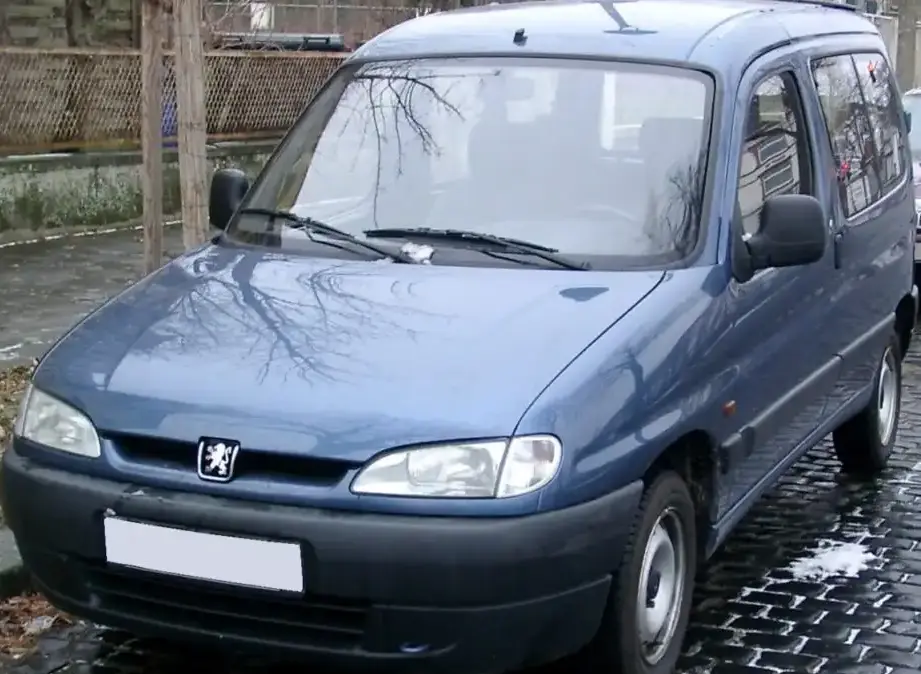
The Peugeot Partner I, specifically the Phase II model produced from 2002 to 2008, represented a practical and versatile offering in the European compact van segment. The 1.4-liter (75 horsepower) variant, while not the performance leader of the range, served as the entry point for many buyers seeking an affordable and functional vehicle for both commercial and family use. This version occupied a key position in the Partner lineup, appealing to those prioritizing economy and practicality over outright speed. It was built upon the shared platform with the Citroën Berlingo, a common practice within the PSA Group at the time.
Technical Specifications
| Brand | Peugeot |
| Model | Partner |
| Generation | Partner I (Phase II, 2002) |
| Type (Engine) | 1.4 (75 Hp) |
| Start of production | 2002 |
| End of production | 2008 |
| Powertrain Architecture | Internal Combustion engine |
| Body type | Minivan |
| Seats | 5 |
| Doors | 5 |
| Fuel consumption (urban) | 9.7 l/100 km (24.2 US mpg) |
| Fuel consumption (extra urban) | 6.2 l/100 km (37.9 US mpg) |
| Fuel consumption (combined) | 7.5 l/100 km (31.4 US mpg) |
| Fuel Type | Petrol (Gasoline) |
| Acceleration 0 – 100 km/h | 17.5 sec |
| Acceleration 0 – 62 mph | 17.5 sec |
| Acceleration 0 – 60 mph | 16.6 sec |
| Maximum speed | 150 km/h (93.21 mph) |
| Weight-to-power ratio | 15.9 kg/Hp |
| Weight-to-torque ratio | 9.9 kg/Nm |
| Power | 75 Hp @ 5500 rpm |
| Torque | 120 Nm @ 3400 rpm (88.51 lb.-ft. @ 3400 rpm) |
| Engine layout | Front, Transverse |
| Engine Model/Code | KFW TU3JP |
| Engine displacement | 1361 cm3 (83.05 cu. in.) |
| Number of cylinders | 4 |
| Engine configuration | Inline |
| Number of valves per cylinder | 2 |
| Fuel injection system | Multi-port manifold injection |
| Engine aspiration | Naturally aspirated |
| Engine oil capacity | 3 l (3.17 US qt | 2.64 UK qt) |
| Coolant capacity | 6 l (6.34 US qt | 5.28 UK qt) |
| Kerb Weight | 1190 kg (2623.5 lbs.) |
| Max. weight | 1780 kg (3924.23 lbs.) |
| Max load | 590 kg (1300.73 lbs.) |
| Trunk (boot) space – minimum | 625 l (22.07 cu. ft.) |
| Trunk (boot) space – maximum | 2800 l (98.88 cu. ft.) |
| Fuel tank capacity | 55 l (14.53 US gal | 12.1 UK gal) |
| Length | 4140 mm (162.99 in.) |
| Width | 1720 mm (67.72 in.) |
| Height | 1810 mm (71.26 in.) |
| Wheelbase | 2690 mm (105.91 in.) |
| Front track | 1420 mm (55.91 in.) |
| Rear track | 1440 mm (56.69 in.) |
| Drivetrain | Front wheel drive |
| Number of gears | 5 |
| Gearbox type | Manual transmission |
| Front suspension | Wishbone |
| Rear suspension | Trailing arm |
| Front brakes | Disc |
| Rear brakes | Drum |
| Tires size | 175/70 R14 |
Powertrain & Engine Architecture
The heart of this Partner variant is the KFW (or sometimes designated as TU3JP) 1.4-liter inline-four cylinder gasoline engine. This engine, a staple in many PSA Group vehicles of the era, is a naturally aspirated unit featuring a single overhead camshaft (SOHC) and two valves per cylinder. Fuel delivery is managed by a multi-port fuel injection system, providing adequate, though not exceptional, combustion control. The engine’s 75 horsepower output at 5500 rpm and 120 Nm (88.5 lb-ft) of torque at 3400 rpm are modest figures, reflecting its focus on fuel efficiency rather than performance. The engine is transversely mounted in the front of the vehicle. The Partner I 1.4 typically came equipped with a five-speed manual transmission, designed to maximize the engine’s limited power band. This transmission was chosen for its simplicity and cost-effectiveness, contributing to the overall affordability of the vehicle.
Driving Characteristics
The driving experience in the 1.4-liter Partner is best described as utilitarian. Acceleration is slow, with a 0-60 mph time of around 16.6 seconds. The engine requires frequent downshifts, particularly when laden with passengers or cargo, to maintain momentum. The five-speed manual transmission helps to mitigate this somewhat, allowing the driver to keep the engine within its optimal operating range. Compared to the more powerful 1.6 or 2.0-liter versions, or even the diesel variants, the 1.4 feels noticeably underpowered. However, for urban driving and shorter trips, the engine provides sufficient power, and the light clutch and easy steering make it a comfortable vehicle to maneuver.
Equipment & Trim Levels
The 1.4-liter Partner typically represented the base trim level. Standard equipment generally included power steering, a driver’s airbag, and basic instrumentation. Interior appointments were functional rather than luxurious, with durable plastic trim and cloth upholstery. Options, depending on the market and year, could include air conditioning, a radio/cassette player, and power windows. The emphasis was on providing a practical and affordable vehicle, so creature comforts were often sacrificed in favor of cost savings. The Partner’s modular interior, with its folding rear seats and configurable cargo area, was a key selling point, offering a high degree of versatility.
Chassis & Braking
The Partner I utilizes a relatively simple chassis design. Front suspension consists of independent wishbones, while the rear employs a trailing arm setup. This configuration provides a reasonable balance between ride comfort and handling. Braking is handled by disc brakes on the front wheels and drum brakes on the rear. While adequate for the vehicle’s weight and performance, the drum brakes on the rear can lack the stopping power of a fully disc-based system. The steering is unassisted, providing a direct feel but requiring more effort at low speeds.
Market Reception & Comparison
The 1.4-liter Partner was generally well-received as an affordable and practical van. Critics acknowledged its limitations in terms of performance but praised its fuel economy and versatility. Compared to the higher-output versions, the 1.4 offered a lower purchase price and reduced running costs, making it an attractive option for budget-conscious buyers. The diesel variants, while more expensive, offered superior fuel economy and torque, making them a popular choice for those covering long distances or frequently carrying heavy loads. The 1.6-liter gasoline engine provided a noticeable performance upgrade, but at a higher price point.
Legacy
The Peugeot Partner I 1.4, while not a particularly exciting vehicle, proved to be a reliable and durable workhorse. The KFW/TU3JP engine, while simple in design, is known for its longevity when properly maintained. Today, these vehicles can be found in the used car market at very affordable prices. Common issues include wear and tear on suspension components and potential oil leaks from the engine. However, parts are readily available and relatively inexpensive, making them a viable option for those seeking a budget-friendly van for light commercial or personal use. The Partner I established the model as a popular choice in the compact van segment, paving the way for subsequent generations that continue to offer practicality and versatility.