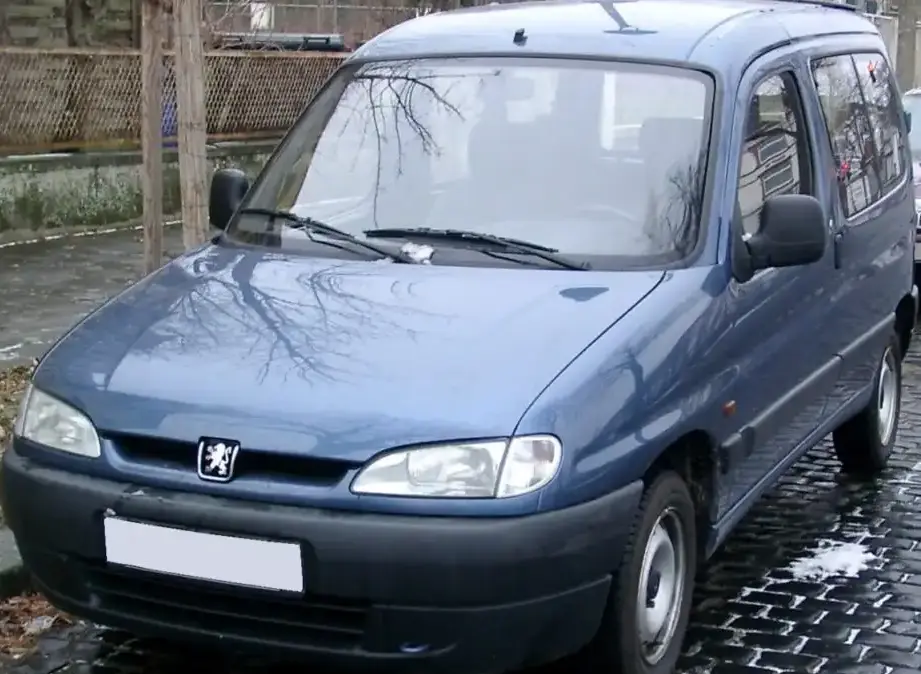
The Peugeot Partner I, specifically the Phase II model produced between 2002 and 2008, represented a significant offering in the European compact van segment. The 1.6-liter (109 horsepower) variant, equipped with a five-speed manual transmission, occupied a middle ground within the Partner lineup, balancing affordability with reasonable performance and practicality. This version was aimed at buyers needing a versatile vehicle for both commercial and family use, offering a compromise between the base models and the more powerful, often diesel-powered, options. The Partner I itself was a collaborative effort with Citroën, sharing its platform and many components with the Citroën Berlingo, a common practice within the PSA Group at the time.
Technical Specifications
| Brand | Peugeot |
| Model | Partner |
| Generation | Partner I (Phase II, 2002) |
| Type (Engine) | 1.6 (109 Hp) |
| Start of production | 2002 |
| End of production | 2008 |
| Powertrain Architecture | Internal Combustion engine |
| Body type | Minivan |
| Seats | 5 |
| Doors | 5 |
| Fuel consumption (urban) | 9.5 l/100 km (24.8 US mpg) |
| Fuel consumption (extra urban) | 6.2 l/100 km (37.9 US mpg) |
| Fuel consumption (combined) | 7.4 l/100 km (31.8 US mpg) |
| Fuel Type | Petrol (Gasoline) |
| Acceleration 0 – 100 km/h | 13.1 sec |
| Acceleration 0 – 62 mph | 13.1 sec |
| Acceleration 0 – 60 mph | 12.4 sec |
| Maximum speed | 170 km/h (105.63 mph) |
| Weight-to-power ratio | 11.5 kg/Hp |
| Weight-to-torque ratio | 8.5 kg/Nm |
| Power | 109 Hp @ 5750 rpm |
| Torque | 147 Nm @ 4000 rpm (108.42 lb.-ft. @ 4000 rpm) |
| Engine layout | Front, Transverse |
| Engine Model/Code | NFU TU5JP4 |
| Engine displacement | 1587 cm3 (96.84 cu. in.) |
| Number of cylinders | 4 |
| Engine configuration | Inline |
| Cylinder Bore | 78 mm (3.07 in.) |
| Piston Stroke | 83 mm (3.27 in.) |
| Compression ratio | 11:1 |
| Number of valves per cylinder | 4 |
| Fuel injection system | Multi-port manifold injection |
| Engine aspiration | Naturally aspirated |
| Engine oil capacity | 3.25 l (3.43 US qt | 2.86 UK qt) |
| Kerb Weight | 1250 kg (2755.78 lbs.) |
| Max. weight | 1840 kg (4056.51 lbs.) |
| Max load | 590 kg (1300.73 lbs.) |
| Trunk (boot) space – minimum | 625 l (22.07 cu. ft.) |
| Trunk (boot) space – maximum | 2800 l (98.88 cu. ft.) |
| Fuel tank capacity | 55 l (14.53 US gal | 12.1 UK gal) |
| Length | 4140 mm (162.99 in.) |
| Width | 1720 mm (67.72 in.) |
| Height | 1810 mm (71.26 in.) |
| Wheelbase | 2690 mm (105.91 in.) |
| Front track | 1420 mm (55.91 in.) |
| Rear track | 1440 mm (56.69 in.) |
| Drivetrain Architecture | Front wheel drive |
| Number of gears | 5 |
| Gearbox type | Manual transmission |
| Front suspension | Wishbone |
| Rear suspension | Trailing arm |
| Front brakes | Disc |
| Rear brakes | Drum |
| Tires size | 175/70 R14 |
Powertrain & Engine Architecture
The heart of this Partner variant is the Peugeot NFU (TU5JP4) 1.6-liter inline-four cylinder gasoline engine. This engine, a mainstay of Peugeot and Citroën vehicles during the late 1990s and early 2000s, is a naturally aspirated unit featuring multi-port fuel injection. The TU5JP4 engine is known for its relatively simple design and robust construction. It utilizes a single overhead camshaft (SOHC) operating four valves per cylinder. The 109 horsepower output is achieved through a combination of a relatively high compression ratio (11:1) and optimized intake and exhaust porting. The five-speed manual transmission, a BE4 type, was the standard offering for this trim level. It’s a conventional gearbox known for its durability and relatively smooth shift action. The transmission’s gear ratios were tuned for a balance of fuel efficiency and everyday drivability, rather than outright performance.
Driving Characteristics
The 1.6-liter engine, paired with the five-speed manual, provided adequate, though not exhilarating, performance. Acceleration from 0-60 mph took around 12.4 seconds, and top speed was limited to 105.63 mph. In real-world driving, the engine felt most comfortable in the mid-range, offering sufficient power for overtaking and maintaining highway speeds. However, it required frequent downshifts when encountering steep inclines or when fully loaded. Compared to the more powerful petrol options or the diesel variants, this 1.6L engine felt noticeably less responsive. The manual transmission allowed for greater driver control and engagement compared to the optional (and less common) automatic transmission, and contributed to slightly better fuel economy.
Equipment & Trim Levels
The 1.6-liter Partner typically came with a fairly basic level of equipment, reflecting its position as a workhorse vehicle. Standard features generally included power steering, central locking, and a basic audio system. Interior upholstery was typically hard-wearing cloth. Optional extras included air conditioning, electric windows, and upgraded audio systems. Higher trim levels, though less common with this engine, could add features like alloy wheels and body-colored bumpers. The interior was designed with practicality in mind, featuring durable plastics and a modular seating arrangement that allowed for flexible cargo space.
Chassis & Braking
The Partner I utilized a relatively simple chassis design. Front suspension consisted of independent wishbones, while the rear employed a trailing arm setup. This configuration prioritized ride comfort and load-carrying capacity over sporty handling. The braking system featured disc brakes on the front wheels and drum brakes on the rear. This configuration was typical for vehicles in this weight class and price range at the time. Anti-lock Braking System (ABS) was often an optional extra, rather than standard equipment. Stabilizer bars were present, but relatively thin, contributing to a noticeable degree of body roll during cornering.
Market Reception & Comparison
The 1.6-liter Partner was generally well-received as a practical and affordable van. Critics praised its versatility and fuel efficiency, but noted its lack of outright performance. Compared to the diesel variants, the petrol engine offered a smoother and quieter driving experience, but at the cost of significantly lower fuel economy and torque. The 1.6L engine was often seen as a good choice for drivers who primarily used the vehicle for short trips and light loads. The diesel models were favored by those who frequently traveled long distances or carried heavy loads.
Legacy
The Peugeot Partner I 1.6L (109 Hp) has proven to be a relatively reliable vehicle, particularly the engine itself. The TU5JP4 engine is known for its durability, and with regular maintenance, can withstand high mileage. However, like any vehicle of this age, it is prone to age-related issues such as corrosion and wear and tear on suspension components. In the used car market, these Partners are typically available at very affordable prices, making them attractive to budget-conscious buyers. While not a performance icon, the 1.6L Partner I remains a testament to Peugeot’s commitment to building practical and versatile vehicles.