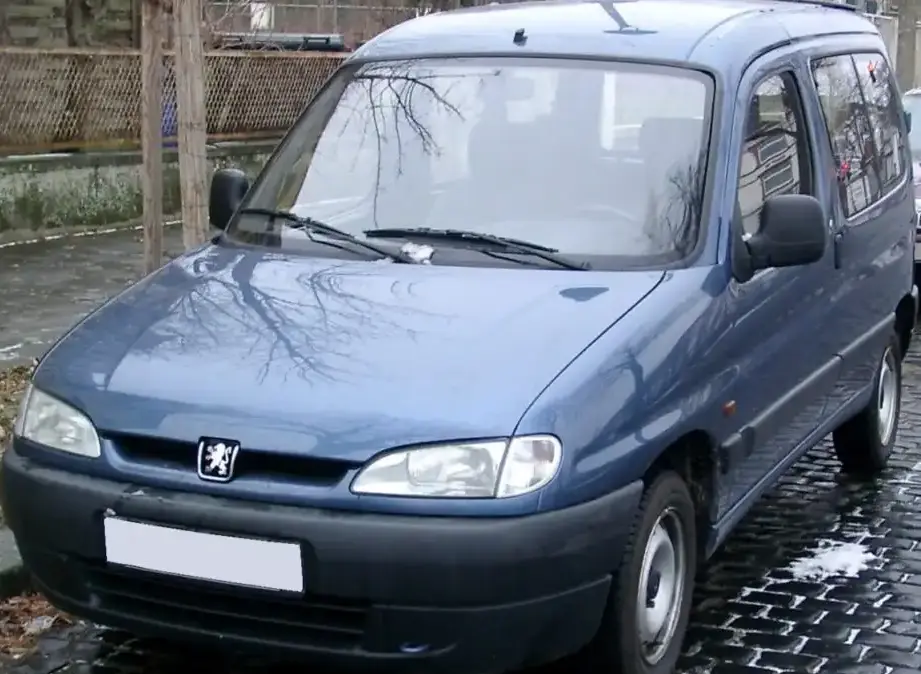
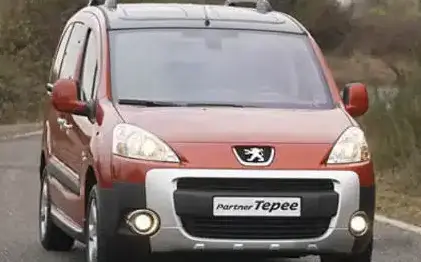
The Peugeot Partner I (Phase II), produced from 2002 to 2006, represents a notable evolution of Peugeot’s popular light commercial vehicle and multi-purpose vehicle (MPV). The 1.9 D variant, powered by a 69 horsepower diesel engine, served as a core offering within the Partner lineup during this period. Positioned as an entry-level model, it primarily appealed to buyers who valued practicality and fuel efficiency over outright performance. This version of the Partner was predominantly sold in European markets, where compact vans and MPVs remained – and continue to be – in high demand for both commercial and family applications. It is based on the first generation of the Partner, internally designated as the 5F platform.
Technical Specifications
| Brand | Peugeot |
| Model | Partner |
| Generation | Partner I (Phase II, 2002) |
| Type (Engine) | 1.9 D (69 Hp) |
| Start of production | 2002 |
| End of production | 2006 |
| Powertrain Architecture | Internal Combustion engine |
| Body type | Minivan |
| Seats | 5 |
| Doors | 5 |
| Fuel consumption (urban) | 8.8 l/100 km (26.7 US mpg, 32.1 UK mpg, 11.4 km/l) |
| Fuel consumption (extra urban) | 5.7 l/100 km (41.3 US mpg, 49.6 UK mpg, 17.5 km/l) |
| Fuel consumption (combined) | 6.9 l/100 km (34.1 US mpg, 40.9 UK mpg, 14.5 km/l) |
| Fuel Type | Diesel |
| Acceleration 0 – 100 km/h | 20.4 sec |
| Acceleration 0 – 62 mph | 20.4 sec |
| Acceleration 0 – 60 mph | 19.4 sec |
| Maximum speed | 142 km/h (88.23 mph) |
| Weight-to-power ratio | 18.3 kg/Hp, 54.5 Hp/tonne |
| Weight-to-torque ratio | 10.1 kg/Nm, 98.8 Nm/tonne |
| Power | 69 Hp @ 4600 rpm |
| Power per litre | 36.9 Hp/l |
| Torque | 125 Nm @ 2500 rpm (92.2 lb.-ft. @ 2500 rpm) |
| Engine layout | Front, Transverse |
| Engine Model/Code | WJY DW8B |
| Engine displacement | 1868 cm3 (113.99 cu. in.) |
| Number of cylinders | 4 |
| Engine configuration | Inline |
| Cylinder Bore | 82.2 mm (3.24 in.) |
| Piston Stroke | 88 mm (3.46 in.) |
| Compression ratio | 23:1 |
| Number of valves per cylinder | 2 |
| Fuel injection system | Precombustion chamber injection |
| Engine aspiration | Naturally aspirated engine |
| Valvetrain | OHC |
| Engine oil capacity | 4.5 l (4.76 US qt | 3.96 UK qt) |
| Coolant capacity | 9 l (9.51 US qt | 7.92 UK qt) |
| Kerb Weight | 1265 kg (2788.85 lbs.) |
| Max. weight | 1840 kg (4056.51 lbs.) |
| Max load | 575 kg (1267.66 lbs.) |
| Trunk (boot) space – minimum | 625 l (22.07 cu. ft.) |
| Trunk (boot) space – maximum | 2800 l (98.88 cu. ft.) |
| Fuel tank capacity | 60 l (15.85 US gal | 13.2 UK gal) |
| Length | 4140 mm (162.99 in.) |
| Width | 1720 mm (67.72 in.) |
| Height | 1810 mm (71.26 in.) |
| Wheelbase | 2690 mm (105.91 in.) |
| Front track | 1420 mm (55.91 in.) |
| Rear (Back) track | 1440 mm (56.69 in.) |
| Drivetrain Architecture | Front wheel drive |
| Number of gears | 5 |
| Gearbox type | Manual transmission |
| Front brakes | Disc |
| Rear brakes | Drum |
| Assisting systems | ABS (Anti-lock braking system) |
| Tires size | 185/65 R14H |
Powertrain & Engine Architecture
The Peugeot Partner 1.9 D’s engine is the WJY DW8B, a 1.9-liter inline-four diesel. This naturally aspirated engine utilizes precombustion chamber injection, a system prevalent in older diesel designs. This system employs a small precombustion chamber connected to the main cylinder, where fuel is initially ignited and then transferred for complete combustion. The DW8 engine family is recognized for its durability and simplicity, though it lacks the refinement of modern common-rail diesel engines. It generates 69 horsepower at 4600 rpm and 125 Nm (92.2 lb-ft) of torque at 2500 rpm. The Partner 1.9 D was exclusively equipped with a five-speed manual transmission, selected for its cost-effectiveness and compatibility with the engine’s torque characteristics. The transmission is a standard front-wheel-drive configuration.
Driving Characteristics
The Partner powered by the 1.9 D engine doesn’t offer particularly swift performance. Acceleration is gradual, taking approximately 19.4 seconds to reach 60 mph. The engine’s torque, while sufficient for everyday tasks, necessitates frequent gear changes to maintain momentum, especially when carrying a load. The five-speed manual transmission is well-suited to the engine, providing a reasonable range of gear ratios. Compared to higher-output Partner variants, such as those with the 2.0 HDI engine, the 1.9 D feels noticeably less powerful. However, the 1.9 D’s inherent simplicity and reduced stress levels contribute to its longevity. The driving experience is best described as practical, prioritizing functionality over excitement.
Equipment & Trim Levels
The 1.9 D trim level of the Partner I (Phase II) was generally a base model, emphasizing essential features. Standard equipment typically included power steering, a driver’s airbag, and basic instrumentation. Interior upholstery was usually a durable, easy-to-clean fabric. Optional extras, such as air conditioning, upgraded audio systems, and power windows, were available at an additional cost. The Partner’s interior is designed for practicality, maximizing space and ease of use. The rear seats can be folded or removed to create a larger cargo area.
Chassis & Braking
The Partner I features a relatively straightforward chassis design. The front suspension utilizes MacPherson struts, while the rear suspension employs a torsion beam axle. This setup delivers a comfortable ride, although it isn’t particularly sporty. The braking system incorporates disc brakes on the front wheels and drum brakes on the rear. Anti-lock Braking System (ABS) was standard, enhancing safety. The suspension is tuned to handle loads, providing a stable and controlled ride even when the vehicle is fully loaded. Stabilizer bars were commonly fitted to improve handling.
Market Reception & Comparison
The Peugeot Partner 1.9 D was well-received in the European market as a practical and affordable light commercial vehicle and MPV. Reviewers praised its fuel economy and durability, but acknowledged its lack of performance. Compared to the more powerful HDI diesel versions, the 1.9 D offered a lower purchase price but sacrificed refinement and performance. The 1.9 D appealed to buyers prioritizing cost-effectiveness and reliability over driving enjoyment. Its fuel economy, averaging around 34.1 US mpg combined, was a significant selling point.
Legacy
The Peugeot Partner 1.9 D, while not the most dynamic version of the Partner, has proven to be a remarkably durable and reliable vehicle. Numerous examples remain in service today, a testament to the robustness of the DW8 engine and the overall build quality of the Partner. In the used car market, the 1.9 D is often sought after by those seeking a simple, affordable, and dependable workhorse. Maintenance is relatively uncomplicated, and parts are readily available. While it may not offer the performance or refinement of newer vehicles, the Partner 1.9 D remains a practical and economical choice for those needing a versatile and reliable van or MPV.