Technical Specifications
| Brand | Peugeot |
| Model | Partner |
| Generation | Partner II Tepee |
| Type (Engine) | 1.6 (90 Hp) |
| Start of production | 2008 |
| End of production | 2012 |
| Powertrain Architecture | Internal Combustion engine |
| Body type | Minivan |
| Seats | 5 |
| Doors | 5 |
| Fuel consumption (urban) | 10.8 l/100 km (21.8 US mpg) |
| Fuel consumption (extra urban) | 6.8 l/100 km (34.6 US mpg) |
| Fuel consumption (combined) | 8.2 l/100 km (28.7 US mpg) |
| Fuel Type | Petrol (Gasoline) |
| Acceleration 0 – 100 km/h | 16.7 sec |
| Acceleration 0 – 62 mph | 16.7 sec |
| Acceleration 0 – 60 mph | 15.9 sec |
| Maximum speed | 159 km/h (98.8 mph) |
| Emission standard | Euro 4 |
| Weight-to-power ratio | 15.5 kg/Hp |
| Weight-to-torque ratio | 10.6 kg/Nm |
| Power | 90 Hp @ 5500 rpm |
| Torque | 132 Nm @ 2500 rpm (97.36 lb.-ft. @ 2500 rpm) |
| Engine layout | Front, Transverse |
| Engine Model/Code | NFR TU5JP4B |
| Engine displacement | 1587 cm3 (96.84 cu. in.) |
| Number of cylinders | 4 |
| Engine configuration | Inline |
| Cylinder Bore | 78.5 mm (3.09 in.) |
| Piston Stroke | 82 mm (3.23 in.) |
| Compression ratio | 10.2:1 |
| Number of valves per cylinder | 2 |
| Fuel injection system | Multi-port manifold injection |
| Engine aspiration | Naturally aspirated engine |
| Valvetrain | DOHC |
| Engine oil capacity | 3.25 l (3.43 US qt | 2.86 UK qt) |
| Coolant capacity | 5.9 l (6.23 US qt | 5.19 UK qt) |
| Kerb Weight | 1397 kg (3079.86 lbs.) |
| Max. weight | 2025 kg (4464.36 lbs.) |
| Max load | 628 kg (1384.5 lbs.) |
| Trunk (boot) space – minimum | 505 l (17.83 cu. ft.) |
| Fuel tank capacity | 60 l (15.85 US gal | 13.2 UK gal) |
| Length | 4380 mm (172.44 in.) |
| Width | 1810 mm (71.26 in.) |
| Height | 1803 mm (70.98 in.) |
| Wheelbase | 2728 mm (107.4 in.) |
| Front track | 1505 mm (59.25 in.) |
| Rear track | 1554 mm (61.18 in.) |
| Drivetrain Architecture | Front wheel drive |
| Number of gears | 5 gears, manual transmission |
| Front brakes | Ventilated discs |
| Rear brakes | Disc |
| Assisting systems | ABS (Anti-lock braking system) |
| Tires size | 205/65 R15H |
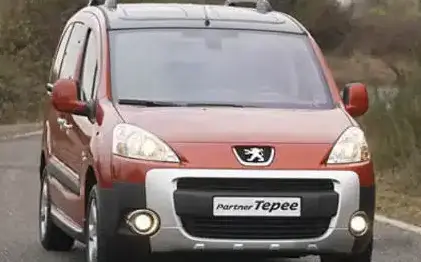
The Peugeot Partner II Tepee 1.6, producing 90 horsepower, was a popular configuration of Peugeot’s versatile leisure activity vehicle (LAV) sold primarily in Europe from 2008 to 2012. Positioned as an entry-level to mid-range option within the Partner II Tepee lineup, it offered a practical and affordable solution for families and commercial users alike. This variant was part of the first generation facelift (post-2008) of the Partner II, which itself was based on the Citroën Berlingo and shared its platform with other vehicles within the PSA Group (now Stellantis). The Tepee designation signified a more passenger-focused trim level compared to the standard Partner van.
Powertrain & Engine Architecture
The heart of the Partner II Tepee 1.6 90 Hp is the NFR TU5JP4B engine, a 1.6-liter inline-four cylinder gasoline engine. This engine was a mainstay of PSA’s offerings for many years, known for its relative simplicity and durability. It utilizes a multi-point fuel injection system, delivering fuel to each cylinder independently for optimized combustion. The engine features a double overhead camshaft (DOHC) valvetrain, operating two valves per cylinder. This configuration contributes to reasonable power output and efficiency for its displacement. The 90 horsepower output is achieved at 5500 rpm, while peak torque of 132 Nm (97.36 lb-ft) is delivered at 2500 rpm. The engine is transversely mounted in the front of the vehicle, driving the front wheels. The standard transmission for this variant was a five-speed manual gearbox, although a four-speed automatic transmission was also available, albeit less common.
Driving Characteristics
The 1.6-liter engine with 90 hp in the Partner II Tepee provided adequate, but not exhilarating, performance. Acceleration from 0-60 mph took around 15.9 seconds, and top speed was limited to approximately 98.8 mph. The engine felt somewhat strained when fully loaded or climbing hills. The five-speed manual transmission offered a reasonable spread of gears, allowing the driver to keep the engine in its optimal power band. The automatic transmission, while offering convenience, further reduced performance and increased fuel consumption. The gear ratios were tuned for economy rather than outright speed. Compared to the more powerful 1.6 HDi diesel variants, the gasoline engine lacked low-end torque, requiring more frequent downshifts. Handling was typical for a small minivan – comfortable and predictable, but not particularly sporty.
Equipment & Trim Levels
The Partner II Tepee 1.6 90 Hp typically came with a modest level of standard equipment. This included power steering, central locking, electric front windows, and an adjustable steering column. Interior upholstery was generally cloth, with a durable and practical design. Higher trim levels, such as the ‘Outdoor’ or ‘Escapade’ versions, added features like air conditioning, alloy wheels, and upgraded interior trim. Optional extras included a panoramic sunroof, rear parking sensors, and a CD player with radio. The dashboard layout was functional and straightforward, prioritizing usability over aesthetics.
Chassis & Braking
The Partner II Tepee utilized a relatively simple chassis design. Front suspension consisted of MacPherson struts, while the rear employed a torsion beam axle. This setup provided a comfortable ride, but didn’t offer particularly engaging handling. Braking was handled by ventilated discs on the front wheels and solid discs on the rear. Anti-lock Braking System (ABS) was standard, enhancing safety. The suspension was tuned to prioritize ride comfort and load-carrying capacity over sporty handling. Stabilizer bars were fitted to both the front and rear axles to reduce body roll.
Market Reception & Comparison
The Peugeot Partner II Tepee 1.6 90 Hp was generally well-received as a practical and affordable family vehicle. Critics praised its spacious interior, versatility, and fuel efficiency (around 28.7 US mpg combined). However, the engine was often criticized for its lack of power, particularly when the vehicle was fully loaded. Compared to the diesel variants, the 1.6 gasoline engine offered lower fuel economy and less torque. The automatic transmission was also seen as a detriment to performance. The Partner II Tepee competed with other small minivans such as the Citroën Berlingo, Renault Kangoo, and Fiat Doblo.
Legacy
The Peugeot Partner II Tepee 1.6 90 Hp remains a relatively common sight on European roads today. The TU5JP4B engine is known for its durability, although regular maintenance is essential to prevent issues such as oil leaks and timing belt failure. Used examples are generally affordable, making them an attractive option for budget-conscious buyers. While not a performance standout, the 1.6-liter engine provides adequate power for everyday use. The Partner II Tepee’s practicality and versatility have ensured its continued popularity in the used car market, particularly among families and small businesses.