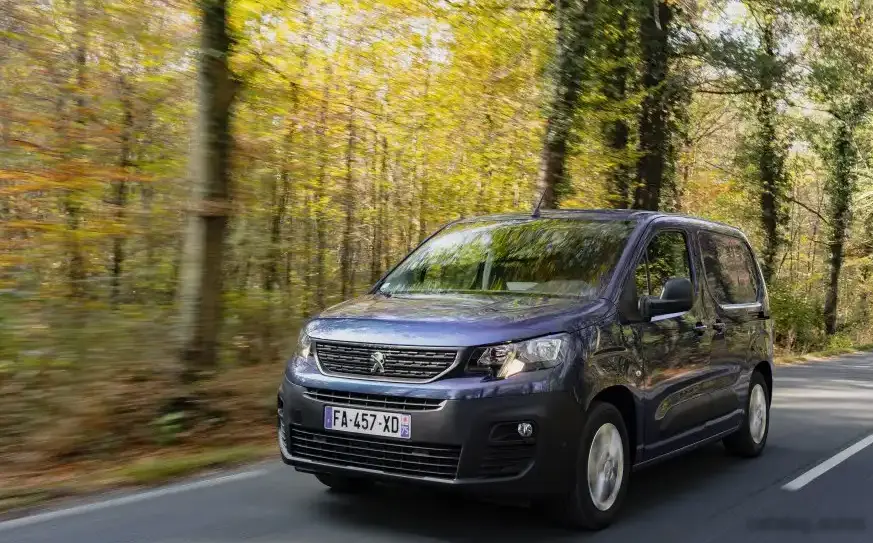
The Peugeot Partner III Van 1.6 BlueHDi (75 hp) is a commercial vehicle produced by the French manufacturer Peugeot, starting in 2019. It represents a key variant within the third generation of the Partner van, a vehicle known for its practicality and versatility in the light commercial vehicle (LCV) segment. This specific configuration, featuring the 1.6-liter BlueHDi diesel engine paired with a five-speed manual transmission, was designed to offer an economical and functional solution for businesses and tradespeople. It falls within the broader range of Partner III models, which also include variations in length, payload capacity, and engine options, catering to a diverse range of commercial needs. The Partner III is based on the EMP2 platform, shared with other PSA Group vehicles like the Citroën Berlingo and Opel Combo.
Technical Specifications
| Brand | Peugeot |
| Model | Partner |
| Generation | Partner III Van |
| Type (Engine) | 1.6 BlueHDi (75 Hp) |
| Start of production | 2019 |
| Powertrain Architecture | Internal Combustion engine |
| Body type | Minivan |
| Seats | 5 |
| Doors | 5 |
| Fuel consumption (urban) | 4.9 l/100 km (48 US mpg, 57.6 UK mpg, 20.4 km/l) |
| Fuel consumption (extra urban) | 4.1 l/100 km (57.4 US mpg, 68.9 UK mpg, 24.4 km/l) |
| Fuel consumption (combined) | 4.4 l/100 km (53.5 US mpg, 64.2 UK mpg, 22.7 km/l) |
| CO2 emissions | 114 g/km |
| Fuel Type | Diesel |
| Acceleration 0 – 100 km/h | 15.7-16.5 sec |
| Acceleration 0 – 62 mph | 15.7-16.5 sec |
| Acceleration 0 – 60 mph | 14.9 sec |
| Maximum speed | 151 km/h (93.83 mph) |
| Emission standard | Euro 6 |
| Weight-to-power ratio | 17.4 kg/Hp, 57.6 Hp/tonne |
| Weight-to-torque ratio | 5.7 kg/Nm, 176.5 Nm/tonne |
| Power | 75 Hp @ 3500 rpm |
| Power per litre | 48.1 Hp/l |
| Torque | 230 Nm @ 1750 rpm (169.64 lb.-ft. @ 1750 rpm) |
| Engine layout | Front, Transverse |
| Engine Model/Code | BHW DV6FE |
| Engine displacement | 1560 cm3 (95.2 cu. in.) |
| Number of cylinders | 4 |
| Engine configuration | Inline |
| Cylinder Bore | 75 mm (2.95 in.) |
| Piston Stroke | 88.3 mm (3.48 in.) |
| Number of valves per cylinder | 4 |
| Fuel injection system | Diesel Commonrail |
| Engine aspiration | Turbocharger, Intercooler |
| Engine oil capacity | 3.75 l (3.96 US qt | 3.3 UK qt) |
| Kerb Weight | 1303-1320 kg (2872.62 – 2910.1 lbs.) |
| Max. weight | 2350 kg (5180.86 lbs.) |
| Max load | 1030-1047 kg (2270.76 – 2308.24 lbs.) |
| Trunk (boot) space – maximum | 3900 l (137.73 cu. ft.) |
| Fuel tank capacity | 50 l (13.21 US gal | 11 UK gal) |
| AdBlue tank | 17 l (4.49 US gal | 3.74 UK gal) |
| Permitted trailer load with brakes (12%) | 750-1000 kg (1653.47 – 2204.62 lbs.) |
| Permitted trailer load without brakes | 680-690 kg (1499.14 – 1521.19 lbs.) |
| Permitted towbar download | 74 kg (163.14 lbs.) |
| Length | 4403 mm (173.35 in.) |
| Width | 1848 mm (72.76 in.) |
| Width including mirrors | 2107 mm (82.95 in.) |
| Height | 1840-1860 mm (72.44 – 73.23 in.) |
| Wheelbase | 2785 mm (109.65 in.) |
| Front overhang | 892 mm (35.12 in.) |
| Rear overhang | 726 mm (28.58 in.) |
| Minimum turning circle | 10.82-10.85 m (35.5 – 35.6 ft.) |
| Drivetrain Architecture | Front wheel drive |
| Drive wheel | Front wheel drive |
| Number of gears and type of gearbox | 5 gears, manual transmission |
| Front brakes | Ventilated discs |
| Rear brakes | Disc |
| Assisting systems | ABS (Anti-lock braking system) |
| Steering type | Steering rack and pinion |
| Power steering | Electric Steering |
| Tires size | 195/65 R15; 215/65 R16 |
| Wheel rims size | 15; 16 |
Powertrain & Engine Architecture
The heart of this Partner III variant is the 1.6-liter BlueHDi diesel engine, specifically the DV6FE engine code (BHW). This engine is a four-cylinder, inline configuration, utilizing a common-rail direct fuel injection system. The BlueHDi technology incorporates a Selective Catalytic Reduction (SCR) system, utilizing AdBlue (Diesel Exhaust Fluid) to reduce nitrogen oxide (NOx) emissions, ensuring compliance with stringent Euro 6 emission standards. The engine features a turbocharger with an intercooler, which enhances power output and efficiency. The 75 horsepower output is achieved at 3500 rpm, while the peak torque of 230 Nm (169.64 lb.-ft.) is delivered at 1750 rpm. This torque curve provides good low-end responsiveness, suitable for carrying loads. The engine is transversely mounted in the front of the vehicle. The five-speed manual transmission is a standard gearbox, chosen for its simplicity and cost-effectiveness. Gear ratios are optimized for fuel economy and load-carrying capability rather than outright performance.
Driving Characteristics
The 1.6 BlueHDi 75 hp engine, when paired with the five-speed manual transmission, delivers a functional, rather than sporty, driving experience. Acceleration is modest, with a 0-60 mph time around 14.9 seconds. The focus is on providing sufficient power for everyday commercial tasks and maintaining good fuel economy. The engine’s torque characteristics mean that it feels more responsive in the lower gears, making it suitable for navigating urban environments and carrying loads. The gear ratios are relatively long, prioritizing fuel efficiency at cruising speeds. Compared to higher-powered versions of the Partner III, such as those with the 100 or 130 hp engines, this variant feels noticeably slower, especially when fully loaded. However, it offers a significant advantage in fuel consumption.
Equipment & Trim Levels
The 1.6 BlueHDi 75 hp variant of the Partner III Van typically represents an entry-level or mid-range trim. Standard equipment generally includes features like power steering, ABS, a driver’s airbag, and basic steel wheels. Interior appointments are functional and durable, with hard-wearing plastics and cloth upholstery. Depending on the specific market and optional packages, features like air conditioning, a radio with Bluetooth connectivity, and rear parking sensors could be added. The van’s interior is designed with practicality in mind, offering a comfortable driver’s seat and a functional dashboard layout. The cargo area is the primary focus, offering a substantial 3900 liters of space.
Chassis & Braking
The Partner III Van utilizes a conventional front-wheel-drive layout with a MacPherson strut front suspension and a torsion beam rear suspension. This setup provides a good balance between ride comfort and load-carrying capacity. The braking system consists of ventilated discs on the front wheels and solid discs on the rear. ABS (Anti-lock Braking System) is standard. The suspension is tuned to prioritize stability and handling when carrying loads, rather than providing a particularly sporty driving experience. The steering is electrically assisted, providing light and easy steering for urban driving.
Market Reception & Comparison
The Peugeot Partner III 1.6 BlueHDi 75 hp was generally well-received as a practical and economical choice for businesses seeking a reliable light commercial vehicle. Critics praised its fuel efficiency and low running costs. Compared to the more powerful engine options, this variant was seen as a more budget-friendly option, suitable for businesses that didn’t require maximum performance. The 1.6 BlueHDi engine offered a good balance between fuel economy and reliability, making it a popular choice in the LCV segment. Compared to competitors like the Volkswagen Caddy or the Ford Transit Connect, the Partner III offered a competitive price point and a spacious cargo area.
Legacy
The 1.6 BlueHDi engine has proven to be a relatively reliable powertrain, with many examples still in service today. Common maintenance items include regular oil changes, filter replacements, and AdBlue top-ups. The engine is generally known for its durability, but like any diesel engine, it can be susceptible to issues with the turbocharger or fuel injection system if not properly maintained. On the used car market, the Partner III 1.6 BlueHDi 75 hp represents a good value proposition for businesses seeking an affordable and practical van. Its fuel efficiency and relatively low maintenance costs make it an attractive option for those on a budget.