
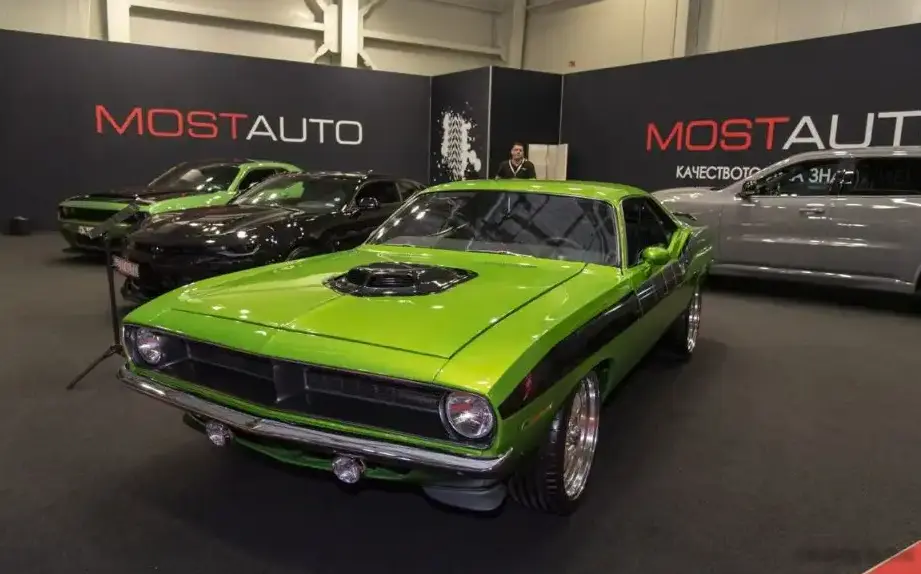
The Plymouth Barracuda III, specifically the 3.7-liter (225 cubic inch) variant producing 145 horsepower, represented an entry-level offering within the second-generation Barracuda lineup, produced solely for the 1970 model year. This generation, often referred to as the ‘Cuda, marked a significant departure from the earlier, Valiant-based models, adopting a more aggressive and sporty aesthetic. The 3.7-liter engine served as the base powerplant, aiming to provide affordable transportation while still embodying the Barracuda’s performance-oriented image. It occupied the lower end of a diverse engine range that included larger V8 options, catering to a broader spectrum of buyers.
Technical Specifications
| Brand | Plymouth |
| Model | Barracuda |
| Generation | Barracuda III |
| Type (Engine) | 3.7 (145 Hp) |
| Start of production | 1970 |
| End of production | 1970 |
| Powertrain Architecture | Internal Combustion engine |
| Body type | Coupe |
| Seats | 4 |
| Doors | 2 |
| Fuel Type | Petrol (Gasoline) |
| Power | 145 Hp @ 4000 rpm |
| Power per litre | 39.3 Hp/l |
| Torque | 292 Nm @ 2400 rpm |
| Torque (lb-ft) | 215.37 lb.-ft. @ 2400 rpm |
| Engine layout | Front, Longitudinal |
| Engine Model/Code | Slant Six |
| Engine displacement | 3687 cm3 |
| Engine displacement (cu. in.) | 224.99 cu. in. |
| Number of cylinders | 6 |
| Engine configuration | Inline |
| Cylinder Bore | 86.4 mm |
| Cylinder Bore (in.) | 3.4 in. |
| Piston Stroke | 104.8 mm |
| Piston Stroke (in.) | 4.13 in. |
| Compression ratio | 8.4:1 |
| Number of valves per cylinder | 2 |
| Fuel injection system | Carburettor |
| Engine aspiration | Naturally aspirated engine |
| Valvetrain | OHV |
| Engine oil capacity | 4.7 l |
| Engine oil capacity (US qt) | 4.97 US qt |
| Engine oil capacity (UK qt) | 4.14 UK qt |
| Trunk (boot) space – minimum | 167 l |
| Trunk (boot) space (cu. ft.) | 5.9 cu. ft. |
| Fuel tank capacity | 72 l |
| Fuel tank capacity (US gal) | 19.02 US gal |
| Fuel tank capacity (UK gal) | 15.84 UK gal |
| Length | 4742 mm |
| Length (in.) | 186.69 in. |
| Width | 1902 mm |
| Width (in.) | 74.88 in. |
| Height | 1293 mm |
| Height (in.) | 50.91 in. |
| Wheelbase | 2743 mm |
| Wheelbase (in.) | 107.99 in. |
| Front track | 1516 mm |
| Front track (in.) | 59.69 in. |
| Rear (Back) track | 1557 mm |
| Rear (Back) track (in.) | 61.3 in. |
| Drivetrain Architecture | The Internal combustion engine (ICE) drives the rear wheels of the vehicle. |
| Drive wheel | Rear wheel drive |
| Number of gears and type of gearbox | 3 gears, manual transmission |
| Front suspension | Independent torsion bar, double wishbone |
| Rear suspension | Rigid axle suspension, Leaf spring |
| Front brakes | Drum, 254×63.5 mm |
| Rear brakes | Drum, 254×63.5 mm |
| Steering type | Cone worm with recirculation balls |
| Wheel rims size | 5J x 14 |
Powertrain & Engine Architecture
The heart of this Barracuda variant was the Chrysler Slant Six engine, specifically the 3.7-liter (225 cubic inch) version. This engine, designated internally as the LA225, was known for its durability and relatively simple design. It featured an overhead valve (OHV) configuration with two valves per cylinder. Fuel delivery was managed by a single-barrel carburetor, a common setup for the time, prioritizing simplicity and cost-effectiveness. The engine’s “slant” refers to the 30-degree cylinder bank angle, which allowed for a lower engine profile and improved rigidity. The 145 horsepower output was achieved at 4000 rpm, while peak torque of 292 Nm (215.37 lb-ft) arrived at 2400 rpm. This engine was paired with a standard three-speed manual transmission, providing a direct connection to the rear wheels. The longitudinal engine placement was typical for rear-wheel-drive vehicles of the era.
Driving Characteristics
The 3.7-liter Barracuda offered a distinctly different driving experience compared to its V8-powered siblings. Acceleration was modest, focusing on providing adequate power for everyday driving rather than outright speed. The three-speed manual transmission, while offering driver engagement, had relatively wide gear ratios, meaning the engine often operated at higher rpm during highway cruising. The Slant Six was known for its smooth operation and willingness to rev, but it lacked the low-end grunt of the larger displacement engines. Handling was typical for a 1970s American coupe – comfortable but not particularly sporty. The torsion bar front suspension provided a reasonably compliant ride, while the leaf-sprung rear end could feel somewhat stiff over rough surfaces.
Equipment & Trim Levels
The base 3.7-liter Barracuda was positioned as the entry-level model. Standard features included basic vinyl upholstery, a simple dashboard layout, and minimal exterior trim. While not lavishly equipped, it did offer essential amenities like a heater and defroster. Optional extras included upgraded interior trim, a radio, and various appearance packages. The interior was functional and straightforward, reflecting the car’s affordable price point. The exterior typically featured minimal brightwork, emphasizing the Barracuda’s sporty lines without excessive ornamentation.
Chassis & Braking
The Barracuda III utilized a body-on-frame construction, common for American cars of the period. The front suspension employed independent torsion bars and a double wishbone setup, providing a degree of ride comfort and handling stability. The rear suspension consisted of a solid axle with leaf springs, a more traditional and cost-effective design. Braking duties were handled by drum brakes on all four wheels, measuring 254×63.5 mm. While adequate for the car’s weight and performance, the drum brakes lacked the stopping power and fade resistance of disc brakes. Steering was accomplished via a cone worm and recirculating ball system, offering a somewhat indirect feel.
Market Reception & Comparison
The 1970 Barracuda with the 3.7-liter engine was generally viewed as a sensible and affordable option for buyers seeking a stylish coupe. Critics acknowledged its attractive design but noted its modest performance compared to the V8 models. Fuel economy was a relative strength, particularly in an era of rising gasoline prices. Compared to the Barracuda models equipped with the 318 or 340 cubic inch V8 engines, the 3.7-liter version offered significantly less power and acceleration. However, it also boasted lower maintenance costs and better fuel efficiency. The 3.7-liter was often seen as a good choice for students or those prioritizing practicality over performance.
Legacy
The 1970 Plymouth Barracuda 3.7, while not the most sought-after variant, holds a place in automotive history as a representative of the early muscle car era. The Slant Six engine proved to be remarkably durable, and many examples are still on the road today. In the used car market, these models are generally more affordable than their V8 counterparts, making them an accessible entry point for enthusiasts. While not a high-performance machine, the 3.7-liter Barracuda offers a unique blend of style, affordability, and reliability, appealing to those seeking a classic American coupe with a more modest character.
