
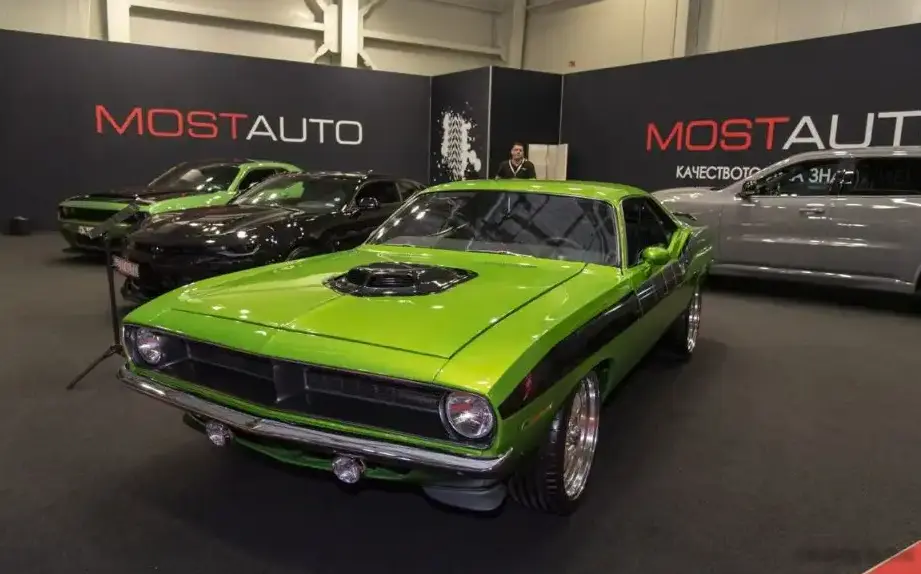
The Plymouth Barracuda AAR (All American Racing) was a high-performance variant of the third-generation Barracuda, produced for a single model year in 1970. Developed in collaboration with Dan Gurney’s All American Racing team, the AAR was specifically designed for Trans-Am racing homologation. While the racing program didn’t achieve the success hoped for, the AAR became a highly sought-after muscle car, representing a potent blend of Plymouth’s performance heritage and racing technology. It was positioned as the ultimate performance version of the Barracuda, sitting above the standard 383 cubic inch models and offering a more focused driving experience than the luxurious ‘Cuda variants.
Technical Specifications
| Brand | Plymouth |
| Model | Barracuda |
| Generation | Barracuda III |
| Type (Engine) | AAR 5.6 V8 (290 Hp) |
| Start of production | 1970 |
| End of production | 1970 |
| Powertrain Architecture | Internal Combustion engine |
| Body type | Coupe |
| Seats | 4 |
| Doors | 2 |
| Fuel Type | Petrol (Gasoline) |
| Weight-to-power ratio | 5.2 kg/Hp, 194 Hp/tonne |
| Weight-to-torque ratio | 3.1 kg/Nm, 317.7 Nm/tonne |
| Power | 290 Hp @ 5000 rpm |
| Power per litre | 52.1 Hp/l |
| Torque | 475 Nm @ 2800 rpm, 350.34 lb.-ft. @ 2800 rpm |
| Engine layout | Front, Longitudinal |
| Engine Model/Code | LA |
| Engine displacement | 5563 cm3, 339.48 cu. in. |
| Number of cylinders | 8 |
| Engine configuration | V-engine |
| Cylinder Bore | 102.6 mm, 4.04 in. |
| Piston Stroke | 84.1 mm, 3.31 in. |
| Compression ratio | 10.5:1 |
| Number of valves per cylinder | 2 |
| Fuel injection system | Carburettor |
| Engine aspiration | Naturally aspirated engine |
| Valvetrain | OHV |
| Kerb Weight | 1495 kg, 3295.91 lbs |
| Trunk (boot) space – minimum | 167 l, 5.9 cu. ft |
| Fuel tank capacity | 72 l, 19.02 US gal | 15.84 UK gal |
| Length | 4742 mm, 186.69 in |
| Width | 1902 mm, 74.88 in |
| Height | 1293 mm, 50.91 in |
| Wheelbase | 2743 mm, 107.99 in |
| Front track | 1516 mm, 59.69 in |
| Rear (Back) track | 1542 mm, 60.71 in |
| Drivetrain Architecture | The Internal combustion engine (ICE) drives the rear wheels of the vehicle. |
| Drive wheel | Rear wheel drive |
| Number of gears and type of gearbox | 4 gears, manual transmission |
| Front suspension | Independent torsion bar, double wishbone, Transverse stabilizer |
| Rear suspension | Rigid axle suspension, Transverse stabilizer, Leaf spring |
| Front brakes | Disc |
| Rear brakes | Drum, 279.4×63.5 mm |
| Steering type | Cone worm with recirculation balls |
| Wheel rims size | 7J x 15 |
Powertrain & Engine Architecture
The heart of the AAR Barracuda was the 340 cubic inch (5.6-liter) LA-series V8 engine. While advertised as producing 290 horsepower, dyno tests often revealed figures closer to 325-340 hp. This power increase was achieved through a combination of factors, including a high-flow cylinder head design, a more aggressive camshaft, and a specially tuned carburetor. The engine featured a cast iron block and aluminum cylinder heads, contributing to its robust construction. The LA engine was known for its relatively simple design and ease of maintenance, making it a popular choice for both street and track applications. The AAR was exclusively offered with a four-speed manual transmission, a crucial element for maximizing performance and driver engagement. This transmission was a heavy-duty unit designed to handle the engine’s substantial torque output.
Driving Characteristics
The AAR Barracuda delivered a raw and visceral driving experience. The 340 V8 provided strong acceleration throughout the rev range, with peak torque arriving relatively early at 2800 rpm. The four-speed manual transmission allowed drivers to precisely control the engine’s power, making the most of its capabilities. The car’s relatively lightweight construction, compared to other full-size muscle cars of the era, contributed to its nimble handling. However, the solid rear axle suspension and relatively basic steering system meant that the AAR wasn’t as refined as some of its European counterparts. The AAR was a car that demanded driver attention and skill, rewarding those who were willing to push its limits.
Equipment & Trim Levels
The AAR Barracuda was a fairly spartan machine, focused primarily on performance. Standard features included a heavy-duty suspension, disc brakes on the front wheels, and a unique “AAR” exterior styling package. This package included a distinctive fiberglass hood with a centrally located scoop, a rear spoiler, and special side stripes. The interior was relatively basic, with standard vinyl upholstery and a minimal array of options. However, buyers could opt for features such as a radio, air conditioning, and upgraded interior trim. The AAR’s interior was designed to be functional and driver-focused, rather than luxurious.
Chassis & Braking
The Barracuda AAR utilized a traditional body-on-frame construction. The front suspension featured independent torsion bars and a double wishbone setup, while the rear suspension employed a solid axle with leaf springs. This configuration provided a good balance of ride comfort and handling, although it wasn’t as sophisticated as some contemporary independent rear suspension designs. The AAR came equipped with disc brakes on the front wheels and drum brakes on the rear. While the braking system was adequate for street use, it wasn’t as powerful or fade-resistant as some of the more advanced braking systems available on other performance cars.
Market Reception & Comparison
The AAR Barracuda was generally well-received by automotive critics, who praised its performance and handling. However, some critics noted its relatively basic interior and lack of refinement. Compared to other muscle cars of the era, such as the Chevrolet Chevelle SS and the Ford Mustang Mach 1, the AAR offered a more focused and raw driving experience. It was also more expensive than many of its competitors, reflecting its limited production run and performance-oriented features. The AAR’s fuel economy was typical for a muscle car of its time, averaging around 15-18 miles per gallon.
Legacy
The Plymouth Barracuda AAR has become a highly collectible muscle car, with values continuing to rise. Its limited production run, combined with its performance pedigree and association with Dan Gurney, has made it a favorite among enthusiasts. The 340 LA engine is known for its durability and reliability, and many AARs are still being driven and enjoyed today. While the AAR’s racing program didn’t achieve the success hoped for, the car remains a significant chapter in Plymouth’s performance history, representing a bold and uncompromising approach to muscle car design.
