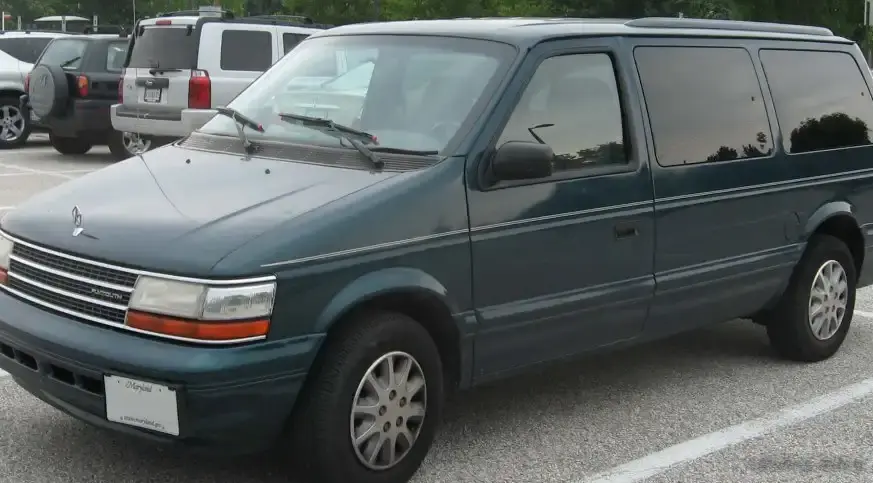
The Plymouth Grand Voyager 3.0 i V6 (144 hp) was a significant offering in the American minivan market from 1990 to 1995. Representing the first generation of the Voyager, this variant played a crucial role in establishing Plymouth as a competitive force in the family transportation segment. It was positioned as a comfortably equipped, mid-range option within the Grand Voyager lineup, offering a balance between affordability and features. The model year range corresponds to the initial release of the AS platform, which was also shared with the Dodge Caravan and Chrysler Town & Country.
Technical Specifications
| Brand | Plymouth |
| Model | Grand Voyager |
| Type (Engine) | 3.0 i V6 (144 Hp) |
| Start of production | 1990 year |
| End of production | 1995 year |
| Powertrain Architecture | Internal Combustion engine |
| Body type | Minivan |
| Seats | 7 |
| Doors | 4 |
| Fuel consumption (combined) | 11.2 l/100 km (21 US mpg, 25.2 UK mpg, 8.9 km/l) |
| Fuel Type | Petrol (Gasoline) |
| Weight-to-power ratio | 10.9 kg/Hp, 91.4 Hp/tonne |
| Weight-to-torque ratio | 6.7 kg/Nm, 149.2 Nm/tonne |
| Power | 144 Hp @ 5000 rpm |
| Power per litre | 48.5 Hp/l |
| Torque | 235 Nm @ 2800 rpm (173.33 lb.-ft. @ 2800 rpm) |
| Engine layout | Front, Transverse |
| Engine Model/Code | 6G72 |
| Engine displacement | 2972 cm3 (181.36 cu. in.) |
| Number of cylinders | 6 |
| Engine configuration | V-engine |
| Cylinder Bore | 91.1 mm (3.59 in.) |
| Piston Stroke | 76 mm (2.99 in.) |
| Compression ratio | 8.9:1 |
| Number of valves per cylinder | 2 |
| Fuel injection system | Multi-port manifold injection |
| Engine aspiration | Naturally aspirated engine |
| Valvetrain | OHC |
| Engine oil capacity | 4.3 l (4.54 US qt | 3.78 UK qt) |
| Coolant | 9.5 l (10.04 US qt | 8.36 UK qt) |
| Kerb Weight | 1575 kg (3472.28 lbs.) |
| Trunk (boot) space – minimum | 1020 l (36.02 cu. ft.) |
| Fuel tank capacity | 75 l (19.81 US gal | 16.5 UK gal) |
| Length | 4896 mm (192.76 in.) |
| Width | 1830 mm (72.05 in.) |
| Height | 1646 mm (64.8 in.) |
| Wheelbase | 3030 mm (119.29 in.) |
| Front track | 1522 mm (59.92 in.) |
| Rear (Back) track | 1578 mm (62.13 in.) |
| Drivetrain Architecture | The Internal combustion engine (ICE) drives the front wheels of the vehicle. |
| Drive wheel | Front wheel drive |
| Number of gears and type of gearbox | 3 gears, automatic transmission |
| Front suspension | Coil spring |
| Rear suspension | Coil spring |
| Front brakes | Ventilated discs |
| Rear brakes | Drum |
| Assisting systems | ABS (Anti-lock braking system) |
| Steering type | Steering rack and pinion |
| Power steering | Hydraulic Steering |
| Tires size | 205/70 R15 S |
Powertrain & Engine Architecture
The heart of the Grand Voyager 3.0 i V6 was the Mitsubishi-sourced 6G72 engine. This 2.97-liter, naturally aspirated V6 featured a 60-degree V-angle and utilized a single overhead camshaft (OHC) design for each cylinder bank. The engine employed multi-port fuel injection, contributing to improved fuel efficiency and smoother operation compared to earlier carbureted designs. The 6G72 was known for its relatively robust construction and decent power output for its displacement. Paired with this engine was a 3-speed automatic transmission, designed for comfortable and convenient operation. This transmission, while not particularly sophisticated by modern standards, provided adequate shifting performance for everyday driving. The automatic transmission was a key selling point for families prioritizing ease of use over sporty driving dynamics.
Driving Characteristics
The 144 horsepower and 173 lb-ft of torque delivered by the 3.0L V6 and automatic transmission combination resulted in adequate, but not exhilarating, performance. Acceleration was sufficient for merging onto highways and passing slower traffic, but the Grand Voyager wasn’t designed for quick sprints. The 3-speed automatic transmission had relatively wide gear ratios, which meant that the engine often operated at higher RPMs during acceleration. This could lead to a noticeable drone, especially under heavy load. Compared to the manual transmission versions, the automatic offered less driver control and slightly reduced fuel economy. However, it provided a more relaxed driving experience, particularly in stop-and-go traffic.
Equipment & Trim Levels
The 3.0 i V6 automatic trim typically included features such as air conditioning, power windows and locks, and an AM/FM stereo. Higher trim levels offered upgrades like cruise control, upgraded upholstery (often cloth or velour), and a rear window wiper. The interior was designed with family practicality in mind, featuring durable materials and ample storage compartments. Optional extras included a factory-installed cassette player, alloy wheels, and a towing package. The Grand Voyager prioritized functionality and comfort over luxury, making it an appealing choice for budget-conscious families.
Chassis & Braking
The Grand Voyager utilized a front-wheel-drive layout with independent coil spring suspension in the front and a solid axle with coil springs in the rear. The front brakes were ventilated discs, providing adequate stopping power, while the rear brakes were drums. ABS (Anti-lock Braking System) was available, and became increasingly common as a standard feature towards the end of the production run. The suspension was tuned for a comfortable ride, prioritizing smoothness over sporty handling. Steering was rack-and-pinion with hydraulic power assist, making it relatively easy to maneuver in tight spaces.
Market Reception & Comparison
The Plymouth Grand Voyager 3.0 i V6 automatic was generally well-received by critics as a practical and affordable family vehicle. It offered a compelling alternative to larger, more expensive station wagons. Fuel economy was considered average for its class, around 21 mpg in combined driving. Compared to the base 2.5-liter four-cylinder engine, the 3.0L V6 offered a significant performance boost, albeit at a slightly higher price point. The V6 automatic was often seen as a sweet spot in the lineup, providing a good balance of power, fuel economy, and convenience. Reliability was generally good, although some owners reported issues with the automatic transmission over the long term.
Legacy
The Plymouth Grand Voyager 3.0 i V6 (144 hp) remains a relatively common sight on used car lots today. The 6G72 engine is known for its durability, and many examples have surpassed 200,000 miles with proper maintenance. However, potential buyers should be aware of potential issues with the automatic transmission, such as slipping or harsh shifting. Overall, this variant represents a solid and dependable choice for those seeking an affordable and spacious minivan. Its impact on the minivan segment was significant, helping to popularize the front-wheel-drive, family-oriented vehicle that remains a staple of American roads.