
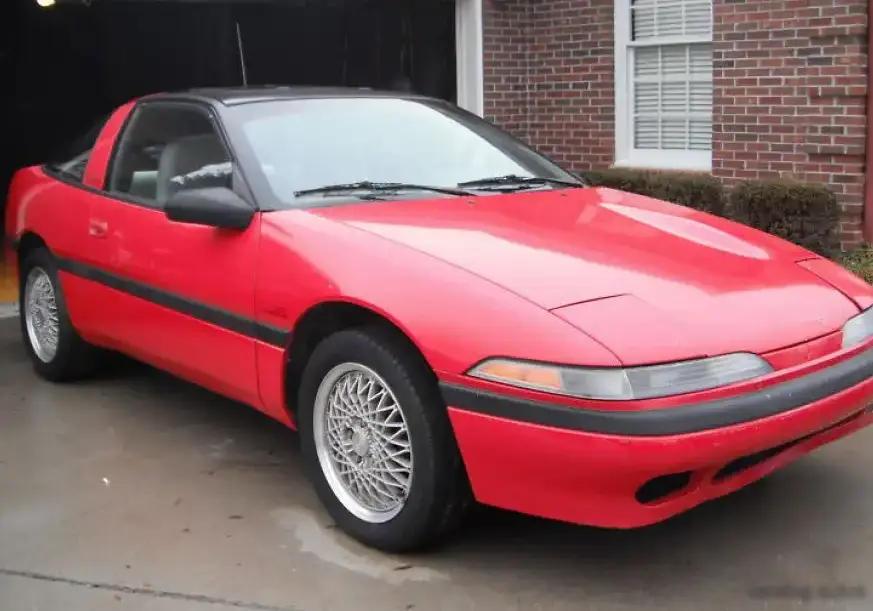
The Plymouth Laser 1.8i, equipped with a 94 horsepower engine and an automatic transmission, was a compact coupe produced between 1989 and 1994. It represented Plymouth’s entry into the sporty coupe market, leveraging a collaborative effort with Mitsubishi and Chrysler. The Laser was part of the first generation, sharing its platform (the Chrysler/Mitsubishi Diamond Star platform) with the Eagle Talon and Mitsubishi Eclipse. This particular 1.8L automatic variant served as the base model, offering an affordable and relatively fuel-efficient option within the Laser lineup.
Technical Specifications
| Brand | Plymouth |
| Model | Laser |
| Generation | Laser |
| Type (Engine) | 1.8i (94 Hp) Automatic |
| Start of production | 1989 |
| End of production | 1994 |
| Powertrain Architecture | Internal Combustion engine |
| Body type | Coupe |
| Seats | 4 |
| Doors | 3 |
| Fuel consumption (urban) | 10 l/100 km (23.5 US mpg) |
| Fuel consumption (extra urban) | 6 l/100 km (39.2 US mpg) |
| Fuel Type | Petrol (Gasoline) |
| Maximum speed | 170 km/h (105.63 mph) |
| Weight-to-power ratio | 12.7 kg/Hp |
| Weight-to-torque ratio | 8.4 kg/Nm |
| Power | 94 Hp @ 5000 rpm |
| Power per litre | 53.6 Hp/l |
| Torque | 142 Nm @ 3500 rpm (104.73 lb.-ft. @ 3500 rpm) |
| Engine layout | Front, Transverse |
| Engine Model/Code | 4G37 |
| Engine displacement | 1755 cm3 (107.1 cu. in.) |
| Number of cylinders | 4 |
| Engine configuration | Inline |
| Cylinder Bore | 80.6 mm (3.17 in.) |
| Piston Stroke | 86 mm (3.39 in.) |
| Compression ratio | 9:1 |
| Number of valves per cylinder | 2 |
| Fuel injection system | Multi-port manifold injection |
| Engine aspiration | Naturally aspirated engine |
| Valvetrain | OHC |
| Engine oil capacity | 3.8 l (4.02 US qt | 3.34 UK qt) |
| Coolant capacity | 6 l (6.34 US qt | 5.28 UK qt) |
| Kerb Weight | 1190 kg (2623.5 lbs.) |
| Trunk (boot) space – minimum | 290 l (10.24 cu. ft.) |
| Trunk (boot) space – maximum | 730 l (25.78 cu. ft.) |
| Fuel tank capacity | 60 l (15.85 US gal | 13.2 UK gal) |
| Length | 4330 mm (170.47 in.) |
| Width | 1690 mm (66.54 in.) |
| Height | 1310 mm (51.57 in.) |
| Wheelbase | 2470 mm (97.24 in.) |
| Front track | 1465 mm (57.68 in.) |
| Rear track | 1450 mm (57.09 in.) |
| Drivetrain Architecture | Front wheel drive |
| Number of gears | 4 |
| Gearbox type | Automatic transmission |
| Front suspension | Coil spring |
| Rear suspension | Coil spring |
| Front brakes | Ventilated discs |
| Rear brakes | Disc |
| Assisting systems | ABS (Anti-lock braking system) |
| Steering type | Steering rack and pinion |
| Power steering | Hydraulic Steering |
| Tires size | 185/70 R14 |
| Wheel rims size | 14 |
Introduction
The Plymouth Laser 1.8i Automatic, produced from 1989 to 1994, was a key component of Plymouth’s attempt to capture a share of the burgeoning sports coupe market. Built on the Diamond Star platform jointly developed by Chrysler and Mitsubishi, it shared significant mechanical components with the Eagle Talon and Mitsubishi Eclipse. The Laser aimed to provide a stylish and affordable alternative to established players like the Toyota Celica and Honda Prelude. The 1.8i Automatic trim level represented the entry point into the Laser range, prioritizing fuel efficiency and ease of driving over outright performance.
Powertrain & Engine Architecture
The heart of the Laser 1.8i was the 4G37 inline-four cylinder engine, displacing 1.8 liters (1755 cc). This engine featured a single overhead camshaft (SOHC) valvetrain with two valves per cylinder. Fuel delivery was handled by a multi-port fuel injection system, contributing to improved efficiency and smoother operation compared to earlier carbureted designs. The engine produced 94 horsepower at 5000 rpm and 142 Nm (104.73 lb-ft) of torque at 3500 rpm. The engine’s relatively modest output was paired with a four-speed automatic transmission. This transmission, while providing convenience, was not known for its sporty responsiveness. It was designed for smooth shifts and comfortable cruising rather than aggressive acceleration. The 4G37 engine, while generally reliable, was known to be susceptible to oil leaks as it aged.
Driving Characteristics
The 1.8i Automatic Laser offered a comfortable, but not particularly exhilarating, driving experience. The automatic transmission, while convenient, resulted in noticeable acceleration lag compared to the available five-speed manual transmission. The gear ratios were optimized for fuel economy, meaning the engine often felt strained during quick acceleration or when climbing hills. The Laser’s front-wheel-drive configuration provided predictable handling, but lacked the dynamic capabilities of rear-wheel-drive competitors. Steering was light and easy, making it well-suited for city driving. Compared to the higher-performance Turbo models or the more powerful 2.0L engine options, the 1.8i Automatic felt noticeably slower and less engaging.
Equipment & Trim Levels
The base 1.8i Automatic trim level included standard features such as air conditioning, a basic AM/FM stereo, cloth upholstery, and power steering. Power windows and locks were often optional extras. Interior appointments were relatively spartan, reflecting the Laser’s position as an affordable coupe. Optional extras included a sunroof, upgraded stereo systems, and alloy wheels. The dashboard layout was functional but lacked the aesthetic flair of some competitors. Safety features were limited by the standards of the time, typically including only a driver’s side airbag and ABS (Anti-lock Braking System) on some models.
Chassis & Braking
The Laser 1.8i utilized a relatively simple chassis design, featuring coil spring suspension at all four corners. The front suspension incorporated MacPherson struts, while the rear used a multi-link setup. The suspension tuning prioritized ride comfort over sporty handling. Braking duties were handled by ventilated discs at the front and solid discs at the rear. The ABS system, when equipped, provided improved braking performance in slippery conditions. The Laser’s relatively lightweight construction (approximately 1190 kg or 2623.5 lbs) helped to offset the modest engine output.
Market Reception & Comparison
The Plymouth Laser 1.8i Automatic received mixed reviews from automotive critics. While praised for its affordability and fuel efficiency, it was often criticized for its lack of performance and somewhat bland styling. Compared to the more powerful Turbo and 2.0L models, the 1.8i Automatic appealed to a different demographic – buyers who prioritized practicality and economy over sporty driving dynamics. Fuel economy was a strong point, achieving around 23.5 mpg in the city and 39.2 mpg on the highway. Reliability was generally good, although the 4G37 engine was known to be prone to oil leaks as it aged. The Eagle Talon and Mitsubishi Eclipse, sharing the same platform and powertrains, offered similar performance and features, often at a slightly higher price point.
Legacy
The Plymouth Laser, and specifically the 1.8i Automatic variant, holds a modest place in automotive history. While not a groundbreaking vehicle, it provided an affordable and relatively reliable entry into the sports coupe market for a generation of drivers. Today, well-maintained examples are becoming increasingly rare and are sought after by enthusiasts looking for a nostalgic reminder of the early 1990s. The 4G37 engine, while not known for its high performance, proved to be reasonably durable, and parts availability remains relatively good. The Laser’s collaborative design, born from the Chrysler-Mitsubishi partnership, represents an interesting chapter in automotive engineering and manufacturing.
