
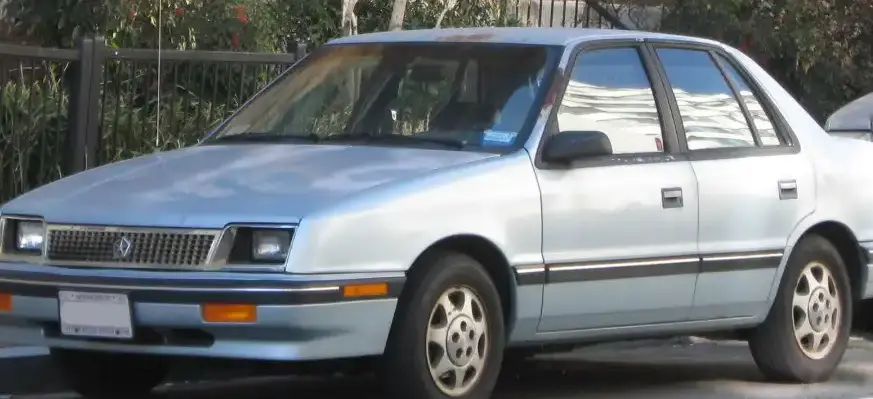
The Plymouth Sundance 2.2i, produced from 1986 to 1992, was a compact hatchback marketed by Plymouth as an affordable and practical transportation option. It was part of the first generation of the Sundance, built on the Chrysler JH platform. The 2.2i variant, equipped with a 2.2-liter inline-four engine producing 94 horsepower, represented a core offering within the Sundance lineup, positioned as an entry-level to mid-range model. It aimed to provide a balance between fuel efficiency and acceptable performance for everyday driving. Available in both 3-door and 5-door configurations, the Sundance competed with other compact hatchbacks like the Ford Escort and Chevrolet Cavalier.
Technical Specifications
| Brand | Plymouth |
| Model | Sundance |
| Type (Engine) | 2.2i (94 Hp) |
| Start of production | 1986 |
| End of production | 1992 |
| Powertrain Architecture | Internal Combustion engine |
| Body type | Hatchback |
| Seats | 5 |
| Doors | 3/5 |
| Fuel consumption (urban) | 12 l/100 km (19.6 US mpg) |
| Fuel consumption (extra urban) | 7 l/100 km (33.6 US mpg) |
| Fuel Type | Petrol (Gasoline) |
| Maximum speed | 170 km/h (105.63 mph) |
| Weight-to-power ratio | 12.8 kg/Hp |
| Weight-to-torque ratio | 7.3 kg/Nm |
| Power | 94 Hp @ 4800 rpm |
| Power per litre | 42.5 Hp/l |
| Torque | 165 Nm @ 3200 rpm (121.7 lb.-ft. @ 3200 rpm) |
| Engine layout | Front, Transverse |
| Engine displacement | 2213 cm3 (135.05 cu. in.) |
| Number of cylinders | 4 |
| Engine configuration | Inline |
| Cylinder Bore | 87.5 mm (3.44 in.) |
| Piston Stroke | 92 mm (3.62 in.) |
| Compression ratio | 9.5:1 |
| Number of valves per cylinder | 2 |
| Fuel injection system | Single-point injection |
| Engine aspiration | Naturally aspirated |
| Valvetrain | OHC |
| Engine oil capacity | 4.3 l (4.54 US qt | 3.78 UK qt) |
| Coolant | 8.5 l (8.98 US qt | 7.48 UK qt) |
| Kerb Weight | 1205 kg (2656.57 lbs.) |
| Trunk (boot) space – minimum | 375 l (13.24 cu. ft.) |
| Trunk (boot) space – maximum | 945 l (33.37 cu. ft.) |
| Fuel tank capacity | 53 l (14 US gal | 11.66 UK gal) |
| Length | 4360 mm (171.65 in.) |
| Width | 1710 mm (67.32 in.) |
| Height | 1350 mm (53.15 in.) |
| Wheelbase | 2470 mm (97.24 in.) |
| Front track | 1460 mm (57.48 in.) |
| Rear track | 1455 mm (57.28 in.) |
| Drivetrain Architecture | Front wheel drive |
| Number of gears | 5 |
| Type of gearbox | Manual transmission |
| Front suspension | Coil spring |
| Rear suspension | Coil spring |
| Front brakes | Ventilated discs |
| Rear brakes | Disc |
| Assisting systems | ABS (Anti-lock braking system) |
| Steering type | Steering rack and pinion |
| Power steering | Hydraulic |
| Tires size | 185/70 R14 |
Powertrain & Engine Architecture
The heart of the Sundance 2.2i was the Chrysler 2.2L inline-four engine, internally designated as the P-code. This engine utilized a single-point fuel injection system, a relatively simple setup for the time, where fuel was injected into the intake manifold rather than directly into the cylinders. The engine featured an overhead camshaft (OHC) valvetrain with two valves per cylinder. This configuration was chosen for its balance of cost-effectiveness and reasonable performance. The 94 horsepower output was achieved at 4800 rpm, while peak torque of 121.7 lb.-ft. arrived at 3200 rpm. The engine’s relatively low compression ratio of 9.5:1 allowed it to run on regular unleaded gasoline. The 2.2L engine was known for its durability, but the single-point injection system wasn’t as efficient or refined as multi-port fuel injection systems found in some competing vehicles.
Driving Characteristics
The 5-speed manual transmission paired with the 94 hp engine provided adequate, though not exhilarating, performance. Acceleration was modest, and highway passing required planning. The gear ratios were tuned for fuel economy rather than outright speed. Compared to the higher-output versions of the Sundance, such as those equipped with the turbocharged 2.5L engine, the 2.2i felt noticeably slower. However, the 2.2i offered a smoother and more predictable driving experience, particularly in city traffic. The front-wheel-drive layout provided decent handling, but the suspension was tuned for comfort rather than sporty handling. The manual transmission allowed for greater driver control compared to the optional 3-speed automatic.
Equipment & Trim Levels
The Sundance 2.2i typically came standard with features considered essential for the time, including a basic AM/FM radio, cloth upholstery, and manual windows and locks. Air conditioning was often an optional extra. Higher trim levels, such as the LE, added features like upgraded upholstery, a better sound system, and power windows and locks. The interior design was functional but lacked the sophistication of some European or Japanese competitors. The 3-door model was generally the more affordable option, while the 5-door offered increased practicality with easier access to the rear seats.
Chassis & Braking
The Sundance 2.2i utilized a relatively simple chassis design with coil spring suspension at all four wheels. The front suspension featured independent coil springs, while the rear suspension employed a semi-independent twist-beam setup. Braking duties were handled by ventilated discs at the front and solid discs at the rear. An anti-lock braking system (ABS) was available as an option, enhancing safety. The steering was rack-and-pinion with hydraulic power assistance, providing reasonably light and precise steering feel. The 185/70 R14 tires offered a good balance of ride comfort and grip.
Market Reception & Comparison
The Plymouth Sundance 2.2i was generally well-received as an affordable and reliable compact car. Critics praised its practicality and fuel efficiency, but noted its lack of refinement and relatively modest performance. Compared to the turbocharged Sundance models, the 2.2i offered significantly lower running costs but sacrificed performance. The 2.2i’s fuel economy was competitive with other cars in its class, averaging around 19.6 mpg in the city and 33.6 mpg on the highway. Reliability was generally good, although the single-point fuel injection system could require occasional maintenance.
Legacy
The Plymouth Sundance, and specifically the 2.2i variant, remains a relatively common sight in the used car market, though finding well-maintained examples is becoming increasingly difficult. The 2.2L engine is known for its durability and relatively simple design, making it relatively easy to repair. However, age-related issues such as corrosion and wear and tear on rubber components are common. The Sundance 2.2i represents a snapshot of American automotive engineering in the late 1980s and early 1990s – a focus on affordability, practicality, and fuel efficiency. While not a performance icon, it served as a dependable and economical mode of transportation for many drivers.
