
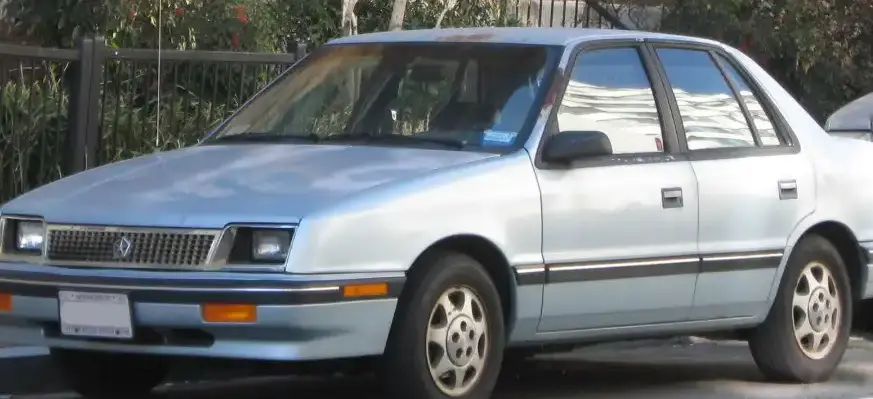
The Plymouth Sundance 2.5i, produced from 1986 to 1994, was a compact hatchback marketed by Plymouth as an affordable and practical transportation option. It represented Plymouth’s entry into the increasingly competitive compact car segment, sharing its platform with the Dodge Shadow and Chrysler LeBaron. The 2.5i variant, equipped with a 2.5-liter inline-four engine producing 102 horsepower, occupied a middle ground in the Sundance lineup, offering a balance between performance and fuel economy. It was available in both 3-door and 5-door body styles, catering to a range of customer needs. The Sundance, and its sibling models, were key vehicles for Chrysler during a period of restructuring and aimed to recapture market share in the small car segment.
Technical Specifications
| Brand | Plymouth |
| Model | Sundance |
| Generation | Sundance |
| Type (Engine) | 2.5 i (102 Hp) |
| Start of production | 1986 |
| End of production | 1994 |
| Powertrain Architecture | Internal Combustion engine |
| Body type | Hatchback |
| Seats | 5 |
| Doors | 3/5 |
| Fuel consumption (urban) | 14 l/100 km (16.8 US mpg, 20.2 UK mpg, 7.1 km/l) |
| Fuel consumption (extra urban) | 8 l/100 km (29.4 US mpg, 35.3 UK mpg, 12.5 km/l) |
| Fuel Type | Petrol (Gasoline) |
| Maximum speed | 170 km/h (105.63 mph) |
| Weight-to-power ratio | 12 kg/Hp, 83.6 Hp/tonne |
| Weight-to-torque ratio | 6.7 kg/Nm, 150 Nm/tonne |
| Power | 102 Hp @ 4800 rpm |
| Power per litre | 40.8 Hp/l |
| Torque | 183 Nm @ 2800 rpm (134.97 lb.-ft. @ 2800 rpm) |
| Engine layout | Front, Transverse |
| Engine displacement | 2501 cm3 (152.62 cu. in.) |
| Number of cylinders | 4 |
| Engine configuration | Inline |
| Cylinder Bore | 87.5 mm (3.44 in.) |
| Piston Stroke | 104 mm (4.09 in.) |
| Compression ratio | 9:1 |
| Number of valves per cylinder | 2 |
| Fuel injection system | Single-point injection |
| Engine aspiration | Naturally aspirated engine |
| Valvetrain | OHC |
| Engine oil capacity | 4.3 l (4.54 US qt | 3.78 UK qt) |
| Coolant | 8.5 l (8.98 US qt | 7.48 UK qt) |
| Kerb Weight | 1220 kg (2689.64 lbs.) |
| Trunk (boot) space – minimum | 375 l (13.24 cu. ft.) |
| Trunk (boot) space – maximum | 945 l (33.37 cu. ft.) |
| Fuel tank capacity | 53 l (14 US gal | 11.66 UK gal) |
| Length | 4360 mm (171.65 in.) |
| Width | 1710 mm (67.32 in.) |
| Height | 1350 mm (53.15 in.) |
| Wheelbase | 2470 mm (97.24 in.) |
| Front track | 1460 mm (57.48 in.) |
| Rear (Back) track | 1455 mm (57.28 in.) |
| Drivetrain Architecture | The Internal combustion engine (ICE) drives the front wheels of the vehicle. |
| Drive wheel | Front wheel drive |
| Number of gears and type of gearbox | 5 gears, manual transmission |
| Front suspension | Coil spring |
| Rear suspension | Coil spring |
| Front brakes | Ventilated discs |
| Rear brakes | Disc |
| Assisting systems | ABS (Anti-lock braking system) |
| Steering type | Steering rack and pinion |
| Power steering | Hydraulic Steering |
| Tires size | 185/70 R14 |
Powertrain & Engine Architecture
The heart of the Sundance 2.5i was the Chrysler 2.5-liter inline-four cylinder engine. This engine, internally designated as the 525 engine family, was a relatively simple and robust design. It featured a single overhead camshaft (OHC) operating two valves per cylinder. Fuel delivery was handled by a single-point fuel injection system, which, while less sophisticated than multi-port injection, contributed to reasonable fuel economy and acceptable performance for the intended market segment. The engine produced 102 horsepower at 4800 rpm and 135 lb-ft of torque at 2800 rpm. The 9:1 compression ratio was typical for the era. The engine was transversely mounted in the front of the vehicle, driving the front wheels. The standard transmission for the 2.5i was a five-speed manual, but a three-speed automatic transmission was also available, and was a popular choice for buyers prioritizing convenience over outright performance.
Driving Characteristics
The Sundance 2.5i with the five-speed manual transmission offered adequate, though not exhilarating, performance. Acceleration was modest, with a 0-60 mph time estimated around 11-12 seconds. The automatic transmission version, while providing smoother operation, further reduced acceleration due to its less efficient power transfer and wider gear ratios. The automatic’s gear ratios were optimized for fuel economy rather than spirited driving. Handling was typical of compact front-wheel-drive cars of the period – safe and predictable, but not particularly sporty. The suspension, consisting of coil springs all around, provided a comfortable ride on most road surfaces. The steering, aided by hydraulic power steering, was light and easy to use, making it well-suited for city driving.
Equipment & Trim Levels
The Sundance 2.5i typically came standard with features considered essential for the time, including cloth upholstery, an AM/FM radio, and basic instrumentation. Higher trim levels, such as the LE, added features like upgraded sound systems, power windows and locks, and cruise control. Optional extras included air conditioning, a sunroof, and upgraded interior trim. The interior design was functional and straightforward, prioritizing practicality over luxury. The 5-door model offered increased cargo space and rear passenger access compared to the 3-door version.
Chassis & Braking
The Sundance utilized a unibody construction. The front suspension featured independent coil springs, while the rear suspension employed a semi-independent twist beam setup. Brakes were ventilated discs in the front and solid discs in the rear. An anti-lock braking system (ABS) was available as an option, enhancing safety. The relatively lightweight construction of the Sundance contributed to its reasonable fuel economy and handling characteristics. The standard tire size was 185/70R14.
Market Reception & Comparison
The Plymouth Sundance 2.5i was generally well-received by consumers as an affordable and reliable compact car. Critics noted its practical interior, decent fuel economy, and reasonable price. However, it was often criticized for its lack of refinement and somewhat bland styling. Compared to other trims in the Sundance lineup, the 2.5i offered a good balance between performance and economy. The higher-output versions, while offering more power, were more expensive and less fuel-efficient. The 2.5i was a more sensible choice for buyers prioritizing practicality and value. Compared to competitors like the Ford Escort and Chevrolet Cavalier, the Sundance offered a similar level of features and performance at a competitive price point.
Legacy
The Plymouth Sundance, and the 2.5i variant specifically, has developed a reputation for being a relatively reliable and affordable used car. The 2.5-liter engine is known for its durability, and parts availability remains good. While not a particularly collectible vehicle, the Sundance represents a significant part of Chrysler’s history and a popular choice for budget-conscious buyers. Common issues with these vehicles often relate to age-related wear and tear, such as corrosion, worn suspension components, and failing sensors. However, the basic mechanical design is relatively simple, making it accessible for DIY repairs. Today, well-maintained examples of the Sundance 2.5i can still provide reliable transportation at a very low cost.
