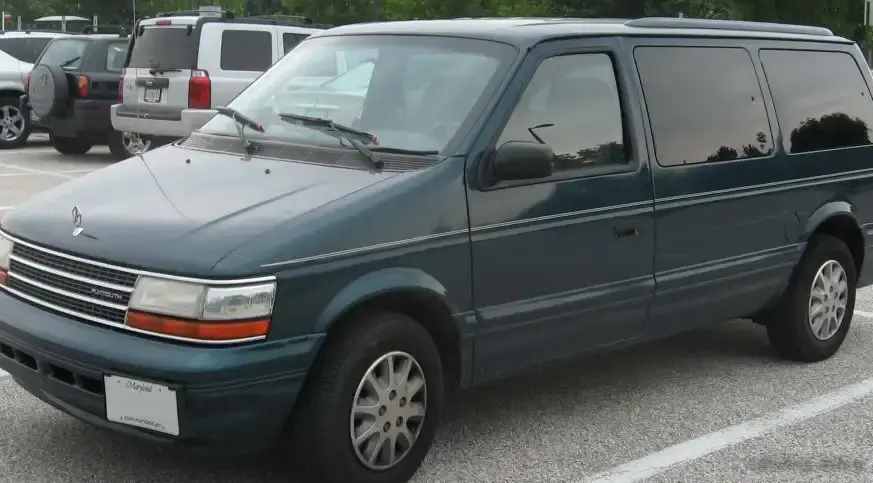
The Plymouth Voyager 3.3i 4WD SE, produced between 1990 and 1995, represented a significant offering in the burgeoning minivan segment. Part of the first generation of Voyager minivans (based on the Chrysler AS platform), this variant aimed to provide a blend of space, practicality, and all-weather capability. Positioned as a mid-to-upper trim level, the 3.3i 4WD SE catered to families needing extra space and the security of four-wheel drive, particularly in regions experiencing inclement weather. It was a key model in Plymouth’s lineup during a period where minivans were rapidly gaining popularity as the family vehicle of choice.
Technical Specifications
| Brand | Plymouth |
| Model | Voyager |
| Type | 3.3 i 4WD SE (152 Hp) |
| Start of production | 1990 |
| End of production | 1995 |
| Powertrain Architecture | Internal Combustion engine |
| Body type | Minivan |
| Seats | 5 |
| Doors | 4 |
| Fuel consumption (combined) | 12.4 l/100 km (19 US mpg, 22.8 UK mpg, 8.1 km/l) |
| Fuel Type | Petrol (Gasoline) |
| Weight-to-power ratio | 11.5 kg/Hp, 87 Hp/tonne |
| Weight-to-torque ratio | 7 kg/Nm, 143.6 Nm/tonne |
| Power | 152 Hp @ 4800 rpm |
| Power per litre | 46 Hp/l |
| Torque | 251 Nm @ 3600 rpm (185.13 lb.-ft. @ 3600 rpm) |
| Engine layout | Front, Transverse |
| Engine Model/Code | EGA |
| Engine displacement | 3301 cm3 (201.44 cu. in.) |
| Number of cylinders | 6 |
| Engine configuration | V-engine |
| Cylinder Bore | 93 mm (3.66 in.) |
| Piston Stroke | 81 mm (3.19 in.) |
| Compression ratio | 8.9:1 |
| Number of valves per cylinder | 2 |
| Fuel injection system | Multi-port manifold injection |
| Engine aspiration | Naturally aspirated engine |
| Engine oil capacity | 4.3 l (4.54 US qt | 3.78 UK qt) |
| Coolant capacity | 9.5 l (10.04 US qt | 8.36 UK qt) |
| Kerb Weight | 1748 kg (3853.68 lbs.) |
| Trunk (boot) space – minimum | 670 l (23.66 cu. ft.) |
| Fuel tank capacity | 68 l (17.96 US gal | 14.96 UK gal) |
| Length | 4525 mm (178.15 in.) |
| Width | 1830 mm (72.05 in.) |
| Height | 1673 mm (65.87 in.) |
| Wheelbase | 2853 mm (112.32 in.) |
| Front track | 1522 mm (59.92 in.) |
| Rear track | 1578 mm (62.13 in.) |
| Drive wheel | All wheel drive (4×4) |
| Number of gears and type of gearbox | 4 gears, automatic transmission |
| Front suspension | Coil spring |
| Rear suspension | Coil spring |
| Front brakes | Ventilated discs |
| Rear brakes | Drum |
| Assisting systems | ABS (Anti-lock braking system) |
| Steering type | Steering rack and pinion |
| Power steering | Hydraulic Steering |
| Tires size | 205/70 R15 |
Powertrain & Engine Architecture
The heart of the Voyager 3.3i 4WD SE was the Chrysler EGA V6 engine. This 3.3-liter (3301 cc) engine featured a 60-degree V-configuration, utilizing a cast iron block and aluminum cylinder heads. The EGA engine employed multi-port fuel injection, a significant advancement over earlier carburetor-based systems, contributing to improved fuel efficiency and smoother operation. It featured two valves per cylinder and a relatively modest 8.9:1 compression ratio. The engine was transversely mounted in the front of the vehicle, driving all four wheels through a four-speed automatic transmission (typically the A727 Torqueflite). This transmission, while robust, was known for its conventional hydraulic control system rather than electronic management. The 4WD system was a part-time system, requiring the driver to manually engage four-wheel drive when needed.
Driving Characteristics
The 152 horsepower and 185 lb-ft of torque produced by the 3.3L V6, while adequate for a minivan, didn’t deliver particularly brisk acceleration. The four-speed automatic transmission, while reliable, had relatively wide gear ratios, prioritizing fuel economy over performance. Compared to the later, more powerful 3.8L V6 options, the 3.3L felt noticeably slower, especially when fully loaded with passengers and cargo. The 4WD system provided enhanced traction in slippery conditions, making it a valuable asset in colder climates. However, it did add weight, slightly impacting fuel economy and handling on dry pavement. The steering was light and easy, typical of minivans of the era, prioritizing ease of use over sporty feel.
Equipment & Trim Levels
The “SE” designation indicated a higher level of equipment compared to base Voyager models. Standard features typically included air conditioning, power windows and locks, an upgraded sound system, and cloth upholstery. Optional extras included a rear entertainment system (a popular choice for families), upgraded seating with captain’s chairs, and a sunroof. The interior design was functional and family-oriented, with a focus on durability and ease of cleaning. The dashboard layout was straightforward, with clearly labeled controls.
Chassis & Braking
The Voyager 3.3i 4WD SE utilized a body-on-frame construction, which was common for minivans at the time. The suspension consisted of coil springs at all four corners, providing a comfortable ride. The front brakes were ventilated discs, offering better stopping power than the drum brakes used on the rear wheels. An anti-lock braking system (ABS) was included as standard equipment, enhancing safety. The 4WD system added to the vehicle’s weight, requiring a slightly more robust suspension setup compared to front-wheel-drive models.
Market Reception & Comparison
The Voyager 3.3i 4WD SE was generally well-received by critics as a practical and versatile family vehicle. However, its fuel economy was often cited as a drawback, particularly compared to smaller, more fuel-efficient vehicles. Compared to the higher-output 3.8L V6 versions, the 3.3L offered a more affordable entry point into the Voyager lineup, but at the expense of performance. The 4WD system was a significant selling point for buyers in regions with harsh winters, providing a level of confidence that front-wheel-drive models couldn’t match. Reliability was generally good, although the automatic transmission could require occasional servicing.
Legacy
The Plymouth Voyager 3.3i 4WD SE, while not the most powerful or fuel-efficient minivan of its era, remains a popular choice among collectors and enthusiasts seeking a classic family vehicle. The EGA V6 engine, while not known for its longevity in some applications, proved reasonably durable in the Voyager. Today, well-maintained examples are becoming increasingly rare, and values are slowly appreciating. The Voyager’s legacy lies in its contribution to the minivan revolution, offering families a spacious, practical, and relatively affordable transportation solution. Finding parts can be challenging, but a dedicated community of owners and online resources helps to keep these vehicles on the road.