
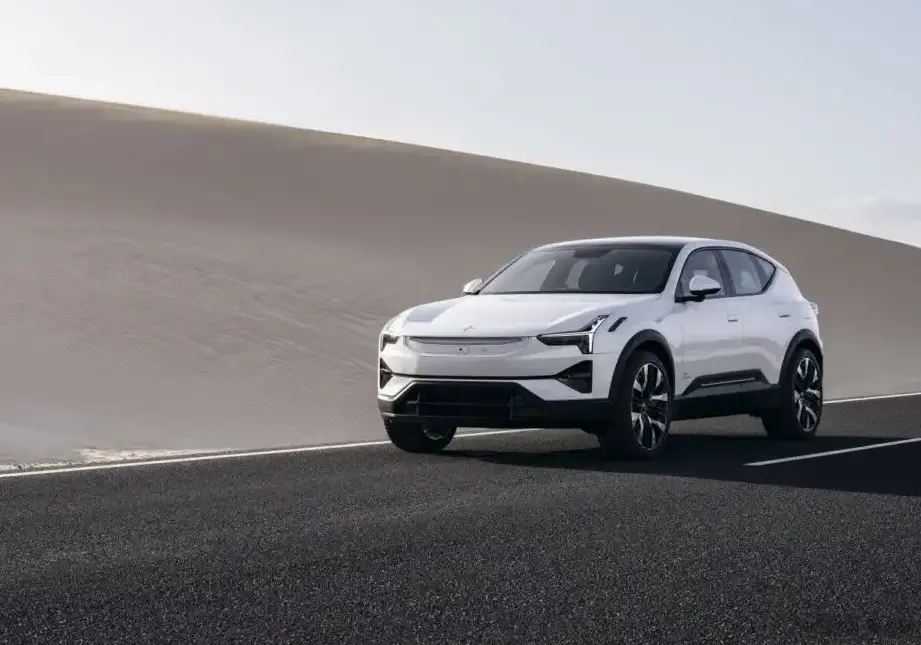
The Polestar 3 106 kWh (544 Hp) AWD Dual Motor represents Polestar’s entry into the competitive all-electric SUV market. Officially launched for the 2025 model year, with initial production commencing in October 2024, the Polestar 3 is built upon a dedicated electric vehicle architecture and aims to blend Scandinavian design with high-performance capabilities. This particular variant, featuring the larger 106 kWh battery pack and dual-motor all-wheel-drive system, sits at the top of the initial Polestar 3 lineup, offering the longest range and highest performance figures available at launch. It is positioned as a premium electric SUV, competing with models like the Porsche Cayenne Electric, BMW iX, and Tesla Model X.
Technical Specifications
| Brand | Polestar |
| Model | 3 |
| Generation | 3 |
| Type (Engine) | 106 kWh (544 Hp) AWD Dual Motor |
| Start of production | October, 2024 |
| Powertrain Architecture | BEV (Electric Vehicle) |
| Body type | SUV |
| Seats | 5 |
| Doors | 5 |
| Fuel Type | Electricity |
| Acceleration 0 – 60 mph | 4.5 sec |
| Maximum speed | 225 km/h (139.81 mph) |
| Weight-to-power ratio | 4.6 kg/Hp, 218.5 Hp/tonne |
| Weight-to-torque ratio | 3.4 kg/Nm, 297.2 Nm/tonne |
| Gross battery capacity | 106 kWh |
| Net (usable) battery capacity | 102 kWh |
| Battery voltage | 800 V |
| Battery technology | Lithium-ion (Li-Ion) |
| Battery location | Below the floor |
| All-electric range (WLTP) | 634.1 km (394.01 mi) |
| Average Energy consumption (WLTP) | 19.1-23.4 kWh/100 km (30.74 – 37.66 kWh/100 mi) |
| Average Energy consumption (MPGe) | 110 – 89 |
| Average Energy consumption (km/kWh) | 5.2 – 4.3 |
| Average Energy consumption (mi/kWh) | 3.3 – 2.7 |
| Electric motor 1 power | 340 Hp |
| Electric motor 1 location | Rear axle, Transverse |
| Electric motor 1 type | Synchronous |
| Electric motor 2 power | 204 Hp |
| Electric motor 2 location | Front axle, Transverse |
| Electric motor 2 type | Synchronous |
| System power | 544 Hp |
| System torque | 740 Nm (545.8 lb.-ft.) |
| Kerb Weight | 2490-2600 kg (5489.51 – 5732.02 lbs.) |
| Trunk (boot) space – minimum | 484 l (17.09 cu. ft.) |
| Trunk (boot) space – maximum | 1411 l (49.83 cu. ft.) |
| Permitted trailer load with brakes (12%) | 2200 kg (4850.17 lbs.) |
| Length | 4900 mm (192.91 in.) |
| Width | 1968 mm (77.48 in.) |
| Width including mirrors | 2120 mm (83.46 in.) |
| Height | 1614 mm (63.54 in.) |
| Wheelbase | 2985 mm (117.52 in.) |
| Front track | 1675-1679 mm (65.94 – 66.1 in.) |
| Rear (Back) track | 1669-1680 mm (65.71 – 66.14 in.) |
| Ride height (ground clearance) | 202 mm (7.95 in.) |
| Minimum turning circle (turning diameter) | 11.8 m (38.71 ft.) |
| Drivetrain Architecture | One electric motor drives the front wheels, one electric motor drives the rear wheels. |
| Drive wheel | All wheel drive (4×4) |
| Number of gears and type of gearbox | 1 gears, automatic transmission |
| Front suspension | Double wishbone |
| Rear suspension | Independent multi-link suspension |
| Front brakes | Ventilated discs, 400 mm |
| Rear brakes | Ventilated discs, 390 mm |
| Assisting systems | ABS (Anti-lock braking system) |
| Steering type | Steering rack and pinion |
| Power steering | Electric Steering |
| Front wheel tires | 255/50 R20; 265/45 R21; 265/40 R22 |
| Rear wheel tires | 285/45 R20; 295/40 R21; 295/35 R22 |
| Front wheel rims | 20; 21; 22 |
| Rear wheel rims | 20; 21; 22 |
Powertrain & Engine Architecture
The Polestar 3 utilizes a dual-motor, all-wheel-drive (AWD) powertrain. Each axle is driven by a permanently magnetized synchronous electric motor. The rear motor produces 340 horsepower, while the front motor contributes 204 horsepower, resulting in a combined system output of 544 horsepower and 740 Nm (545.8 lb-ft) of torque. The powertrain operates on an 800-volt architecture, enabling faster charging times. The 106 kWh battery pack is positioned low in the vehicle’s floor, contributing to a lower center of gravity and improved handling. The single-speed automatic transmission is integral to each motor, providing seamless power delivery. Regenerative braking is a key component of the system, capturing energy during deceleration to extend range.
Driving Characteristics
The Polestar 3 106 kWh AWD delivers brisk acceleration, achieving 0-60 mph in approximately 4.5 seconds. The dual-motor setup provides instant torque and confident traction in various driving conditions. The single-speed transmission offers smooth and linear acceleration, without the gear changes associated with traditional internal combustion engines. While the instant torque provides a sporty feel, the substantial weight of the vehicle (between 2490-2600 kg) is noticeable, particularly during spirited driving. The low center of gravity, thanks to the battery placement, helps mitigate body roll and contributes to a stable and planted feel. The steering is precise and well-weighted, providing good feedback to the driver.
Equipment & Trim Levels
The Polestar 3 106 kWh AWD comes standard with a comprehensive suite of features, including a large 14.5-inch central touchscreen infotainment system powered by Android Automotive OS, a premium audio system, panoramic glass roof, and a full suite of advanced driver-assistance systems (ADAS) such as Pilot Assist. Interior upholstery is typically a high-quality vegan material, with options for leather upgrades. Standard exterior features include LED headlights, power-folding mirrors, and a hands-free power tailgate. Optional extras include a performance package with upgraded suspension and brakes, a head-up display, and various interior trim options.
Chassis & Braking
The Polestar 3 features a double-wishbone front suspension and an independent multi-link rear suspension, tuned for a balance of comfort and handling. Ventilated disc brakes are used on all four wheels, with 400mm rotors at the front and 390mm rotors at the rear. The standard braking system includes ABS (Anti-lock Braking System) and electronic stability control. The vehicle’s weight necessitates a robust braking system to ensure confident stopping power. Adaptive dampers are available as an option, allowing drivers to adjust the suspension stiffness to suit their preferences.
Market Reception & Comparison
Initial reviews of the Polestar 3 have been largely positive, with critics praising its stylish design, high-quality interior, and strong performance. The 106 kWh variant, offering the longest range, has been particularly well-received. Compared to other electric SUVs in its class, the Polestar 3 is positioned as a more driver-focused alternative to the Tesla Model X, with a greater emphasis on Scandinavian design and build quality. Fuel economy, expressed as energy consumption, ranges from 19.1-23.4 kWh/100 km, translating to approximately 110-89 MPGe. Reliability data is still emerging, as the vehicle is relatively new to the market, but Polestar’s reputation for quality and its partnership with Volvo suggest a high level of long-term durability.
Legacy
The Polestar 3 represents a significant step for Polestar as it expands its model lineup and establishes itself as a major player in the premium electric vehicle segment. The 106 kWh AWD variant, as the flagship model, sets the standard for performance and range within the Polestar 3 family. Its advanced technology, including the 800-volt architecture and sophisticated driver-assistance systems, positions it as a forward-thinking electric SUV. As the electric vehicle market matures, the Polestar 3 is expected to become a benchmark for design, performance, and sustainability.
