
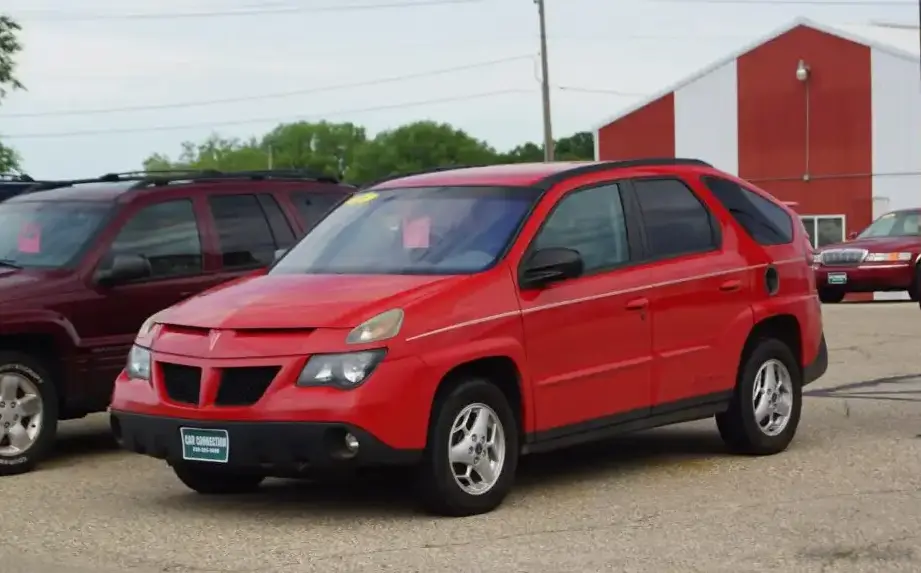
The Pontiac Aztec 3.4i V6 AWD, produced from July 2000 to August 2005, represented Pontiac’s foray into the burgeoning sport utility vehicle (SUV) market. Positioned as a mid-range offering within the Aztec lineup, it aimed to blend practicality with a distinctive, albeit controversial, exterior design. Built on the GM Theta platform, shared with the Buick Rendezvous and Chevrolet Equinox, the Aztec sought to appeal to buyers desiring a versatile vehicle with available all-wheel drive. This particular variant, equipped with the 3.4-liter V6 engine and a four-speed automatic transmission, was intended to provide a balance between performance and fuel efficiency for everyday driving.
Technical Specifications
| Brand | Pontiac |
| Model | Aztec |
| Generation | Aztec |
| Type (Engine) | 3.4 i V6 AWD (188 Hp) |
| Start of production | July, 2000 |
| End of production | August, 2005 |
| Powertrain Architecture | Internal Combustion engine |
| Body type | SUV |
| Seats | 5 |
| Doors | 5 |
| Fuel consumption (urban) | 13.1 l/100 km (18 US mpg, 21.6 UK mpg, 7.6 km/l) |
| Fuel consumption (extra urban) | 9.4 l/100 km (25 US mpg, 30.1 UK mpg, 10.6 km/l) |
| Fuel consumption (combined) | 11.2 l/100 km (21 US mpg, 25.2 UK mpg, 8.9 km/l) |
| Fuel Type | Petrol (Gasoline) |
| Maximum speed | 180 km/h (111.85 mph) |
| Weight-to-power ratio | 9.8 kg/Hp, 102.5 Hp/tonne |
| Weight-to-torque ratio | 6.5 kg/Nm, 154.8 Nm/tonne |
| Power | 188 Hp @ 5200 rpm |
| Power per litre | 56.1 Hp/l |
| Torque | 284 Nm @ 4000 rpm (209.47 lb.-ft. @ 4000 rpm) |
| Engine layout | Front, Transverse |
| Engine Model/Code | LA1 |
| Engine displacement | 3350 cm3 (204.43 cu. in.) |
| Number of cylinders | 6 |
| Engine configuration | V-engine |
| Cylinder Bore | 92 mm (3.62 in.) |
| Piston Stroke | 84 mm (3.31 in.) |
| Compression ratio | 9.5:1 |
| Number of valves per cylinder | 2 |
| Fuel injection system | Multi-port manifold injection |
| Engine aspiration | Naturally aspirated engine |
| Engine oil capacity | 3.8 l (4.02 US qt | 3.34 UK qt) |
| Coolant | 9.1 l (9.62 US qt | 8.01 UK qt) |
| Kerb Weight | 1835 kg (4045.48 lbs.) |
| Trunk (boot) space – minimum | 1280 l (45.2 cu. ft.) |
| Trunk (boot) space – maximum | 2670 l (94.29 cu. ft.) |
| Fuel tank capacity | 68 l (17.96 US gal | 14.96 UK gal) |
| Length | 4585 mm (180.51 in.) |
| Width | 1872 mm (73.7 in.) |
| Height | 1702 mm (67.01 in.) |
| Wheelbase | 2751 mm (108.31 in.) |
| Front track | 1593 mm (62.72 in.) |
| Rear (Back) track | 1621 mm (63.82 in.) |
| Drive wheel | All wheel drive (4×4) |
| Number of gears and type of gearbox | 4 gears, automatic transmission |
| Front suspension | Spring Strut |
| Rear suspension | Double wishbone |
| Front brakes | Ventilated discs |
| Rear brakes | Drum |
| Assisting systems | ABS (Anti-lock braking system) |
| Steering type | Steering rack and pinion |
| Power steering | Hydraulic Steering |
| Tires size | 215/70 R15 |
Powertrain & Engine Architecture
The heart of the Aztec 3.4i AWD was the LA1 3.4-liter (3350 cc) 60-degree V6 engine. This engine, a member of GM’s L850 family, featured a cast iron block with aluminum cylinder heads. It utilized a multi-port fuel injection system, delivering fuel directly to each intake port for improved combustion efficiency. The engine produced 188 horsepower at 5200 rpm and 284 Nm (209.47 lb-ft) of torque at 4000 rpm. The four-speed 4T65-E automatic transmission was the sole transmission option for this variant. This transmission was known for its relatively smooth shifts but wasn’t particularly fuel-efficient compared to later designs. The all-wheel-drive system was an automatic, on-demand system, engaging the rear wheels when slippage was detected at the front.
Driving Characteristics
The 3.4L V6 and automatic transmission combination in the Aztec delivered adequate, but not exhilarating, performance. Acceleration from 0 to 60 mph was typically in the 8-9 second range. The automatic transmission’s gear ratios were geared more towards comfort and fuel economy than outright speed. While the engine provided sufficient torque for everyday driving and moderate towing, it lacked the responsiveness of the manual transmission or the higher-output 3.9L V6 option. The all-wheel-drive system provided enhanced traction in inclement weather, making it a capable vehicle for regions experiencing snow or rain. However, the added weight of the AWD system did slightly diminish overall fuel economy.
Equipment & Trim Levels
The 3.4i AWD trim generally included standard features such as air conditioning, power windows and locks, a CD player, and cloth upholstery. Optional extras included leather upholstery, a sunroof, upgraded audio systems, and alloy wheels. The interior design, while functional, was often criticized for its use of hard plastics. The rear seats were foldable, allowing for increased cargo space. The distinctive, angular dashboard design was a defining characteristic of the Aztec’s interior.
Chassis & Braking
The Aztec’s chassis featured an independent front suspension with coil springs and a multi-link rear suspension. The front brakes were ventilated discs, providing adequate stopping power, while the rear brakes were drum brakes, a cost-saving measure. Anti-lock brakes (ABS) were standard equipment. The suspension tuning was geared towards comfort, resulting in a relatively soft ride. Stabilizer bars were included at both the front and rear to reduce body roll during cornering, though the vehicle’s high center of gravity limited its handling capabilities.
Market Reception & Comparison
The Pontiac Aztec received largely negative reviews upon its release, with its polarizing exterior design being the primary source of criticism. The 3.4i V6 AWD variant was generally considered a more practical choice than the base 2.2L four-cylinder model, offering improved performance and the added security of all-wheel drive. However, it wasn’t as sporty or fuel-efficient as some of its competitors, such as the Honda CR-V or Toyota RAV4. Fuel economy figures of 11.2 l/100 km (21 US mpg) were average for the class at the time. Reliability was generally acceptable, though some owners reported issues with the automatic transmission and the electronic stability control system.
Legacy
The Pontiac Aztec, despite its commercial failure, has gained a cult following in recent years, largely due to its unique and unconventional design. The 3.4i V6 AWD variant remains a relatively affordable option on the used car market. The LA1 engine, while not known for its longevity, is generally reliable if properly maintained. Parts availability is generally good, as the engine and transmission were used in a variety of GM vehicles. While not a performance icon, the Aztec 3.4i AWD represents a unique chapter in Pontiac’s history and a testament to the brand’s willingness to take risks.
