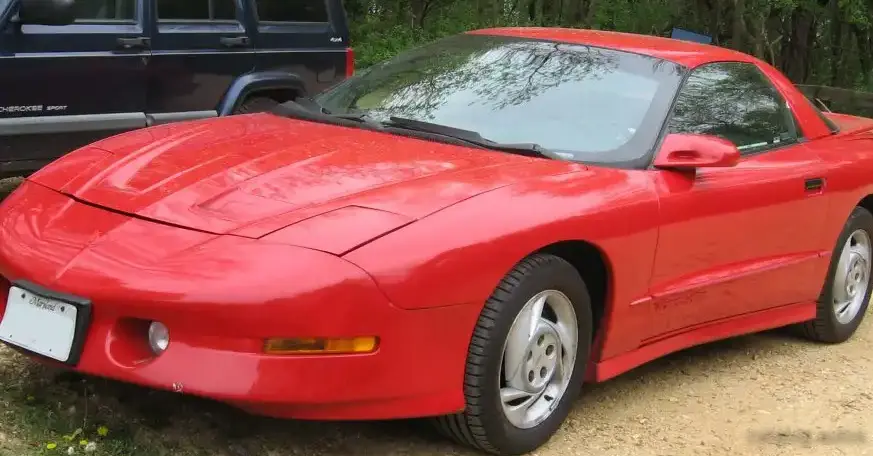
The Pontiac Firebird IV 3.8i V6 Automatic, produced from 1995 to 2002, represented a significant iteration of the iconic Firebird sports car. Falling within the fourth generation (1993-2002) of the Firebird, this variant occupied a middle ground in the lineup, offering a balance between performance and affordability. It served as a more accessible alternative to the higher-performance V8 models, while providing a more refined experience than the base four-cylinder engine. The Firebird IV, and this 3.8i V6 trim specifically, aimed to capture a broader segment of the American sports car market, appealing to buyers seeking style, comfort, and a respectable level of power.
Technical Specifications
| Brand | Pontiac |
| Model | Firebird |
| Generation | Firebird IV |
| Type (Engine) | 3.8i V6 (196 Hp) Automatic |
| Start of production | 1995 |
| End of production | 2002 |
| Powertrain Architecture | Internal Combustion engine |
| Body type | Coupe |
| Seats | 4 |
| Doors | 3 |
| Fuel Type | Petrol (Gasoline) |
| Maximum speed | 201 km/h (124.9 mph) |
| Weight-to-power ratio | 8.4 kg/Hp, 118.4 Hp/tonne |
| Weight-to-torque ratio | 5.5 kg/Nm, 182.4 Nm/tonne |
| Power | 196 Hp @ 5100 rpm |
| Power per litre | 51.7 Hp/l |
| Torque | 302 Nm @ 4200 rpm (222.74 lb.-ft. @ 4200 rpm) |
| Engine layout | Front, Longitudinal |
| Engine Model/Code | L36 |
| Engine displacement | 3791 cm3 (231.34 cu. in.) |
| Number of cylinders | 6 |
| Engine configuration | V-engine |
| Cylinder Bore | 96.5 mm (3.8 in.) |
| Piston Stroke | 86.4 mm (3.4 in.) |
| Compression ratio | 9.4:1 |
| Number of valves per cylinder | 2 |
| Fuel injection system | Multi-port manifold injection |
| Engine aspiration | Naturally aspirated engine |
| Engine oil capacity | 4.3 l (4.54 US qt | 3.78 UK qt) |
| Coolant | 11.6 l (12.26 US qt | 10.21 UK qt) |
| Kerb Weight | 1656 kg (3650.86 lbs.) |
| Max. weight | 2000 kg (4409.25 lbs.) |
| Max load | 344 kg (758.39 lbs.) |
| Trunk (boot) space – minimum | 365 l (12.89 cu. ft.) |
| Trunk (boot) space – maximum | 954 l (33.69 cu. ft.) |
| Fuel tank capacity | 59 l (15.59 US gal | 12.98 UK gal) |
| Length | 4964 mm (195.43 in.) |
| Width | 1892 mm (74.49 in.) |
| Height | 1300 mm (51.18 in.) |
| Wheelbase | 2566 mm (101.02 in.) |
| Front track | 1542 mm (60.71 in.) |
| Rear (Back) track | 1539 mm (60.59 in.) |
| Drivetrain Architecture | The Internal combustion engine (ICE) drives the rear wheels of the vehicle. |
| Drive wheel | Rear wheel drive |
| Number of gears and type of gearbox | 4 gears, automatic transmission |
| Front suspension | Double wishbone |
| Rear suspension | Coil spring |
| Front brakes | Ventilated discs |
| Rear brakes | Ventilated discs |
| Assisting systems | ABS (Anti-lock braking system) |
| Steering type | Steering rack and pinion |
| Power steering | Hydraulic Steering |
| Tires size | 215/60 R16 V |
| Wheel rims size | 16 |
Powertrain & Engine Architecture
The heart of the Firebird IV 3.8i was the 3.8-liter (3791 cc) L36 V6 engine. This engine, part of General Motors’ widely used 3800 Series II V6 family, was known for its smooth operation and respectable power output. The L36 featured a 90-degree V-angle, two valves per cylinder, and a cast iron block with aluminum cylinder heads. Fuel delivery was handled by a multi-port fuel injection system, contributing to improved efficiency and throttle response. The engine produced 196 horsepower at 5100 rpm and 222 lb-ft of torque at 4200 rpm. This power was then routed through a four-speed automatic transmission, a 4T60-E unit, which was chosen for its smoothness and ease of use, catering to a broader audience than a manual transmission would.
Driving Characteristics
The 3.8i V6 Automatic Firebird offered a comfortable and capable driving experience. While not as overtly sporty as the V8-powered models, it provided sufficient power for everyday driving and even some spirited acceleration. The automatic transmission, while smooth, did result in some power loss compared to the available five-speed manual. The gear ratios were tuned for a balance of acceleration and fuel economy. The 0-60 mph time was typically in the 7.5-8.5 second range, making it competitive with other sports coupes of the era. The rear-wheel-drive configuration contributed to balanced handling, although it lacked the outright grip of some front-wheel-drive competitors.
Equipment & Trim Levels
The 3.8i V6 Automatic trim typically included features such as air conditioning, power windows and locks, a CD player, and cloth upholstery. Optional extras included leather seats, a sunroof, upgraded sound systems, and a performance suspension package. The interior design was driver-focused, with a wraparound dashboard and comfortable bucket seats. The Firebird IV aimed for a blend of sporty aesthetics and everyday practicality, offering a reasonably well-equipped interior for its price point.
Chassis & Braking
The Firebird IV utilized a unibody construction for rigidity and weight reduction. The front suspension employed a double wishbone design, while the rear suspension featured a coil spring setup. This configuration provided a comfortable ride while maintaining reasonable handling characteristics. Braking duties were handled by ventilated disc brakes on all four wheels, providing adequate stopping power. An Anti-lock Braking System (ABS) was standard, enhancing safety and control during emergency braking situations. The steering system was a rack-and-pinion setup with hydraulic power assist, offering precise and responsive steering feel.
Market Reception & Comparison
The Firebird IV 3.8i V6 Automatic was generally well-received by automotive critics as a solid all-around performer. It was praised for its smooth engine, comfortable ride, and attractive styling. However, some reviewers noted that it lacked the raw performance of the V8 models. Compared to the Firebird V8, the 3.8i offered better fuel economy (around 19 mpg city / 27 mpg highway) and lower maintenance costs. Against competitors like the Ford Mustang GT and Chevrolet Camaro, the Firebird 3.8i offered a slightly more refined driving experience and a distinctive exterior design.
Legacy
The Pontiac Firebird IV 3.8i V6 Automatic, while not the most sought-after variant, remains a popular choice among enthusiasts seeking an affordable and reliable American sports car. The 3800 Series II V6 engine is known for its durability and longevity, and well-maintained examples can still provide years of enjoyable driving. The availability of parts and relatively simple mechanical design make it a relatively easy car to maintain and repair. Today, the Firebird IV 3.8i represents a nostalgic reminder of a bygone era of American automotive design and performance, and continues to hold a place in the hearts of many car enthusiasts.