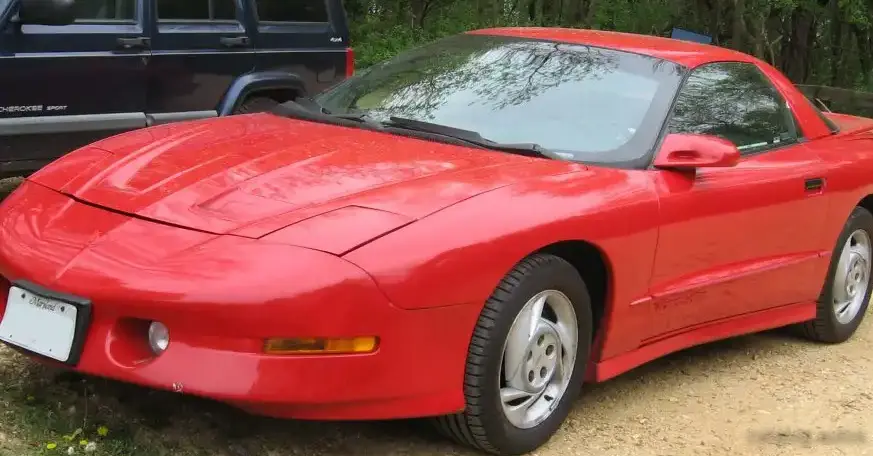
The Pontiac Firebird IV 3.8i V6, produced from 1995 to 2002, represented a significant iteration of the iconic Firebird sports car. Falling within the fourth generation (1993-2002) of the Firebird, this variant occupied a middle-ground position in the lineup, offering a balance between performance and affordability. It served as a step up from the base V6 models, while remaining more accessible than the flagship Firebird Formula or Trans Am equipped with the more potent V8 engines. The 3.8i V6 aimed to provide a compelling driving experience for enthusiasts seeking a stylish and capable coupe without the higher price tag of the top-tier trims.
Technical Specifications
| Brand | Pontiac |
| Model | Firebird |
| Generation | Firebird IV |
| Type (Engine) | 3.8i V6 (208 Hp) |
| Start of production | 1995 |
| End of production | 2002 |
| Powertrain Architecture | Internal Combustion engine |
| Body type | Coupe |
| Seats | 5 |
| Doors | 3 |
| Fuel consumption (combined) | 10.3 l/100 km |
| Fuel consumption (US mpg) | 22.8 US mpg |
| Fuel consumption (UK mpg) | 27.4 UK mpg |
| Fuel consumption (km/l) | 9.7 km/l |
| Fuel Type | Petrol (Gasoline) |
| Weight-to-power ratio | 7.1 kg/Hp |
| Hp/tonne | 141.7 Hp/tonne |
| Weight-to-torque ratio | 4.7 kg/Nm |
| Nm/tonne | 212.5 Nm/tonne |
| Power | 208 Hp @ 5200 rpm |
| Power per litre | 54.9 Hp/l |
| Torque | 312 Nm @ 4000 rpm |
| Torque (lb.-ft.) | 230.12 lb.-ft. @ 4000 rpm |
| Engine layout | Front, Longitudinal |
| Engine Model/Code | L36 |
| Engine displacement | 3791 cm3 |
| Engine displacement (cu. in.) | 231.34 cu. in. |
| Number of cylinders | 6 |
| Engine configuration | V-engine |
| Cylinder Bore | 96.5 mm |
| Cylinder Bore (in.) | 3.8 in. |
| Piston Stroke | 86.4 mm |
| Piston Stroke (in.) | 3.4 in. |
| Compression ratio | 9.4:1 |
| Number of valves per cylinder | 2 |
| Fuel injection system | Multi-port manifold injection |
| Engine aspiration | Naturally aspirated engine |
| Engine oil capacity | 4.3 l |
| Engine oil capacity (US qt) | 4.54 US qt |
| Engine oil capacity (UK qt) | 3.78 UK qt |
| Coolant | 11.8 l |
| Coolant (US qt) | 12.47 US qt |
| Coolant (UK qt) | 10.38 UK qt |
| Kerb Weight | 1468 kg |
| Kerb Weight (lbs.) | 3236.39 lbs. |
| Trunk (boot) space (minimum) | 366 l |
| Trunk (boot) space (cu. ft.) | 12.93 cu. ft. |
| Fuel tank capacity | 59 l |
| Fuel tank capacity (US gal) | 15.59 US gal |
| Fuel tank capacity (UK gal) | 12.98 UK gal |
| Length | 4968 mm |
| Length (in.) | 195.59 in. |
| Width | 1893 mm |
| Width (in.) | 74.53 in. |
| Height | 1321 mm |
| Height (in.) | 52.01 in. |
| Wheelbase | 2566 mm |
| Wheelbase (in.) | 101.02 in. |
| Front track | 1542 mm |
| Front track (in.) | 60.71 in. |
| Rear (Back) track | 1540 mm |
| Rear (Back) track (in.) | 60.63 in. |
| Drivetrain Architecture | Rear wheel drive |
| Drive wheel | Rear wheel drive |
| Number of gears | 5 |
| Type of gearbox | Manual transmission |
| Front suspension | Double wishbone |
| Rear suspension | Coil spring |
| Front brakes | Ventilated discs |
| Rear brakes | Disc |
| Assisting systems | ABS (Anti-lock braking system) |
| Steering type | Steering rack and pinion |
| Power steering | Hydraulic Steering |
| Tires size | 215/60 R16 S |
Powertrain & Engine Architecture
The heart of the Firebird IV 3.8i V6 was the 3.8-liter (3791 cc) L36 V6 engine. This engine was a member of the GM’s 3800 Series II V6 family, known for its durability and smooth operation. The L36 featured a 90-degree V-angle, two valves per cylinder, and a cast iron block with aluminum cylinder heads. Fuel delivery was handled by a multi-port fuel injection system, contributing to improved efficiency and throttle response. The engine produced 208 horsepower at 5200 rpm and 230 lb-ft of torque at 4000 rpm. The standard transmission for this variant was a 5-speed manual, although a 4-speed automatic transmission was also available, impacting the overall driving experience and acceleration times.
Driving Characteristics
The 3.8i V6 with the manual transmission offered a reasonably engaging driving experience. While not as brutally fast as the V8-powered models, it provided sufficient power for everyday driving and spirited backroad excursions. The 5-speed manual allowed drivers to keep the engine in its optimal power band, resulting in respectable acceleration. The automatic transmission, while offering convenience, did diminish performance somewhat, resulting in slightly slower acceleration times and a less connected feel. The rear-wheel-drive layout contributed to balanced handling, although the Firebird’s relatively heavy weight could be felt during aggressive cornering.
Equipment & Trim Levels
The Firebird IV 3.8i V6 typically came standard with features such as air conditioning, power windows and locks, a CD player, and cloth upholstery. Optional extras included leather seats, a sunroof, upgraded sound systems, and various cosmetic enhancements. The interior design was driver-focused, with a straightforward dashboard layout and comfortable seating. The trim level could influence the availability of certain features, with higher trims offering more luxurious appointments.
Chassis & Braking
The Firebird IV utilized a double wishbone suspension setup at the front and a coil spring suspension at the rear. This configuration aimed to provide a balance between ride comfort and handling performance. Braking duties were handled by ventilated discs at the front and solid discs at the rear. An anti-lock braking system (ABS) was standard, enhancing safety and control during emergency braking situations. The steering system employed a rack-and-pinion setup with hydraulic power assistance, providing precise and responsive steering feel.
Market Reception & Comparison
The Firebird IV 3.8i V6 was generally well-received by automotive critics as a capable and affordable sports coupe. It offered a good compromise between performance, comfort, and price. Compared to the base V6 models, the 3.8i V6 provided a noticeable power boost, making it a more enjoyable driving experience. However, it couldn’t match the outright performance of the V8-powered Formula and Trans Am trims. Fuel economy was reasonable for a sports car of its era, averaging around 22.8 US mpg in combined driving. Reliability was generally good, with the 3800 Series II V6 engine being known for its longevity.
Legacy
Today, the Pontiac Firebird IV 3.8i V6 remains a popular choice among enthusiasts seeking a classic American sports car. The 3800 V6 engine is known for its durability and relatively low maintenance costs, making it a practical choice for a daily driver or weekend cruiser. Well-maintained examples command reasonable prices in the used car market, and the Firebird’s iconic styling continues to attract attention. While it may not be the fastest or most technologically advanced sports car, the Firebird IV 3.8i V6 offers a unique blend of style, performance, and affordability that continues to appeal to a wide range of drivers.