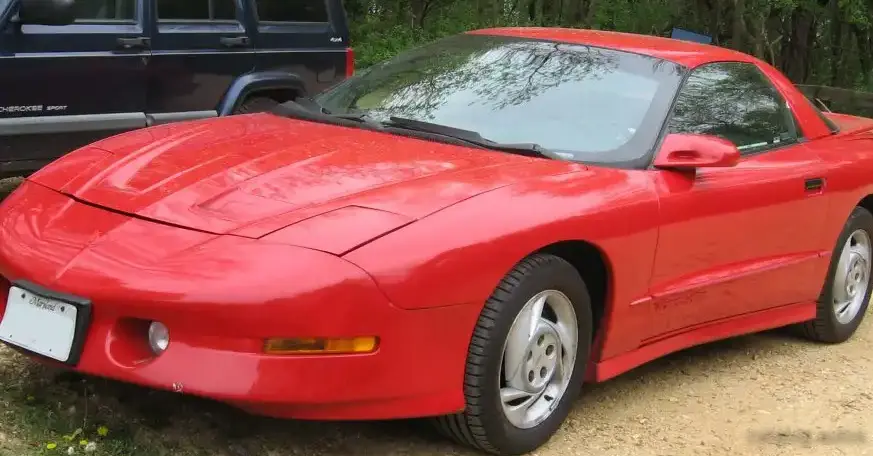
The Pontiac Firebird IV 5.7i V8 Trans Am, produced from November 1992 to August 2002, represented the fourth generation of the iconic Firebird. This particular variant, equipped with the 5.7-liter LT1 V8 engine and a four-speed automatic transmission, occupied a performance-oriented position within the Firebird lineup, slotting above the base V6 models and often serving as a more accessible alternative to the higher-performance WS6 package. It was a key player in Pontiac’s effort to maintain a sporty image during a period of increasing competition in the American muscle car segment.
Technical Specifications
| Brand | Pontiac |
| Model | Firebird |
| Generation | Firebird IV |
| Type (Engine) | 5.7 i V8 Trans Am (265 Hp) |
| Start of production | November, 1992 |
| End of production | August, 2002 |
| Powertrain Architecture | Internal Combustion engine |
| Body type | Coupe |
| Seats | 4 |
| Doors | 3 |
| Fuel consumption (combined) | 10.5 l/100 km (22.4 US mpg, 26.9 UK mpg, 9.5 km/l) |
| Fuel Type | Petrol (Gasoline) |
| Maximum speed | 239 km/h (148.51 mph) |
| Weight-to-power ratio | 6.1 kg/Hp, 163 Hp/tonne |
| Weight-to-torque ratio | 3.9 kg/Nm, 258.3 Nm/tonne |
| Power | 265 Hp @ 5200 rpm |
| Power per litre | 46.2 Hp/l |
| Torque | 420 Nm @ 2400 rpm (309.78 lb.-ft. @ 2400 rpm) |
| Engine layout | Front, Longitudinal |
| Engine Model/Code | LT1 |
| Engine displacement | 5736 cm3 (350.03 cu. in.) |
| Number of cylinders | 8 |
| Engine configuration | V-engine |
| Cylinder Bore | 101.9 mm (4.01 in.) |
| Piston Stroke | 88 mm (3.46 in.) |
| Compression ratio | 10.5:1 |
| Number of valves per cylinder | 2 |
| Fuel injection system | Multi-port manifold injection |
| Engine aspiration | Naturally aspirated engine |
| Engine oil capacity | 4.3 l (4.54 US qt | 3.78 UK qt) |
| Coolant | 14.5 l (15.32 US qt | 12.76 UK qt) |
| Kerb Weight | 1626 kg (3584.72 lbs.) |
| Max. weight | 2060 kg (4541.52 lbs.) |
| Max load | 434 kg (956.81 lbs.) |
| Trunk (boot) space – minimum | 366 l (12.93 cu. ft.) |
| Fuel tank capacity | 59 l (15.59 US gal | 12.98 UK gal) |
| Length | 5006 mm (197.09 in.) |
| Width | 1892 mm (74.49 in.) |
| Height | 1295 mm (50.98 in.) |
| Wheelbase | 2566 mm (101.02 in.) |
| Front track | 1542 mm (60.71 in.) |
| Rear (Back) track | 1539 mm (60.59 in.) |
| Drivetrain Architecture | Rear wheel drive |
| Number of gears and type of gearbox | 4 gears, automatic transmission |
| Front suspension | Double wishbone |
| Rear suspension | Coil spring |
| Front brakes | Ventilated discs |
| Rear brakes | Disc |
| Assisting systems | ABS (Anti-lock braking system) |
| Steering type | Steering rack and pinion |
| Power steering | Hydraulic Steering |
| Tires size | 245/50 R16 |
Powertrain & Engine Architecture
The heart of the Firebird IV 5.7i Trans Am was the General Motors LT1 5.7-liter (350 cubic inch) small-block V8 engine. This engine, introduced in 1992, represented a significant departure from previous GM V8s, featuring reverse-flow cooling (where coolant flowed through the cylinder heads before the block), a high-flow cylinder head design, and a distributorless ignition system. The LT1 produced 265 horsepower at 5200 rpm and 309.78 lb-ft of torque at 2400 rpm. Fuel delivery was handled by a multi-port fuel injection system, providing precise fuel metering for improved efficiency and performance. The engine’s robust bottom end and well-designed cylinder heads allowed for relatively easy modifications for those seeking increased power.
The engine was mated to a 4L60E four-speed automatic transmission. This transmission was known for its durability and smooth shifting characteristics, although it wasn’t always the quickest-shifting unit. The automatic transmission was a key factor in the Trans Am’s appeal to a broader audience, offering ease of use and convenience compared to the available six-speed manual transmission.
Driving Characteristics
The 5.7i Trans Am with the automatic transmission delivered a comfortable yet engaging driving experience. While not as aggressively geared as the manual transmission versions, the automatic provided adequate acceleration, with a 0-60 mph time typically in the mid-6 second range. The torque converter multiplied engine torque, providing strong off-the-line acceleration, but also resulted in some power loss compared to a manual transmission. The automatic’s shift points were programmed for a balance between performance and fuel economy. The car felt planted and stable during cornering, thanks to its well-tuned suspension and relatively wide tires (245/50R16). However, it lacked the raw, visceral feel of the manual transmission models.
Equipment & Trim Levels
The 5.7i Trans Am came standard with a number of features, including air conditioning, power windows and locks, cruise control, and a premium sound system. The interior typically featured cloth bucket seats, although leather upholstery was available as an option. The dashboard layout was driver-focused, with easy-to-read gauges and well-placed controls. Optional extras included a T-top roof, a performance suspension package, and upgraded audio systems. The Trans Am trim level also included unique exterior styling cues, such as a distinctive front fascia, a rear spoiler, and side skirts.
Chassis & Braking
The Firebird IV utilized a unibody construction for improved rigidity and weight reduction. The front suspension consisted of a double wishbone setup, while the rear suspension employed a coil spring arrangement. This suspension configuration provided a good balance between ride comfort and handling performance. Braking duties were handled by ventilated discs at the front and solid discs at the rear. An anti-lock braking system (ABS) was standard, enhancing safety and control during hard braking situations. The steering system was a rack-and-pinion setup with hydraulic power assist, providing precise and responsive steering feel.
Market Reception & Comparison
The Firebird IV 5.7i Trans Am was generally well-received by automotive critics. It was praised for its powerful engine, comfortable ride, and attractive styling. However, some critics noted that the automatic transmission dulled the driving experience compared to the manual transmission models. Compared to the base V6 Firebirds, the 5.7i Trans Am offered a significant performance upgrade. It also provided a more affordable alternative to the WS6 package, which included a more aggressive suspension, higher output engine, and other performance enhancements. Fuel economy was reasonable for a V8-powered sports car, averaging around 22.4 mpg in combined driving.
Legacy
The Pontiac Firebird IV 5.7i V8 Trans Am remains a popular choice among collectors and enthusiasts. The LT1 engine is known for its reliability and relatively easy maintenance. While some common issues, such as oil leaks and sensor failures, can occur, the engine is generally considered to be durable and long-lasting. Today, well-maintained examples of the 5.7i Trans Am command respectable prices in the used car market, reflecting the enduring appeal of this iconic American muscle car. The combination of performance, style, and relative affordability has cemented its place in automotive history.