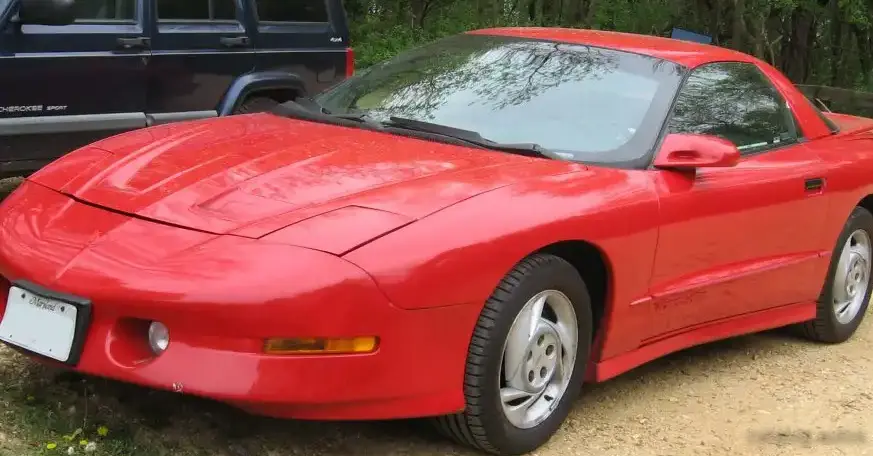
The Pontiac Firebird IV 5.7i V8 Automatic, produced between 2000 and 2002, represented the final iteration of Pontiac’s iconic pony car. Positioned as the performance flagship of the fourth-generation Firebird (1993-2002), this variant offered a substantial power upgrade over the base V6 models and the intermediate 3.8L V6. It was built on the F-body platform, shared with the Chevrolet Camaro, and aimed at enthusiasts seeking a powerful, rear-wheel-drive American coupe. The 5.7i, signified a significant step up in performance and refinement compared to earlier Firebird models, though it arrived near the end of the Firebird’s production run.
Technical Specifications
| Brand | Pontiac |
| Model | Firebird |
| Generation | Firebird IV |
| Type (Engine) | 5.7i V8 (314 Hp) Automatic |
| Start of production | 2000 |
| End of production | 2002 |
| Powertrain Architecture | Internal Combustion engine |
| Body type | Coupe |
| Seats | 5 |
| Doors | 3 |
| Fuel consumption (urban) | 13.1 l/100 km (18 US mpg, 21.6 UK mpg) |
| Fuel consumption (extra urban) | 9.1 l/100 km (25.8 US mpg, 31 UK mpg) |
| Fuel consumption (combined) | 11.2 l/100 km (21 US mpg, 25.2 UK mpg) |
| Fuel Type | Petrol (Gasoline) |
| Acceleration 0 – 100 km/h | 6 sec |
| Acceleration 0 – 62 mph | 6 sec |
| Acceleration 0 – 60 mph | 5.7 sec |
| Maximum speed | 250 km/h (155.34 mph) |
| Weight-to-power ratio | 5 kg/Hp, 198.1 Hp/tonne |
| Weight-to-torque ratio | 3.4 kg/Nm, 290.9 Nm/tonne |
| Power | 314 Hp @ 5200 rpm |
| Power per litre | 55.4 Hp/l |
| Torque | 461 Nm @ 4000 rpm (340.02 lb.-ft. @ 4000 rpm) |
| Engine layout | Front, Longitudinal |
| Engine Model/Code | LS1 |
| Engine displacement | 5665 cm3 (345.7 cu. in.) |
| Number of cylinders | 8 |
| Engine configuration | V-engine |
| Cylinder Bore | 99 mm (3.9 in.) |
| Piston Stroke | 92 mm (3.62 in.) |
| Compression ratio | 10.1:1 |
| Number of valves per cylinder | 2 |
| Fuel injection system | Multi-port manifold injection |
| Engine aspiration | Naturally aspirated engine |
| Engine oil capacity | 5.2 l (5.49 US qt | 4.58 UK qt) |
| Coolant capacity | 11.2 l (11.83 US qt | 9.85 UK qt) |
| Kerb Weight | 1585 kg (3494.33 lbs.) |
| Trunk (boot) space – minimum | 365 l (12.89 cu. ft.) |
| Trunk (boot) space – maximum | 955 l (33.73 cu. ft.) |
| Fuel tank capacity | 59 l (15.59 US gal | 12.98 UK gal) |
| Length | 4910 mm (193.31 in.) |
| Width | 1890 mm (74.41 in.) |
| Height | 1300 mm (51.18 in.) |
| Wheelbase | 2570 mm (101.18 in.) |
| Front track | 1540 mm (60.63 in.) |
| Rear track | 1540 mm (60.63 in.) |
| Drivetrain Architecture | Rear wheel drive |
| Number of gears | 4 |
| Gearbox type | Automatic transmission |
| Front suspension | Double wishbone |
| Rear suspension | Coil spring |
| Front brakes | Ventilated discs |
| Rear brakes | Ventilated discs |
| Assisting systems | ABS (Anti-lock braking system) |
| Steering type | Steering rack and pinion |
| Power steering | Hydraulic Steering |
| Tires size | 235/55 R16 |
| Wheel rims size | 16 |
INTRODUCTION
The 2000-2002 Pontiac Firebird IV 5.7i V8 Automatic represented the pinnacle of performance for the fourth-generation Firebird. Built on the GM F-body platform, alongside the Chevrolet Camaro, the Firebird IV aimed to deliver a compelling blend of American muscle and modern technology. The 5.7i variant, equipped with the LS1 V8 engine and a four-speed automatic transmission, was the top-tier offering, designed to appeal to drivers who desired substantial power without the complexity of a manual gearbox. It was a relatively short-lived model, as the entire Firebird line was discontinued in 2002 due to declining sales and shifting market preferences.
Powertrain & Engine Architecture
The heart of the Firebird IV 5.7i was the LS1 5.7-liter (345.7 cubic inch) V8 engine. This engine, a member of General Motors’ renowned Small-Block V8 family, featured an aluminum block and cylinder heads, contributing to a relatively lightweight construction. The LS1 utilized a 10.1:1 compression ratio and a multi-port fuel injection system, delivering 314 horsepower at 5200 rpm and 340 lb-ft of torque at 4000 rpm. The engine’s valvetrain employed two valves per cylinder, operated by pushrods and rocker arms. The four-speed automatic transmission (4L60E) was specifically tuned to handle the LS1’s power output. While not known for lightning-fast shifts, it provided smooth and reliable operation for everyday driving. The transmission featured electronic control for optimized shift points and torque converter lockup.
Driving Characteristics
The Firebird IV 5.7i Automatic offered a distinctly American driving experience. The LS1 V8 provided ample low-end torque, making it responsive in everyday traffic. Acceleration to 60 mph was achieved in approximately 5.7 seconds, and the car could reach a top speed of 155 mph. Compared to the manual transmission-equipped Firebird, the automatic version sacrificed some responsiveness and driver engagement. The automatic’s shift points, while optimized for performance, weren’t as precise as a skilled driver could achieve with a manual gearbox. However, the automatic offered a more relaxed and comfortable driving experience, particularly in stop-and-go traffic. The rear-wheel-drive configuration provided a balanced feel, although the car was prone to oversteer if pushed to its limits.
Equipment & Trim Levels
The 5.7i trim level was the most well-equipped Firebird available. Standard features included leather upholstery, air conditioning, power windows and locks, a premium sound system, and a sport steering wheel. Optional extras included a T-top roof, a Monsoon audio system, and various cosmetic enhancements. The interior design was driver-focused, with a clear and functional dashboard layout. The seats provided adequate support for spirited driving, and the overall interior quality was a step above the base Firebird models. The exterior featured a unique hood scoop and rear spoiler, differentiating it from the lower trims.
Chassis & Braking
The Firebird IV utilized a double wishbone suspension at the front and a coil spring suspension at the rear. The suspension was tuned for a balance between ride comfort and handling performance. The 5.7i model benefited from slightly stiffer springs and dampers compared to the V6 versions, improving its cornering stability. Braking duties were handled by ventilated disc brakes at all four corners, providing adequate stopping power. An Anti-lock Braking System (ABS) was standard, enhancing safety and control during emergency braking situations. The Firebird’s chassis, while robust, was showing its age by the early 2000s, and it lacked the rigidity of more modern sports cars.
Market Reception & Comparison
The Firebird IV 5.7i V8 Automatic received generally positive reviews from automotive critics. It was praised for its powerful engine, comfortable ride, and relatively affordable price. However, some critics noted the car’s aging design and interior, as well as the automatic transmission’s lack of responsiveness compared to the manual. Compared to the Firebird V6 models, the 5.7i offered a significant performance upgrade, but at a higher price point. Against competitors like the Ford Mustang GT and Chevrolet Camaro SS, the Firebird 5.7i offered a comparable level of performance and features. Fuel economy, at 18 mpg city and 26 mpg highway, was typical for a V8-powered sports car of that era.
Legacy
The Pontiac Firebird IV 5.7i V8 Automatic holds a special place in the hearts of many automotive enthusiasts. The LS1 engine, in particular, has become highly sought after for its reliability and performance potential. Today, well-maintained examples of the Firebird 5.7i are becoming increasingly collectible. While the automatic transmission isn’t as desirable as the manual version among purists, it remains a viable option for drivers who prefer a more relaxed driving experience. The Firebird IV 5.7i represents the final chapter in the Firebird’s storied history, and it serves as a reminder of a bygone era of American muscle cars.