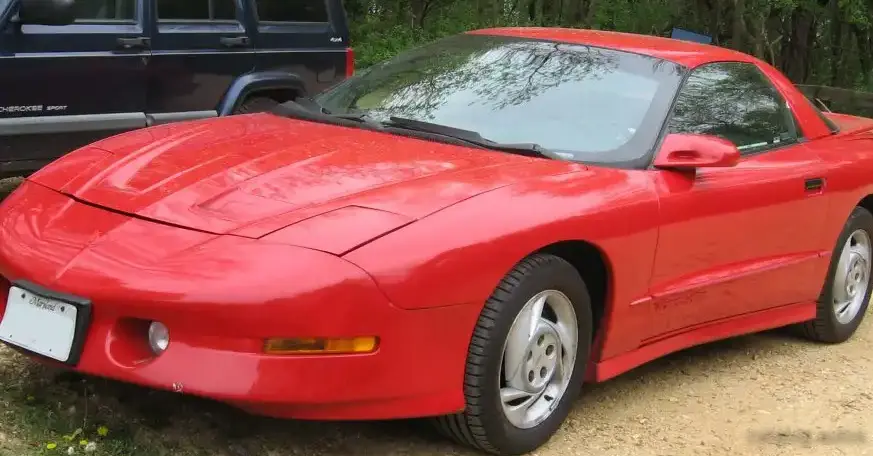
The Pontiac Firebird IV 5.7i V8 Trans Am, produced from November 1992 through 1999, represented the final iteration of Pontiac’s iconic muscle car. Positioned as the performance flagship of the fourth-generation Firebird (1993-2002), the 5.7i Trans Am offered a substantial power upgrade over lower trims like the base V6 models. It was a direct competitor to the Chevrolet Camaro Z28, sharing the same F-body platform. This variant, equipped with the LT1 V8 and a 4-speed automatic transmission, aimed to deliver a blend of raw power and relative ease of use, appealing to drivers seeking a potent American sports coupe.
Technical Specifications
| Brand | Pontiac |
| Model | Firebird |
| Generation | Firebird IV |
| Type | 5.7i V8 Trans Am (269 Hp) Automatic |
| Start of production | November, 1992 |
| End of production | 1999 |
| Powertrain Architecture | Internal Combustion engine |
| Body type | Coupe |
| Seats | 4 |
| Doors | 3 |
| Fuel Type | Petrol (Gasoline) |
| Acceleration 0 – 100 km/h | 6.3 sec |
| Acceleration 0 – 62 mph | 6.3 sec |
| Acceleration 0 – 60 mph | 6 sec |
| Maximum speed | 239 km/h (148.51 mph) |
| Weight-to-power ratio | 6.4 kg/Hp, 157.3 Hp/tonne |
| Weight-to-torque ratio | 4 kg/Nm, 249.7 Nm/tonne |
| Power | 269 Hp @ 5200 rpm |
| Power per litre | 46.9 Hp/l |
| Torque | 427 Nm @ 2300 rpm (314.94 lb.-ft. @ 2300 rpm) |
| Engine layout | Front, Longitudinal |
| Engine Model/Code | LT1 |
| Engine displacement | 5733 cm3 (349.85 cu. in.) |
| Number of cylinders | 8 |
| Engine configuration | V-engine |
| Cylinder Bore | 101.6 mm (4 in.) |
| Piston Stroke | 88.4 mm (3.48 in.) |
| Compression ratio | 10.5:1 |
| Number of valves per cylinder | 2 |
| Fuel injection system | Multi-port manifold injection |
| Engine aspiration | Naturally aspirated engine |
| Engine oil capacity | 4.3 l (4.54 US qt | 3.78 UK qt) |
| Coolant capacity | 14.3 l (15.11 US qt | 12.58 UK qt) |
| Kerb Weight | 1710 kg (3769.9 lbs.) |
| Max. weight | 2160 kg (4761.98 lbs.) |
| Max load | 450 kg (992.08 lbs.) |
| Trunk (boot) space – minimum | 365 l (12.89 cu. ft.) |
| Trunk (boot) space – maximum | 954 l (33.69 cu. ft.) |
| Fuel tank capacity | 59 l (15.59 US gal | 12.98 UK gal) |
| Length | 5006 mm (197.09 in.) |
| Width | 1892 mm (74.49 in.) |
| Height | 1295 mm (50.98 in.) |
| Wheelbase | 2566 mm (101.02 in.) |
| Front track | 1542 mm (60.71 in.) |
| Rear (Back) track | 1540 mm (60.63 in.) |
| Drivetrain Architecture | Rear wheel drive |
| Number of gears and type of gearbox | 4 gears, automatic transmission |
| Front suspension | Double wishbone |
| Rear suspension | Coil spring |
| Front brakes | Ventilated discs |
| Rear brakes | Ventilated discs |
| Assisting systems | ABS (Anti-lock braking system) |
| Steering type | Steering rack and pinion |
| Power steering | Hydraulic Steering |
| Tires size | 245/50 R16 |
| Wheel rims size | 16 |
Powertrain & Engine Architecture
The heart of the 5.7i Trans Am was the General Motors LT1 small-block V8 engine. This 349.85 cubic inch (5.7-liter) engine featured a cast iron block with aluminum cylinder heads. The LT1 was a significant departure from previous GM V8s, incorporating reverse-flow cooling (where coolant flowed through the heads before the block) for improved cylinder head temperature management. It utilized multi-port fuel injection, delivering fuel directly into each intake port, and a two-bolt main bearing cap design for increased rigidity. The engine produced 269 horsepower at 5200 rpm and 314.94 lb-ft of torque at 2300 rpm. The 4L60-E four-speed automatic transmission was the sole transmission option for this trim. This transmission was electronically controlled, offering smoother shifts and improved efficiency compared to older hydraulic automatics. The transmission was tuned for a balance between performance and drivability, with gear ratios optimized for both acceleration and highway cruising.
Driving Characteristics
The 5.7i Trans Am with the automatic transmission delivered brisk acceleration, achieving 0-60 mph in around 6 seconds. While not as quick as a comparable model equipped with a manual transmission (which could shave a few tenths off that time), the automatic provided a more accessible driving experience for a wider range of drivers. The 4L60-E transmission’s shift points were programmed to keep the engine within its optimal power band, providing strong pull throughout the rev range. However, some enthusiasts criticized the automatic for occasionally “hunting” for the right gear during spirited driving. The rear-wheel-drive layout and relatively short wheelbase contributed to a sporty feel, but also required careful throttle control, especially in wet conditions. The suspension, while comfortable for everyday driving, could exhibit some body roll during aggressive cornering.
Equipment & Trim Levels
The Trans Am trim level was already well-equipped, and the 5.7i variant added several premium features. Standard equipment included air conditioning, power windows and locks, cruise control, and a premium sound system. The interior typically featured cloth bucket seats, although leather upholstery was available as an option. The dashboard featured analog gauges, including a speedometer, tachometer, and fuel gauge. Optional extras included a T-top roof, a performance suspension package, and upgraded audio systems. The 5.7i Trans Am also received unique exterior styling cues, such as a ram air induction hood and distinctive wheels, setting it apart from the lower-trim models.
Chassis & Braking
The Firebird IV utilized a unibody construction for improved rigidity. The front suspension consisted of a double wishbone setup with coil springs and gas-charged shocks, while the rear suspension employed a coil-spring solid axle configuration. The 5.7i Trans Am came standard with ventilated disc brakes on all four wheels, providing ample stopping power. An Anti-lock Braking System (ABS) was also standard, enhancing safety and control during hard braking. The steering system was a rack-and-pinion setup with hydraulic power assist, offering precise steering feel and maneuverability. The standard tire size was 245/50R16, providing a good balance of grip and ride comfort.
Market Reception & Comparison
The 1992-1999 Firebird Trans Am 5.7i was generally well-received by automotive critics. It was praised for its powerful engine, sporty handling, and attractive styling. However, some reviewers noted the interior quality was not on par with some of its import competitors. Compared to the base V6 models, the 5.7i offered a significant performance upgrade, but at a higher price point. Against the Chevrolet Camaro Z28, the Trans Am offered a similar level of performance, but with a slightly different aesthetic and driving feel. Fuel economy was reasonable for a V8-powered sports car, averaging around 17 mpg city and 24 mpg highway.
Legacy
The LT1 engine proved to be a durable and reliable powerplant, and well-maintained 5.7i Trans Ams continue to provide enjoyable performance today. The 4L60-E transmission, while generally reliable, can be prone to certain issues with age, such as harsh shifting or failure of the torque converter. In the used car market, the 5.7i Trans Am has become a desirable collectible, particularly among enthusiasts of 1990s American muscle cars. Its combination of power, style, and relative affordability has ensured its continued popularity and cemented its place in automotive history. Parts availability remains good, making it a relatively easy car to maintain and restore.