
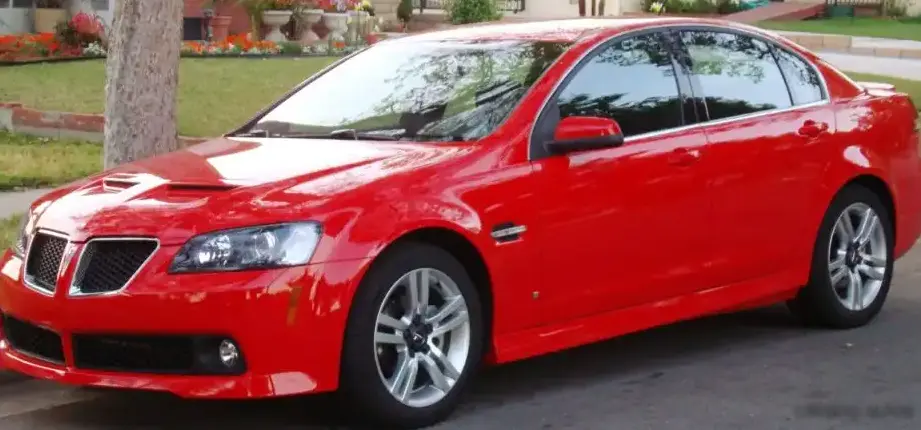
The Pontiac G8 3.6L V6 Automatic, produced for the 2008 and 2009 model years, represented Pontiac’s foray into the rear-wheel-drive performance sedan market. Based on the Holden Commodore (VE series) from General Motors’ Australian subsidiary, the G8 was intended to revitalize the Pontiac brand with a focus on driving dynamics and a more sophisticated image. The 3.6L V6 Automatic variant served as the entry-level model in the G8 lineup, offering a balance of performance and affordability. It occupied a space below the more powerful G8 GT (with the 6.0L V8) and the track-focused G8 GXP (with a supercharged 6.2L V8). The G8 was a relatively short-lived model, discontinued along with the Pontiac brand in 2009 as part of General Motors’ restructuring following the 2008 financial crisis.
Technical Specifications
| Brand | Pontiac |
| Model | G8 |
| Generation | G8 |
| Type (Engine) | 3.6 V6 (256 Hp) Automatic |
| Start of production | 2008 |
| End of production | 2009 |
| Powertrain Architecture | Internal Combustion engine |
| Body type | Sedan |
| Seats | 5 |
| Doors | 4 |
| Fuel consumption (urban) | 14 l/100 km (16.8 US mpg) |
| Fuel consumption (extra urban) | 9.4 l/100 km (25 US mpg) |
| Fuel Type | Petrol (Gasoline) |
| Weight-to-power ratio | 6.9 kg/Hp |
| Weight-to-torque ratio | 5.2 kg/Nm |
| Power | 256 Hp @ 6300 rpm |
| Power per litre | 71.8 Hp/l |
| Torque | 336 Nm @ 2100 rpm (247.82 lb.-ft. @ 2100 rpm) |
| Engine layout | Front, Longitudinal |
| Engine Model/Code | LY7 |
| Engine displacement | 3564 cm3 (217.49 cu. in.) |
| Number of cylinders | 6 |
| Engine configuration | V-engine |
| Cylinder Bore | 94 mm (3.7 in.) |
| Piston Stroke | 85.6 mm (3.37 in.) |
| Compression ratio | 10.2:1 |
| Number of valves per cylinder | 4 |
| Fuel injection system | Multi-port manifold injection |
| Engine aspiration | Naturally aspirated engine |
| Valvetrain | DOHC |
| Engine oil capacity | 6.7 l (7.08 US qt | 5.9 UK qt) |
| Coolant | 10 l (10.57 US qt | 8.8 UK qt) |
| Kerb Weight | 1762 kg (3884.55 lbs.) |
| Trunk (boot) space – minimum | 496 l (17.52 cu. ft.) |
| Fuel tank capacity | 72 l (19.02 US gal | 15.84 UK gal) |
| Permitted trailer load with brakes (12%) | 454 kg (1000.9 lbs.) |
| Length | 4981 mm (196.1 in.) |
| Width | 1900 mm (74.8 in.) |
| Height | 1466 mm (57.72 in.) |
| Wheelbase | 2916 mm (114.8 in.) |
| Front track | 1593 mm (62.72 in.) |
| Rear (Back) track | 1608 mm (63.31 in.) |
| Drivetrain Architecture | Rear wheel drive |
| Number of gears and type of gearbox | 5 gears, automatic transmission |
| Front suspension | Independent coil spring |
| Rear suspension | Independent coil spring |
| Front brakes | Ventilated discs |
| Rear brakes | Ventilated discs |
| Assisting systems | ABS (Anti-lock braking system) |
| Steering type | Steering rack and pinion |
| Power steering | Hydraulic Steering |
| Tires size | 245/45 R18 |
Powertrain & Engine Architecture
The Pontiac G8 3.6L V6 utilized the GM LY7 engine, a 3.6-liter (217.49 cubic inches) naturally aspirated V6. This engine was part of GM’s “Global” V6 engine family, known for its aluminum block and cylinder heads, contributing to a relatively lightweight design. The LY7 featured a 60-degree V-angle, dual overhead camshafts (DOHC) with four valves per cylinder, and multi-port fuel injection. The engine produced 256 horsepower at 6300 rpm and 248 lb-ft of torque at 2100 rpm. The engine’s design prioritized smooth operation and refinement over outright peak power. The transmission paired with the LY7 was a 5-speed automatic transmission (5L40-E), chosen for its balance of efficiency and drivability. This transmission featured electronically controlled shifting and overdrive for highway cruising.
Driving Characteristics
The G8 3.6L Automatic offered a comfortable and capable driving experience. While not as overtly sporty as the V8-powered G8 models, the V6 provided adequate acceleration for everyday driving. The 5-speed automatic transmission was generally smooth-shifting, although some reviewers noted a tendency to hunt for gears in certain situations. The rear-wheel-drive layout contributed to balanced handling, and the independent suspension provided a reasonably comfortable ride. Compared to the G8 GT, the V6 model felt noticeably less powerful, with a 0-60 mph time around 7.5 seconds versus the GT’s roughly 5.5 seconds. The automatic transmission’s gear ratios were tuned for fuel economy and smooth cruising, rather than aggressive acceleration. The V6 G8 was best suited for drivers prioritizing comfort and fuel efficiency over outright performance.
Equipment & Trim Levels
The base G8 3.6L Automatic came standard with a respectable array of features, including air conditioning, power windows and locks, a six-way power-adjustable driver’s seat, a tilt/telescoping steering wheel, and a CD/MP3 stereo system. Upholstery was typically cloth, although leather was available as an option. Optional extras included a sunroof, premium sound system, and remote start. The interior design was generally functional and straightforward, reflecting the G8’s focus on value and practicality. Higher trim levels added features like heated seats, automatic climate control, and upgraded interior trim.
Chassis & Braking
The G8’s chassis was based on the Holden Commodore’s Zeta platform, a rear-wheel-drive architecture designed for performance and handling. The suspension featured independent coil springs at all four corners, providing a good balance of ride comfort and handling precision. The G8 3.6L was equipped with ventilated disc brakes on all four wheels, providing adequate stopping power for its weight class. Anti-lock brakes (ABS) were standard. The steering system utilized a hydraulic power rack-and-pinion setup, offering responsive and precise steering feel. The G8’s relatively long wheelbase contributed to a stable and comfortable ride.
Market Reception & Comparison
The Pontiac G8 3.6L Automatic received generally positive reviews from automotive critics. It was praised for its rear-wheel-drive handling, comfortable ride, and spacious interior. However, some reviewers criticized its relatively modest power output compared to the V8 models and its somewhat dated interior design. Fuel economy was considered reasonable for a V6-powered, rear-wheel-drive sedan, averaging around 17 mpg city and 25 mpg highway. Compared to other sedans in its price range, such as the Ford Taurus and Toyota Camry, the G8 offered a more engaging driving experience but lacked the brand recognition and established reputation of its competitors. Reliability was generally good, although some owners reported minor issues with the automatic transmission.
Legacy
The Pontiac G8, despite its short production run, has gained a following among enthusiasts who appreciate its rear-wheel-drive layout, V6 power, and relatively affordable price point on the used car market. The LY7 V6 engine is generally considered a reliable powerplant, and the 5L40-E automatic transmission, while not without its potential issues, is relatively straightforward to maintain. Today, well-maintained G8 3.6L models can be found for reasonable prices, making them an attractive option for those seeking a comfortable, capable, and somewhat unique sedan. The G8 represents a final, and often overlooked, chapter in Pontiac’s history, showcasing a commitment to performance and driving dynamics that ultimately wasn’t enough to save the brand.
