
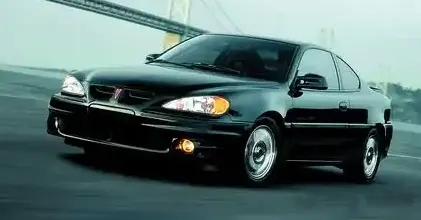
The Pontiac Grand Am Coupe (H) with the 2.4-liter engine producing 152 horsepower was a mainstay of the American compact car market from 1991 through 1998. Representing the second generation of the Grand Am, this coupe variant aimed to provide affordable transportation with a degree of sporty styling. It was positioned as a step up from more basic economy cars, offering a blend of comfort, features, and performance that appealed to a broad range of buyers. The “H” designation refers to the internal platform code used by General Motors. This generation of Grand Am was built on the N-body platform, shared with other GM vehicles like the Buick Skylark and Oldsmobile Achieva.
Technical Specifications
| Brand | Pontiac |
| Model | Grand AM |
| Generation | Grand AM Coupe (H) |
| Type (Engine) | 2.4 (152 Hp) |
| Start of production | 1991 |
| End of production | 1998 |
| Powertrain Architecture | Internal Combustion engine |
| Body type | Coupe |
| Seats | 5 |
| Doors | 2 |
| Fuel consumption (urban) | 9.8 l/100 km (24 US mpg, 28.8 UK mpg, 10.2 km/l) |
| Fuel consumption (extra urban) | 7.3 l/100 km (32.2 US mpg, 38.7 UK mpg, 13.7 km/l) |
| Fuel consumption (combined) | 8.4 l/100 km (28 US mpg, 33.6 UK mpg, 11.9 km/l) |
| Fuel Type | Petrol (Gasoline) |
| Maximum speed | 190 km/h (118.06 mph) |
| Weight-to-power ratio | 9.2 kg/Hp, 109 Hp/tonne |
| Weight-to-torque ratio | 6.6 kg/Nm, 150.5 Nm/tonne |
| Power | 152 Hp @ 5600 rpm |
| Power per litre | 63.5 Hp/l |
| Torque | 210 Nm @ 4400 rpm (154.89 lb.-ft. @ 4400 rpm) |
| Engine layout | Front, Transverse |
| Engine Model/Code | LD9 |
| Engine displacement | 2392 cm3 (145.97 cu. in.) |
| Number of cylinders | 4 |
| Engine configuration | Inline |
| Cylinder Bore | 90 mm (3.54 in.) |
| Piston Stroke | 94 mm (3.7 in.) |
| Compression ratio | 9.5:1 |
| Number of valves per cylinder | 4 |
| Fuel injection system | Multi-port manifold injection |
| Engine aspiration | Naturally aspirated engine |
| Valvetrain | DOHC |
| Engine oil capacity | 3.8 l (4.02 US qt | 3.34 UK qt) |
| Coolant | 9.8 l (10.36 US qt | 8.62 UK qt) |
| Kerb Weight | 1395 kg (3075.45 lbs.) |
| Trunk (boot) space (minimum) | 415 l (14.66 cu. ft.) |
| Fuel tank capacity | 54 l (14.27 US gal | 11.88 UK gal) |
| Length | 4750 mm (187.01 in.) |
| Width | 1730 mm (68.11 in.) |
| Height | 1360 mm (53.54 in.) |
| Wheelbase | 2630 mm (103.54 in.) |
| Front track | 1500 mm (59.06 in.) |
| Rear (Back) track | 1500 mm (59.06 in.) |
| Drivetrain Architecture | The Internal combustion engine (ICE) drives the front wheels of the vehicle. |
| Drive wheel | Front wheel drive |
| Number of gears and type of gearbox | 5 gears, manual transmission |
| Front suspension | Spring Strut |
| Rear suspension | Spring Strut |
| Front brakes | Ventilated discs |
| Rear brakes | Drum |
| Assisting systems | ABS (Anti-lock braking system) |
| Steering type | Steering rack and pinion |
| Power steering | Hydraulic Steering |
| Tires size | 215/60 R15 |
Powertrain & Engine Architecture
The heart of this Grand Am Coupe was the LD9 2.4-liter inline-four cylinder engine. This engine was a significant upgrade from the earlier 2.5-liter pushrod engines found in previous Grand Am generations. The LD9 featured a dual overhead camshaft (DOHC) valvetrain with four valves per cylinder, contributing to improved breathing and higher output. It utilized multi-port fuel injection, delivering fuel directly to each intake valve for precise control. The engine’s 9.5:1 compression ratio was a balance between performance and the ability to run on readily available 87 octane gasoline. The 5-speed manual transmission was the standard offering, providing drivers with direct control over the engine’s power. While an automatic transmission was available, it impacted acceleration and fuel economy.
Driving Characteristics
The 152 horsepower and 210 lb-ft of torque provided by the LD9 engine delivered adequate, though not exhilarating, performance. The 0-60 mph time was typically in the 8-9 second range with the manual transmission. The automatic transmission added roughly a second to that time. The engine felt relatively smooth and refined for its class, with a usable powerband. However, it wasn’t particularly responsive at high RPMs. The front-wheel-drive configuration offered predictable handling, but could exhibit torque steer under hard acceleration. The suspension was tuned for comfort, resulting in a relatively soft ride, but also some body roll during cornering. Compared to the more powerful V6 options available in the Grand Am lineup, this 2.4-liter version prioritized fuel efficiency and affordability over outright performance.
Equipment & Trim Levels
The 2.4-liter Grand Am Coupe typically came with a fairly standard equipment list. Base models included features like air conditioning, an AM/FM stereo, cloth upholstery, and power steering. Higher trim levels, such as the SE, added features like upgraded sound systems, cruise control, power windows and locks, and alloy wheels. Optional extras included a sunroof, leather upholstery, and a CD player. Interior design was functional and straightforward, with a focus on durability rather than luxury. The dashboard layout was typical of early 1990s GM vehicles, with clearly labeled controls and a relatively simple design.
Chassis & Braking
The Grand Am Coupe utilized a front-wheel-drive chassis with independent front suspension and a semi-independent twist-beam rear suspension. The front suspension employed MacPherson struts, while the rear used coil springs and shock absorbers. Braking duties were handled by ventilated discs at the front and drum brakes at the rear. Anti-lock brakes (ABS) were available as an option, enhancing safety. The steering system was a rack-and-pinion setup with hydraulic power assist. The standard tire size was 215/60R15, providing a reasonable balance between ride comfort and handling. Stabilizer bars were included at both the front and rear to reduce body roll.
Market Reception & Comparison
The 1991-1998 Grand Am Coupe with the 2.4-liter engine was generally well-received by consumers as an affordable and practical transportation option. Critics praised its comfortable ride and spacious interior, but noted that its performance was not particularly exciting. Compared to the V6-powered Grand Ams, the 2.4-liter version offered significantly better fuel economy – averaging around 28 mpg combined. However, the V6 models provided a noticeable boost in acceleration and overall driving enjoyment. The 2.4-liter engine was considered relatively reliable, but the automatic transmission was sometimes criticized for its sluggishness and potential for premature failure. Competitors in this segment included the Ford Escort, Honda Civic, and Toyota Corolla.
Legacy
The LD9 2.4-liter engine proved to be a durable and relatively trouble-free powerplant. Grand Ams equipped with this engine are still found on the roads today, often with high mileage. While not known for being particularly collectible, these cars represent an affordable entry point into classic American motoring. Common maintenance issues include oil leaks, worn suspension components, and corrosion in areas prone to rust. The 2.4-liter engine is generally considered to be more reliable than the V6 options, making it a popular choice for buyers seeking a dependable and economical used car. The Grand Am Coupe (H) with the 2.4-liter engine remains a reminder of a time when American automakers focused on providing practical and affordable transportation to the masses.
