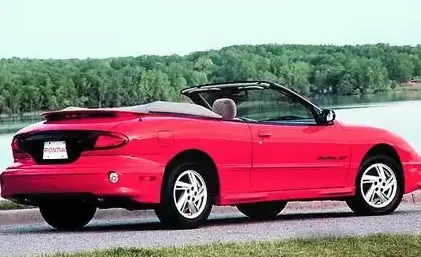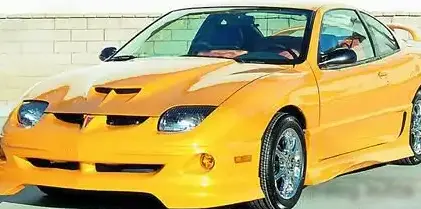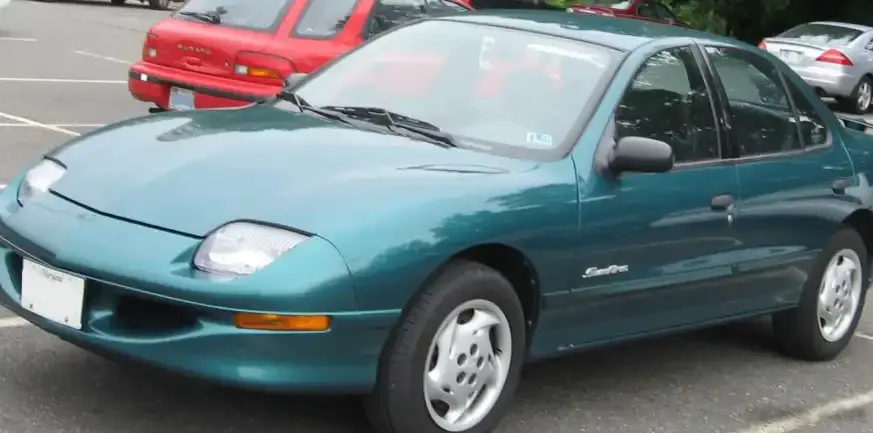
The Pontiac Sunfire Sedan 2.2i (117 hp) was a compact car produced by Pontiac from 1994 to 1999. It represented the second generation of the Sunfire, built on the GM J-body platform (also known as the 1HX0 platform). Positioned as an affordable and practical option within the Pontiac lineup, the 2.2i variant served as a core model, offering a balance between fuel efficiency and acceptable performance. It was aimed at budget-conscious buyers, students, and those seeking reliable transportation. The Sunfire competed with other compact sedans like the Ford Escort, Honda Civic, and Toyota Corolla.
Technical Specifications
| Brand | Pontiac |
| Model | Sunfire |
| Generation | Sunfire Sedan |
| Type (Engine) | 2.2 i (117 Hp) |
| Start of production | 1994 |
| End of production | 1999 |
| Powertrain Architecture | Internal Combustion engine |
| Body type | Sedan |
| Seats | 5 |
| Doors | 4 |
| Fuel consumption (urban) | 10 l/100 km (23.5 US mpg) |
| Fuel consumption (extra urban) | 6.4 l/100 km (36.8 US mpg) |
| Fuel Type | Petrol (Gasoline) |
| Maximum speed | 175 km/h (108.74 mph) |
| Weight-to-power ratio | 15.2 kg/Hp |
| Weight-to-torque ratio | 9.7 kg/Nm |
| Power | 117 Hp @ 5000 rpm |
| Power per litre | 53.4 Hp/l |
| Torque | 183 Nm @ 3600 rpm (134.97 lb.-ft. @ 3600 rpm) |
| Engine layout | Front, Transverse |
| Engine Model/Code | LN2 |
| Engine displacement | 2190 cm3 (133.64 cu. in.) |
| Number of cylinders | 4 |
| Engine configuration | Inline |
| Cylinder Bore | 89 mm (3.5 in.) |
| Piston Stroke | 88 mm (3.46 in.) |
| Compression ratio | 9:1 |
| Number of valves per cylinder | 2 |
| Fuel injection system | Multi-port manifold injection |
| Engine aspiration | Naturally aspirated engine |
| Valvetrain | OHC |
| Engine oil capacity | 3.8 l (4.02 US qt | 3.34 UK qt) |
| Coolant | 9.8 l (10.36 US qt | 8.62 UK qt) |
| Kerb Weight | 1780 kg (3924.23 lbs.) |
| Trunk (boot) space – minimum | 370 l (13.07 cu. ft.) |
| Fuel tank capacity | 57 l (15.06 US gal | 12.54 UK gal) |
| Length | 4620 mm (181.89 in.) |
| Width | 1710 mm (67.32 in.) |
| Height | 1390 mm (54.72 in.) |
| Wheelbase | 2645 mm (104.13 in.) |
| Front track | 1465 mm (57.68 in.) |
| Rear (Back) track | 1435 mm (56.5 in.) |
| Drivetrain Architecture | Front wheel drive |
| Number of gears and type of gearbox | 5 gears, manual transmission |
| Front suspension | Wishbone |
| Rear suspension | Trailing arm |
| Front brakes | Ventilated discs |
| Rear brakes | Drum |
| Assisting systems | ABS (Anti-lock braking system) |
| Steering type | Steering rack and pinion |
| Power steering | Hydraulic Steering |
| Tires size | 195/65 R15 |
Powertrain & Engine Architecture
The heart of the Sunfire 2.2i was the LN2 engine, a 2.2-liter inline-four cylinder powerplant. This engine was a mainstay of GM’s compact car offerings throughout the 1990s. It featured a 9:1 compression ratio and utilized a multi-port fuel injection system for improved fuel efficiency and responsiveness. The engine employed an overhead camshaft (OHC) valvetrain, operating two valves per cylinder. The LN2 engine was known for its relative simplicity and durability, though it wasn’t particularly powerful. The five-speed manual transmission was the standard offering, providing a direct connection between the engine and the front wheels. The transmission’s gear ratios were tuned for fuel economy and everyday drivability rather than outright performance.
Driving Characteristics
The 117 horsepower and 135 lb-ft of torque produced by the 2.2i engine translated to adequate, but not exhilarating, performance. Acceleration from 0 to 60 mph took approximately 9-10 seconds. The manual transmission allowed for reasonable control, but the engine lacked the low-end grunt of larger displacement engines. Compared to the optional 2.3-liter Quad 4 engine available in other Sunfire models, the 2.2i felt noticeably slower. The 2.2i’s strength lay in its fuel efficiency and ease of driving in urban environments. The gear ratios were spaced to prioritize fuel economy, meaning the engine often needed to be revved to access its peak power. Handling was typical for a compact sedan of the era – competent but not sporty.
Equipment & Trim Levels
The Sunfire 2.2i typically came with a fairly basic level of standard equipment. This included features like air conditioning, an AM/FM radio, cloth upholstery, and manual windows and locks. Power steering was standard, but power windows and locks were often optional extras. Higher trim levels, such as the SE, added features like upgraded interior trim, a better sound system, and alloy wheels. Optional equipment could also include a sunroof, cruise control, and upgraded seating.
Chassis & Braking
The Sunfire 2.2i utilized a front-wheel-drive layout with an independent front suspension featuring wishbone components. The rear suspension employed a trailing arm design. Front brakes were ventilated discs, providing adequate stopping power, while rear brakes were drums. Anti-lock braking system (ABS) was available as an option, enhancing safety. The suspension tuning was geared towards comfort rather than sporty handling, resulting in a relatively soft ride quality. The relatively light weight of the 2.2i model, compared to higher-spec Sunfires, helped to mitigate some of the limitations of the suspension.
Market Reception & Comparison
The Sunfire 2.2i was generally well-received as an affordable and reliable compact car. Critics noted its fuel efficiency and practicality, but also pointed out its lack of performance and somewhat bland styling. Compared to the more powerful Sunfire models equipped with the Quad 4 engine, the 2.2i offered significantly lower running costs but a less engaging driving experience. The 2.2i’s fuel economy was competitive with other compact cars of the time, averaging around 23.5 mpg in the city and 36.8 mpg on the highway. Reliability was generally good, although the LN2 engine was known to be susceptible to oil leaks as it aged.
Legacy
The Pontiac Sunfire 2.2i, while not a particularly groundbreaking vehicle, served as a dependable and economical transportation option for many drivers in the 1990s. The LN2 engine, despite its limitations, proved to be relatively durable and is still found in many surviving Sunfires today. In the used car market, these models are often sought after by those looking for an inexpensive and easy-to-maintain vehicle. However, potential buyers should be aware of the possibility of oil leaks and other age-related issues. The Sunfire, and the 2.2i variant specifically, represents a snapshot of the American compact car market during a period of increasing competition and a focus on value.