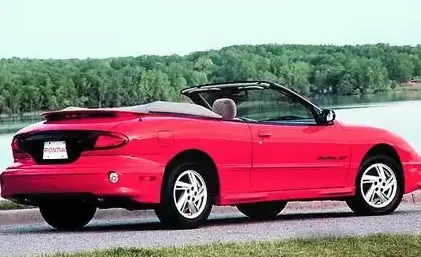
The Pontiac Sunfire Sedan 2.2i 16V Ecotec (141 Hp) Automatic, produced between 2002 and June 2005, represented a key offering in Pontiac’s compact car lineup. Positioned as a mainstream, affordable sedan, it was part of the broader Sunfire Sedan generation, built on the GM J-platform. This variant aimed to provide a balance of fuel efficiency and adequate performance for everyday commuting, targeting budget-conscious buyers. It served as a more accessible entry point into the Sunfire range, sitting below the higher-performance trims and offering a more comfortable driving experience than the base manual transmission models.
Technical Specifications
| Brand | Pontiac |
| Model | Sunfire |
| Generation | Sunfire Sedan |
| Type (Engine) | 2.2i 16V Ecotec (141 Hp) Automatic |
| Start of production | 2002 |
| End of production | June, 2005 |
| Powertrain Architecture | Internal Combustion engine |
| Body type | Sedan |
| Seats | 5 |
| Doors | 4 |
| Fuel consumption (urban) | 10.2 l/100 km (23.1 US mpg, 27.7 UK mpg, 9.8 km/l) |
| Fuel consumption (extra urban) | 7.3 l/100 km (32.2 US mpg, 38.7 UK mpg, 13.7 km/l) |
| Fuel consumption (combined) | 8.7 l/100 km (27 US mpg, 32.5 UK mpg, 11.5 km/l) |
| Fuel Type | Petrol (Gasoline) |
| Maximum speed | 190 km/h (118.06 mph) |
| Power | 141 Hp @ 5600 rpm |
| Power per litre | 64.1 Hp/l |
| Torque | 203 Nm @ 4000 rpm (149.73 lb.-ft. @ 4000 rpm) |
| Engine layout | Front, Transverse |
| Engine Model/Code | L61 |
| Engine displacement | 2198 cm3 (134.13 cu. in.) |
| Number of cylinders | 4 |
| Engine configuration | Inline |
| Cylinder Bore | 86 mm (3.39 in.) |
| Piston Stroke | 94.6 mm (3.72 in.) |
| Compression ratio | 10:1 |
| Number of valves per cylinder | 4 |
| Fuel injection system | Multi-port manifold injection |
| Engine aspiration | Naturally aspirated engine |
| Valvetrain | DOHC |
| Engine oil capacity | 4.8 l (5.07 US qt | 4.22 UK qt) |
| Coolant | 8.2 l (8.66 US qt | 7.21 UK qt) |
| Trunk (boot) space (minimum) | 370 l (13.07 cu. ft.) |
| Fuel tank capacity | 54 l (14.27 US gal | 11.88 UK gal) |
| Length | 4620 mm (181.89 in.) |
| Width | 1730 mm (68.11 in.) |
| Height | 1390 mm (54.72 in.) |
| Wheelbase | 2645 mm (104.13 in.) |
| Front track | 1465 mm (57.68 in.) |
| Rear track | 1435 mm (56.5 in.) |
| Drivetrain Architecture | Front wheel drive |
| Number of gears and type of gearbox | 4 gears, automatic transmission |
| Front suspension | Wishbone |
| Rear suspension | Trailing arm |
| Front brakes | Ventilated discs |
| Rear brakes | Drum |
| Assisting systems | ABS (Anti-lock braking system) |
| Steering type | Steering rack and pinion |
| Power steering | Hydraulic Steering |
| Tires size | 195/65 R15 |
| Wheel rims size | 15 |
Powertrain & Engine Architecture
The heart of the Sunfire 2.2i Automatic is the L61 2.2-liter inline-four cylinder engine, a member of General Motors’ Ecotec family. This engine utilizes a cast iron block with an aluminum cylinder head, featuring dual overhead camshafts (DOHC) and four valves per cylinder. The L61 employed multi-port fuel injection, delivering fuel directly into the intake ports, optimizing combustion efficiency. The engine’s 10:1 compression ratio contributed to its respectable power output for its displacement. Paired with the engine was a four-speed automatic transmission, a common choice for providing smooth and convenient shifting. This transmission was tuned for fuel economy and comfortable cruising rather than aggressive performance.
Driving Characteristics
The 141 horsepower and 149.73 lb-ft of torque produced by the 2.2L Ecotec, when coupled with the four-speed automatic, resulted in adequate, but not exhilarating, performance. Acceleration from 0 to 60 mph was typically in the 9-10 second range. The automatic transmission’s gear ratios were optimized for fuel efficiency, meaning that quick downshifts for passing maneuvers weren’t particularly rapid. Compared to the available five-speed manual transmission, the automatic version felt noticeably slower. However, the automatic offered a smoother and more relaxed driving experience, particularly in city traffic. The power delivery was relatively linear, making it predictable and easy to manage for everyday driving.
Equipment & Trim Levels
The Sunfire 2.2i Automatic typically came standard with features such as air conditioning, power windows and locks, an AM/FM stereo, and basic cloth upholstery. Safety features included dual front airbags and ABS. Optional extras included a CD player, upgraded sound system, cruise control, and power mirrors. The interior was generally functional and straightforward, prioritizing practicality over luxury. Trim levels varied slightly depending on the year, but generally offered packages that added features like alloy wheels, a sunroof, and upgraded interior trim.
Chassis & Braking
The Sunfire Sedan utilized a front-wheel-drive layout with an independent wishbone suspension in the front and a trailing arm suspension in the rear. The front suspension provided reasonable handling characteristics, while the rear suspension prioritized ride comfort. Braking duties were handled by ventilated discs in the front and drum brakes in the rear. ABS was standard, enhancing braking performance and stability, especially in adverse conditions. The suspension tuning was geared towards a comfortable ride rather than sporty handling, making it well-suited for everyday commuting.
Market Reception & Comparison
Critics generally viewed the Sunfire 2.2i Automatic as a competent, if unremarkable, compact sedan. Its fuel economy was a strong point, achieving around 27 mpg combined. However, its performance was often criticized as being underwhelming, especially compared to some of its competitors. Compared to the higher-output Sunfire trims, such as those equipped with the 2.4L engine, the 2.2i Automatic offered significantly less power. The 2.4L models provided a more engaging driving experience, but at the expense of fuel economy. Reliability was generally considered average, with some reports of minor issues with the automatic transmission and fuel injection system.
Legacy
The Pontiac Sunfire 2.2i Automatic, while not a standout performer, remains a relatively affordable and accessible option in the used car market. The L61 Ecotec engine is known for its durability and relatively low maintenance costs, although age-related issues such as oil leaks and sensor failures are common. The four-speed automatic transmission, while not the most advanced, is generally reliable if properly maintained. Today, these Sunfires are often sought after as inexpensive transportation for students or commuters, and their simplicity makes them relatively easy to repair and maintain. While the Pontiac brand is no longer in production, the Sunfire 2.2i Automatic represents a snapshot of early 2000s American compact car design and engineering.