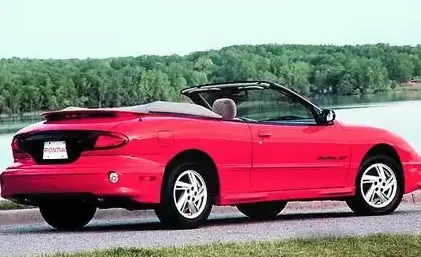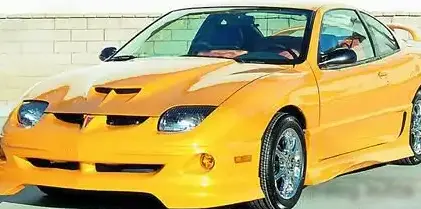
The Pontiac Sunfire Sedan 2.3i 16V, produced between 1994 and 1996, represented a key offering in Pontiac’s compact car lineup. Positioned as a mainstream, affordable sedan, it was part of the first generation of the Sunfire, which aimed to modernize Pontiac’s image and appeal to a broader customer base. This particular variant, with its 2.3-liter inline-four engine producing 147 horsepower, served as a mid-range option, offering a balance between performance and economy within the Sunfire family. It competed directly with other compact sedans like the Ford Escort, Chevrolet Cavalier, and Honda Civic.
Technical Specifications
| Brand | Pontiac |
| Model | Sunfire |
| Generation | Sunfire Sedan |
| Type (Engine) | 2.3i 16V (147 Hp) |
| Start of production | 1994 |
| End of production | 1996 |
| Powertrain Architecture | Internal Combustion engine |
| Body type | Sedan |
| Seats | 5 |
| Doors | 4 |
| Fuel Type | Petrol (Gasoline) |
| Weight-to-power ratio | 8.6 kg/Hp, 116.2 Hp/tonne |
| Weight-to-torque ratio | 6.7 kg/Nm, 150.2 Nm/tonne |
| Power | 147 Hp @ 6000 rpm |
| Power per litre | 65 Hp/l |
| Torque | 190 Nm @ 4800 rpm, 140.14 lb.-ft. @ 4800 rpm |
| Engine layout | Front, Transverse |
| Engine Model/Code | LD2 |
| Engine displacement | 2260 cm3, 137.91 cu. in. |
| Number of cylinders | 4 |
| Engine configuration | Inline |
| Cylinder Bore | 92 mm, 3.62 in. |
| Piston Stroke | 85 mm, 3.35 in. |
| Compression ratio | 9.5:1 |
| Number of valves per cylinder | 4 |
| Fuel injection system | Multi-port manifold injection |
| Engine aspiration | Naturally aspirated engine |
| Valvetrain | DOHC |
| Engine oil capacity | 4.3 l, 4.54 US qt | 3.78 UK qt |
| Coolant | 10 l, 10.57 US qt | 8.8 UK qt |
| Kerb Weight | 1265 kg, 2788.85 lbs |
| Trunk (boot) space – minimum | 370 l, 13.07 cu. ft |
| Fuel tank capacity | 58 l, 15.32 US gal | 12.76 UK gal |
| Length | 4616 mm, 181.73 in |
| Width | 1725 mm, 67.91 in |
| Height | 1393 mm, 54.84 in |
| Wheelbase | 2644 mm, 104.09 in |
| Front track | 1462 mm, 57.56 in |
| Rear (Back) track | 1442 mm, 56.77 in |
| Drivetrain Architecture | The Internal combustion engine (ICE) drives the front wheels of the vehicle. |
| Drive wheel | Front wheel drive |
| Number of gears and type of gearbox | 5 gears, manual transmission |
| Front suspension | Wishbone |
| Rear suspension | Trailing arm |
| Front brakes | Ventilated discs |
| Rear brakes | Drum |
| Assisting systems | ABS (Anti-lock braking system) |
| Steering type | Steering rack and pinion |
| Power steering | Hydraulic Steering |
| Tires size | 195/65 R15 |
Powertrain & Engine Architecture
The heart of the Sunfire 2.3i was the LD2 engine, a 2.3-liter inline-four cylinder powerplant. This engine featured a dual overhead camshaft (DOHC) valvetrain operating 16 valves (four per cylinder), contributing to its relatively high output for its displacement. The LD2 utilized multi-port fuel injection, a common technology in the mid-1990s, which improved fuel atomization and efficiency compared to earlier throttle-body injection systems. The engine’s 9.5:1 compression ratio was a compromise between performance and the ability to run on readily available 87 octane gasoline. The 5-speed manual transmission was the standard offering, providing drivers with direct control over the engine’s powerband. The engine was mounted transversely in the front of the vehicle, driving the front wheels.
Driving Characteristics
The 147 horsepower and 190 Nm (140 lb-ft) of torque provided by the 2.3-liter engine delivered adequate, though not exhilarating, performance. Acceleration from 0 to 60 mph was typically in the 9-10 second range. The 5-speed manual transmission allowed drivers to keep the engine in its optimal power range, providing a more engaging driving experience than the optional 3-speed automatic. The gear ratios were fairly conventional for the time, prioritizing fuel economy over outright acceleration. Compared to the base 2.2-liter engine, the 2.3i offered a noticeable improvement in both power and torque, making it more suitable for highway driving and passing maneuvers. However, it didn’t possess the sporty character of higher-performance models like the later Sunfire GT with its more powerful V6 engine.
Equipment & Trim Levels
The Sunfire 2.3i typically came standard with features considered essential for the era, including air conditioning, power steering, a basic AM/FM radio, and cloth upholstery. The interior was functional and straightforward in its design, prioritizing practicality over luxury. Optional extras included a CD player, upgraded sound system, power windows and locks, and a sunroof. The trim level was generally considered a step up from the base Sunfire, offering a slightly more refined interior and additional convenience features. Exterior features typically included color-keyed mirrors and door handles.
Chassis & Braking
The Sunfire Sedan utilized a front-wheel-drive chassis with an independent front suspension featuring wishbone components and a rear trailing arm suspension. This setup provided a reasonable balance between ride comfort and handling. The front brakes were ventilated discs, offering good stopping power, while the rear brakes were drums, a cost-saving measure common in this class of vehicle. An anti-lock braking system (ABS) was available as an option, enhancing safety by preventing wheel lockup during hard braking. Steering was provided by a hydraulic power rack and pinion system, offering responsive and relatively light steering feel.
Market Reception & Comparison
The Sunfire 2.3i was generally well-received by automotive critics as a competent and affordable compact sedan. It was praised for its comfortable ride, spacious interior, and relatively fuel-efficient engine. However, some reviewers noted that its styling was somewhat bland and that its handling wasn’t as sharp as some of its Japanese competitors. Compared to the base 2.2-liter Sunfire, the 2.3i offered a significant performance boost, making it a more appealing option for drivers who frequently drove on the highway or carried passengers. Fuel economy was comparable to other vehicles in its class, typically achieving around 24 mpg city and 32 mpg highway.
Legacy
The Pontiac Sunfire 2.3i, while not a particularly groundbreaking vehicle, played a significant role in Pontiac’s efforts to modernize its image and compete in the increasingly competitive compact car market. The LD2 engine proved to be reasonably reliable, although like any engine of this era, it was susceptible to oil leaks and occasional sensor failures. Today, these Sunfires are relatively affordable and readily available on the used car market. They are often sought after by those looking for a simple, reliable, and inexpensive mode of transportation. While not a collector’s item, the Sunfire 2.3i represents a snapshot of American automotive design and engineering from the mid-1990s.