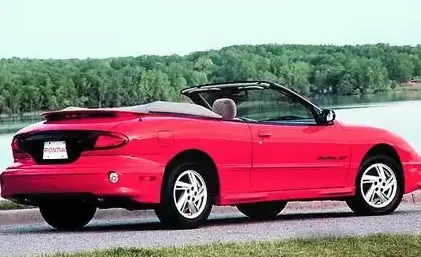
The Pontiac Sunfire Sedan 2.4i 16V, producing 152 horsepower, was a mainstay of the compact car segment in North America from 1996 through 2002. Part of the J-body platform shared with the Chevrolet Cavalier and Oldsmobile Beretta, the Sunfire aimed to provide affordable transportation with a focus on style and, in the 2.4i trim, a reasonable level of performance. This particular variant occupied the mid-range position within the Sunfire lineup, offering a step up in power and refinement compared to the base 2.2-liter engine while remaining more accessible than potential special editions. The 2.4i model was designed to appeal to buyers seeking a balance between fuel efficiency and driving enjoyment.
Technical Specifications
| Brand | Pontiac |
| Model | Sunfire |
| Generation | Sunfire Sedan |
| Type (Engine) | 2.4 i 16V (152 Hp) |
| Start of production | 1996 |
| End of production | 2002 |
| Powertrain Architecture | Internal Combustion engine |
| Body type | Sedan |
| Seats | 5 |
| Doors | 4 |
| Fuel consumption (urban) | 10.7 l/100 km (22 US mpg) |
| Fuel consumption (extra urban) | 7.4 l/100 km (31.8 US mpg) |
| Fuel Type | Petrol (Gasoline) |
| Maximum speed | 190 km/h (118.06 mph) |
| Weight-to-power ratio | 8.4 kg/Hp |
| Weight-to-torque ratio | 6 kg/Nm |
| Power | 152 Hp @ 5600 rpm |
| Power per litre | 63.5 Hp/l |
| Torque | 210 Nm @ 4400 rpm (154.89 lb.-ft. @ 4400 rpm) |
| Engine layout | Front, Transverse |
| Engine Model/Code | LD9 |
| Engine displacement | 2392 cm3 (145.97 cu. in.) |
| Number of cylinders | 4 |
| Engine configuration | Inline |
| Cylinder Bore | 90 mm (3.54 in.) |
| Piston Stroke | 94 mm (3.7 in.) |
| Compression ratio | 9.5:1 |
| Number of valves per cylinder | 4 |
| Fuel injection system | Multi-port manifold injection |
| Engine aspiration | Naturally aspirated engine |
| Valvetrain | DOHC |
| Engine oil capacity | 3.8 l (4.02 US qt | 3.34 UK qt) |
| Coolant capacity | 10.1 l (10.67 US qt | 8.89 UK qt) |
| Kerb Weight | 1270 kg (2799.87 lbs.) |
| Trunk (boot) space | 370 l (13.07 cu. ft.) |
| Fuel tank capacity | 58 l (15.32 US gal | 12.76 UK gal) |
| Length | 4616 mm (181.73 in.) |
| Width | 1725 mm (67.91 in.) |
| Height | 1393 mm (54.84 in.) |
| Wheelbase | 2644 mm (104.09 in.) |
| Front track | 1462 mm (57.56 in.) |
| Rear track | 1442 mm (56.77 in.) |
| Drivetrain Architecture | Front wheel drive |
| Number of gears | 5 |
| Gearbox type | Manual transmission |
| Front suspension | Wishbone |
| Rear suspension | Trailing arm |
| Front brakes | Ventilated discs |
| Rear brakes | Drum |
| Assisting systems | ABS (Anti-lock braking system) |
| Steering type | Steering rack and pinion |
| Power steering | Hydraulic Steering |
| Tires size | 195/65 R15 |
Powertrain & Engine Architecture
The heart of the Sunfire 2.4i was the LD9 engine, a 2.4-liter inline-four cylinder powerplant. This engine featured a dual overhead camshaft (DOHC) valvetrain operating 16 valves, contributing to its relatively high output for its displacement. The LD9 utilized multi-port fuel injection, delivering fuel directly to each intake port for improved combustion efficiency. The engine’s 9.5:1 compression ratio was a compromise between performance and the ability to run on readily available 87 octane gasoline. The five-speed manual transmission was the standard offering, providing drivers with direct control over the engine’s power. The transmission’s gear ratios were tuned for a balance of acceleration and highway cruising efficiency.
Driving Characteristics
The 152 horsepower and 155 lb-ft of torque offered by the 2.4i engine provided a noticeable improvement in acceleration compared to the base 2.2-liter Sunfire. While not a sports car, the 2.4i delivered adequate performance for everyday driving, including merging onto highways and passing slower traffic. The five-speed manual transmission allowed drivers to keep the engine in its optimal power band, enhancing responsiveness. The gear ratios were fairly conventional, with first gear geared for quick acceleration and fifth gear designed for relaxed highway cruising. Compared to the automatic transmission option, the manual version offered better fuel economy and a more engaging driving experience.
Equipment & Trim Levels
The Sunfire 2.4i typically included features such as air conditioning, power windows and locks, and an AM/FM stereo. Higher trim levels added options like cruise control, upgraded upholstery, and a premium sound system. Interior materials were generally durable but not luxurious, reflecting the Sunfire’s position as an affordable compact car. Available options included a sunroof, alloy wheels, and a rear spoiler. The dashboard layout was functional and straightforward, with easy-to-read gauges and well-placed controls.
Chassis & Braking
The Sunfire 2.4i utilized a front-wheel-drive layout with an independent front suspension featuring wishbone components and a trailing arm rear suspension. This suspension setup provided a comfortable ride quality, although it wasn’t particularly sporty. The front brakes were ventilated discs, offering good stopping power, while the rear brakes were drums. Anti-lock braking system (ABS) was standard, enhancing safety by preventing wheel lockup during hard braking. Steering was provided by a hydraulic power rack and pinion system, offering responsive and precise control.
Market Reception & Comparison
The Sunfire 2.4i was generally well-received by automotive critics as a competent and affordable compact car. It was praised for its improved performance compared to the base model and its comfortable ride. However, some critics noted that the interior materials were somewhat basic and that the handling wasn’t as sharp as some of its competitors. Compared to the 2.2-liter Sunfire, the 2.4i offered a significant boost in power and torque, making it a more enjoyable car to drive. Fuel economy was comparable between the two engines, with the 2.4i offering slightly lower MPG in city driving due to its increased power output.
Legacy
The Pontiac Sunfire 2.4i, while not a groundbreaking vehicle, remains a relatively reliable and affordable option in the used car market. The LD9 engine is known for its durability and relatively simple maintenance requirements. Common issues include oil leaks and occasional sensor failures, but these are generally inexpensive to repair. The Sunfire’s simple design and readily available parts make it a popular choice for budget-conscious buyers and those seeking a straightforward and dependable compact car. Today, well-maintained examples of the Sunfire 2.4i can still provide years of reliable transportation.