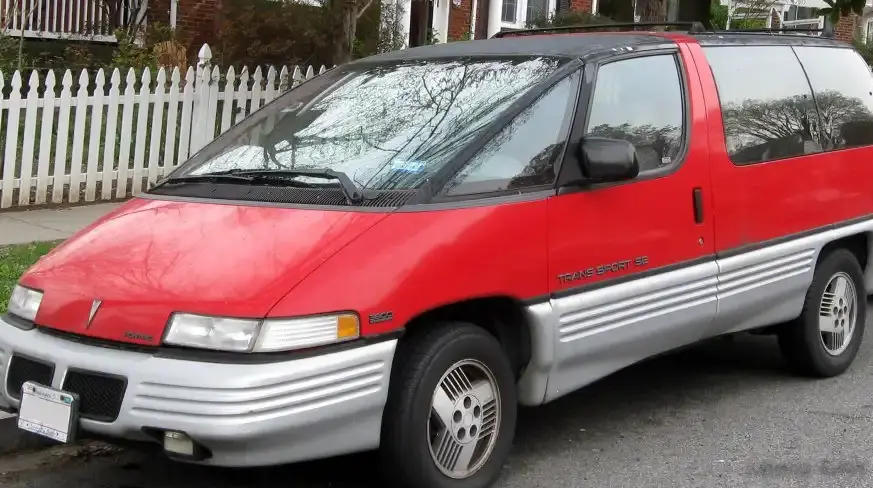
The Pontiac Trans Sport 2.3i 16V, produced between 1993 and 1996, represented a significant entry in the American minivan market. Part of the first generation of the Trans Sport (introduced in 1990), this variant offered a balance between affordability and acceptable performance for families. It was positioned as a mid-range offering within the Trans Sport lineup, slotting below the more powerful 3.8L V6 models and above the base 2.2L four-cylinder versions. The Trans Sport, along with its Chevrolet Lumina APV and Oldsmobile Silhouette siblings, was a key player in GM’s attempt to compete with the dominant Chrysler minivans of the era, utilizing a unique unibody construction and front-wheel drive layout.
Technical Specifications
| Brand | Pontiac |
| Model | Trans Sport |
| Generation | Trans Sport (First Generation) |
| Type (Engine) | 2.3 i 16V (137 Hp) |
| Start of production | 1993 |
| End of production | 1996 |
| Powertrain Architecture | Internal Combustion Engine |
| Body type | Minivan |
| Seats | 5 |
| Doors | 4 |
| Fuel consumption (combined) | 10.6 l/100 km (22.2 US mpg / 26.6 UK mpg / 9.4 km/l) |
| Fuel Type | Petrol (Gasoline) |
| Acceleration 0 – 100 km/h | 12 sec |
| Acceleration 0 – 62 mph | 12 sec |
| Acceleration 0 – 60 mph | 11.4 sec |
| Maximum speed | 185 km/h (114.95 mph) |
| Weight-to-power ratio | 12.4 kg/Hp (80.8 Hp/tonne) |
| Weight-to-torque ratio | 9.1 kg/Nm (110.3 Nm/tonne) |
| Power | 137 Hp @ 5800 rpm |
| Power per litre | 60.6 Hp/l |
| Torque | 187 Nm @ 2800 rpm (137.92 lb.-ft. @ 2800 rpm) |
| Engine layout | Front, Transverse |
| Engine Model/Code | LD2 |
| Engine displacement | 2260 cm3 (137.91 cu. in.) |
| Number of cylinders | 4 |
| Engine configuration | Inline |
| Cylinder Bore | 92 mm (3.62 in.) |
| Piston Stroke | 85 mm (3.35 in.) |
| Compression ratio | 9.5:1 |
| Number of valves per cylinder | 4 |
| Fuel injection system | Multi-port manifold injection |
| Engine aspiration | Naturally aspirated |
| Valvetrain | DOHC |
| Engine oil capacity | 4.3 l (4.54 US qt | 3.78 UK qt) |
| Kerb Weight | 1695 kg (3736.84 lbs.) |
| Max. weight | 2325 kg (5125.75 lbs.) |
| Max load | 630 kg (1388.91 lbs.) |
| Trunk (boot) space – minimum | 521 l (18.4 cu. ft.) |
| Trunk (boot) space – maximum | 3187 l (112.55 cu. ft.) |
| Fuel tank capacity | 76 l (20.08 US gal | 16.72 UK gal) |
| Length | 4946 mm (194.72 in.) |
| Width | 1886 mm (74.25 in.) |
| Height | 1670 mm (65.75 in.) |
| Wheelbase | 2788 mm (109.76 in.) |
| Front track | 1503 mm (59.17 in.) |
| Rear track | 1559 mm (61.38 in.) |
| Drivetrain Architecture | Front Wheel Drive |
| Number of gears | 5 |
| Gearbox type | Manual Transmission |
| Front suspension | Wishbone |
| Rear suspension | Coil spring |
| Front brakes | Ventilated discs |
| Rear brakes | Drum |
| Assisting systems | ABS (Anti-lock braking system) |
| Steering type | Steering rack and pinion |
| Power steering | Hydraulic |
| Tires size | 205/65 R15 H |
Powertrain & Engine Architecture
The 2.3i 16V engine, designated LD2 by GM, was a four-cylinder, inline engine featuring a double overhead camshaft (DOHC) valvetrain and multi-port fuel injection. This configuration allowed for improved breathing and more efficient combustion compared to older pushrod designs. The 16 valves (four per cylinder) further enhanced the engine’s volumetric efficiency. The engine’s 9.5:1 compression ratio was a compromise between performance and the fuel quality available in the US market. The five-speed manual transmission was a common offering, providing drivers with more control over the engine’s powerband. While an automatic transmission was also available, it often resulted in a noticeable decrease in performance and fuel economy.
Driving Characteristics
The 137 horsepower and 187 lb-ft of torque offered by the 2.3L engine provided adequate, but not exhilarating, performance for the Trans Sport. Acceleration to 60 mph took around 11.4 seconds, making it competitive with other minivans of the time, but noticeably slower than the V6-powered versions. The five-speed manual transmission allowed drivers to keep the engine in its optimal power range, improving responsiveness. However, the automatic transmission, while offering convenience, significantly dulled acceleration. The front-wheel drive configuration provided predictable handling, but lacked the all-weather capability of all-wheel drive systems found in some competitors. The gear ratios in the manual transmission were fairly well-spaced, allowing for comfortable highway cruising and reasonable acceleration in city traffic.
Equipment & Trim Levels
The 2.3i 16V Trans Sport typically came standard with features like air conditioning, power windows and locks, and an AM/FM stereo. Higher trim levels offered options such as upgraded upholstery, a sunroof, and a more sophisticated sound system. Interior materials were generally durable and practical, reflecting the minivan’s family-oriented purpose. The dashboard layout was functional, though somewhat dated even for the early 1990s. Optional extras included alloy wheels, cruise control, and rear air conditioning.
Chassis & Braking
The Trans Sport utilized a unibody construction, which contributed to its relatively lightweight design. The front suspension featured independent wishbones, while the rear suspension employed a coil spring setup. This configuration provided a reasonably comfortable ride, though it wasn’t particularly sporty. The braking system consisted of ventilated discs at the front and drum brakes at the rear. Anti-lock brakes (ABS) were available as an option, enhancing safety. The relatively modest weight of the 2.3L-equipped Trans Sport meant that the braking system was generally adequate for everyday driving.
Market Reception & Comparison
Critics generally viewed the 2.3i 16V Trans Sport as a competent, if unremarkable, minivan. It offered a good value for families seeking a spacious and practical vehicle. However, it was often overshadowed by the more powerful V6 models and the established reputation of the Chrysler minivans. Fuel economy was a strong point, averaging around 22 mpg in combined driving. Reliability was generally acceptable, though some owners reported issues with the automatic transmission. Compared to the 3.8L V6 Trans Sport, the 2.3L offered significantly less power but better fuel economy and a lower purchase price. The 2.2L base engine was even more affordable but lacked the refinement and performance of the 2.3L.
Legacy
The Pontiac Trans Sport 2.3i 16V, while not a standout performer, remains a relatively affordable and practical option in the used car market. The LD2 engine is generally considered reliable, though regular maintenance is crucial. Parts availability is decent, as the engine was used in a variety of GM vehicles. The 2.3L engine, while not known for its longevity like some of Toyota’s offerings, can provide years of service with proper care. Today, these minivans are often sought after by collectors of 1990s vehicles and those looking for a nostalgic reminder of a bygone era of automotive design.