
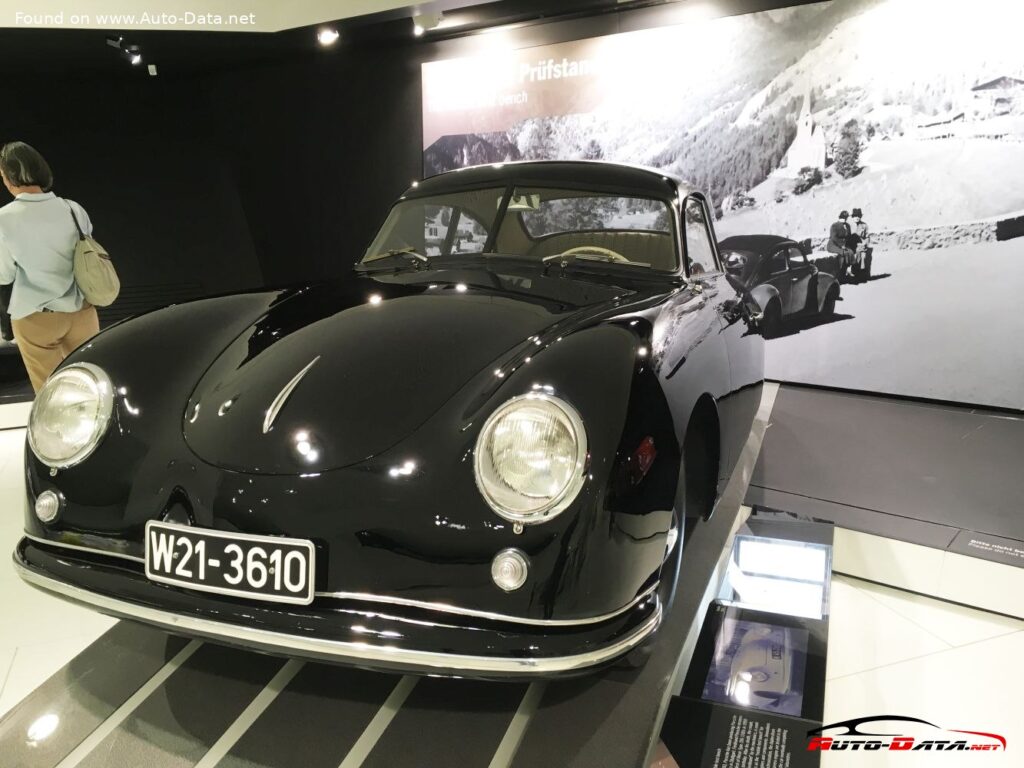
The Porsche 356 Coupe 1300 (44 Hp) stands as a monumental landmark in automotive history, unequivocally defining the genesis of Porsche as an independent and globally recognized sports car manufacturer. Produced between 1950 and 1955, this specific iteration of the first-generation 356 series was the embodiment of Ferdinand “Ferry” Porsche’s vision: a compact, lightweight, and supremely agile sports car. Born from the austere post-World War II environment, the initial models were meticulously hand-built in Gmünd, Austria, before production transitioned to its spiritual home in Zuffenhausen, Stuttgart, Germany. The 356 was more than just a car; it was the crucible where the foundational principles of Porsche engineering – efficiency, performance through lightweight design, and a distinctive rear-engine layout – were forged, setting the stage for an unparalleled legacy in the automotive world. Positioned as a two-seat sports coupe, the 356 Coupe 1300 (44 Hp) appealed to a nascent market of enthusiasts seeking a pure, engaging driving experience, characterized by its modest yet effective power and an instantly recognizable, aerodynamically sculpted silhouette.
Powertrain and Dynamic Prowess of the Porsche 356 Coupe 1300 (44 Hp)
Central to the driving character of the 1950-1955 Porsche 356 Coupe 1300 (44 Hp) was its innovative powertrain: a rear-mounted, longitudinally positioned, air-cooled boxer engine. This horizontally opposed four-cylinder unit, displacing 1286 cubic centimeters (approximately 1.3 liters or 78.48 cubic inches), was a direct descendant of the robust Volkswagen Beetle engine, though significantly refined and enhanced by Porsche engineers for higher performance. Delivering a respectable 44 horsepower at 4000 revolutions per minute, this engine provided a power-per-liter output of 34.2 Hp/l. The air-cooled design was a pragmatic choice for the era, offering simplicity, reliability, and reduced weight compared to water-cooled systems, a philosophy that would define Porsche for decades. Engine internal specifications included a cylinder bore of 3.15 inches (80 mm) and a piston stroke of 2.52 inches (64 mm), yielding a compression ratio of 6.5:1. Fuel was supplied via a carburetor, a standard and reliable system of the time, feeding two valves per cylinder actuated by an Overhead Valve (OHV) valvetrain. The engine required 3.7 US quarts (3.5 liters) of oil, reflecting its compact and efficient design.
While 44 horsepower might seem conservative by contemporary standards, it was the exceptional power-to-weight ratio that truly defined the 356’s dynamic capabilities. With a remarkably low curb weight of just 1686.54 pounds (765 kg), the car achieved a weight-to-power ratio of 17.4 kg/Hp (or 57.5 Hp per tonne). This lightweight construction, combined with the eager boxer engine, allowed the 356 Coupe 1300 (44 Hp) to reach a maximum speed of 85.13 mph (137 km/h), a commendable performance for a car of its class and era. Beyond outright speed, the 356 was celebrated for its agility and responsiveness. Fuel economy was also a noteworthy attribute, with a combined rating between 31.4 and 27.7 US miles per gallon (7.5-8.5 liters per 100 km), making it an economical choice for both spirited drives and daily use. Power was transferred to the rear wheels through a precise four-speed manual transmission, offering direct feedback and encouraging driver engagement – a hallmark of early Porsche vehicles. This rear-wheel-drive architecture, coupled with the rear-engine layout, provided a unique balance and traction characteristic that required skill but rewarded with immense satisfaction.
The driving dynamics were further enhanced by a well-engineered chassis and suspension system. Both the front and rear suspensions employed torsion bars, a sophisticated and space-efficient solution for the 1950s that delivered a compliant ride while maintaining excellent body control. Braking duties were handled by 280 mm drum brakes on all four wheels. While not offering the fade resistance of later disc systems, these drum brakes were perfectly adequate for the car’s weight and performance, requiring a driver attuned to their operation. Steering was facilitated by a worm-reduction unit, complemented by hydraulic power steering – a feature that was quite advanced for the period, significantly reducing steering effort and enhancing maneuverability, particularly at lower speeds or during parking. The overall effect was a highly communicative and enjoyable driving experience, where every input from the driver translated directly into the car’s behavior, reinforcing the 356’s reputation as a true driver’s machine.
Iconic Design and Enduring Appeal of the Porsche 356 Coupe
The aesthetic appeal of the
